Fontaines-sur-Saône – Panorama from the Old Bridge
Geographic description
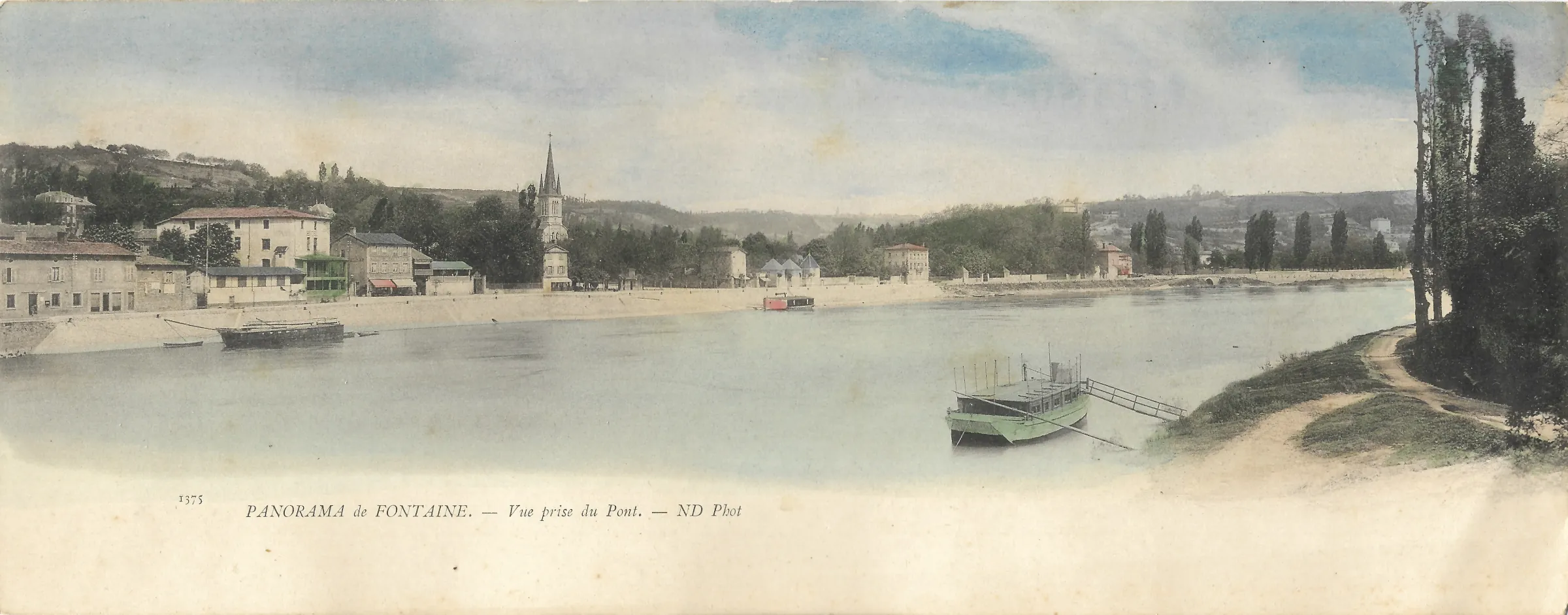
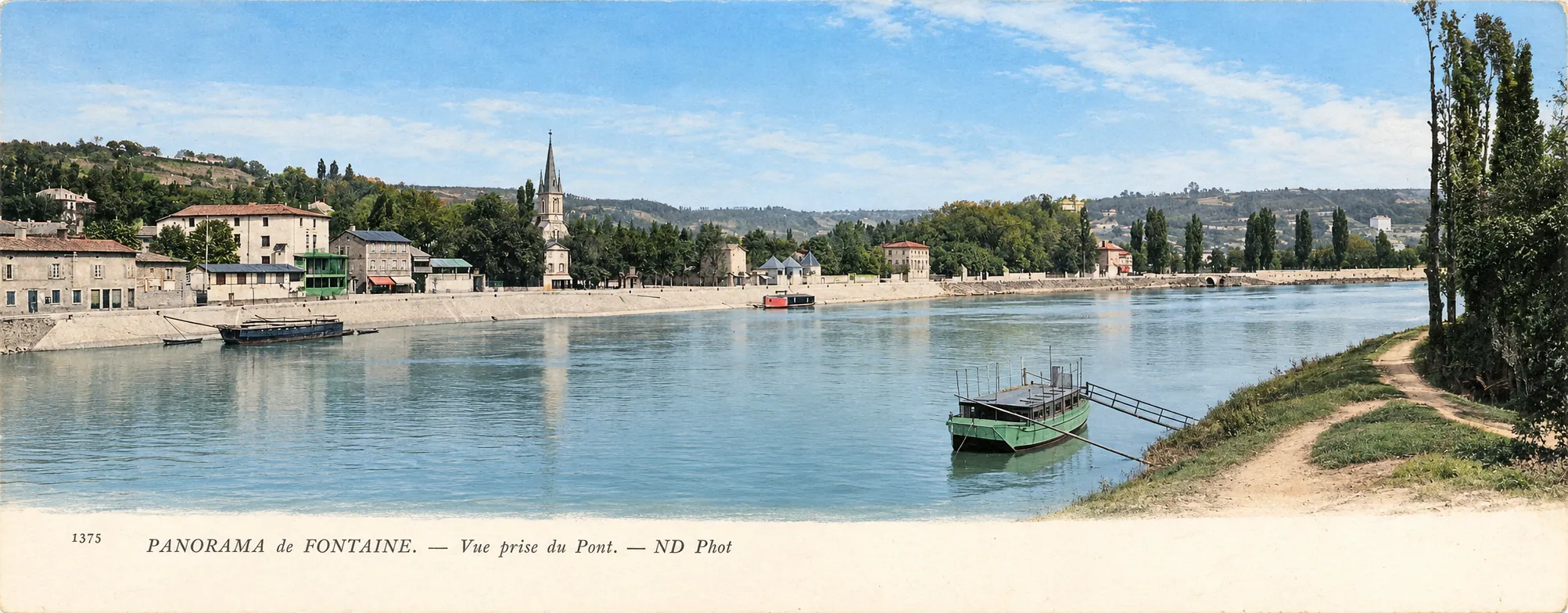
This Fontaines-sur-Saône panorama provides a sweeping view over the River Saône and the old riverside settlement, photographed from the bridge connecting Fontaines with Collonges-au-Mont-d’Or. Fontaines-sur-Saône is now a municipality within the Lyon Metropolis, about ten kilometres north of central Lyon in the Saône Valley. The printed caption reads: “PANORAMA de FONTAINE. — Vue prise du Pont. — ND Phot.” Although the postcard uses the singular form “Fontaine,” the setting can be identified with considerable confidence as present-day Fontaines-sur-Saône, particularly from the layout of the riverfront and the prominent spire of Saint-Louis Church.
The Saône dominates the composition. Its broad, calm surface occupies most of the image and gives the postcard an unusually spacious quality. Along the left side stands the old centre of Fontaines-sur-Saône. A long masonry embankment separates the river from a line of modest houses and other buildings. Development is still comparatively sparse, with trees and open ground remaining between several groups of structures.
The most distinctive landmark is the tall spire of Saint-Louis Church. The present church is a nineteenth-century Neo-Gothic building. It was inaugurated in 1869, while its spire was completed in 1891. The church therefore provides both a strong geographical clue and an important chronological marker for the photograph.
Several vessels can be seen on the river. A long, low craft lies close to the built-up bank, while another small boat appears farther out. In the foreground on the opposite side is a larger floating craft or pontoon connected to the shore by a narrow gangway. Its exact purpose cannot be established from the photograph alone. It may have been associated with local river traffic or riverside activities, but any more specific identification would remain speculative.
The foreground bank presents a striking contrast with the town. It is almost completely undeveloped, with a simple dirt track following the river beneath a line of tall poplar trees. Grass and low vegetation extend down towards the water. This juxtaposition between the settled Fontaines bank and the much more rural opposite shore is one of the most informative features of the postcard.
The bridge from which the photograph was taken was most probably the old Fontaines suspension bridge, opened in 1842. It linked the two sides of the Saône between Fontaines and Collonges. It should therefore not be confused with the present Général-Leclerc Bridge, which dates from the twentieth century.
The camera appears to be looking along the valley, probably downstream, although the precise orientation should remain cautious. The riverside buildings, church, tree-lined banks and wooded slopes beyond combine to preserve an excellent image of the Saône Valley before the much denser urban development of the twentieth century. The contrast with the present day is particularly striking: Fontaines-sur-Saône is now fully integrated into the Lyon urban area and the Lyon Metropolis, while retaining the identity of a small riverside town.
Historical description
The postcard can reasonably be dated to the early twentieth century, probably around 1900-1910, although no exact year can be established without a dated postmark or other information from the reverse.
The first chronological clue is Saint-Louis Church. The church was inaugurated in 1869, and the spire visible in the postcard was completed only in 1891. The original photograph must therefore have been taken after that date.
A second important clue is the publisher’s mark “ND Phot.” This was used by the Neurdein photographic and publishing house in Paris, one of the major producers of French photographic views and postcards around the turn of the twentieth century. Neurdein issued numerous postcard series under this mark during the early decades of the postcard’s golden age.
The unusually wide panoramic format and the delicate colourised appearance are also consistent with some of the more elaborate tourist postcards produced during the early twentieth century. The small number “1375” printed near the caption is most likely a publisher’s series or catalogue reference and should not be interpreted as a date.
The postcard also records Fontaines-sur-Saône at an important stage in its development. The locality became an independent municipality and adopted its present name during the nineteenth century. Roughly half a century later, the postcard shows a clearly established riverside community centred on its church, quay and bridge, yet still surrounded by extensive greenery.
The nineteenth-century suspension bridge was particularly important to this landscape. Opened in 1842, it linked the two banks of the Saône and connected Fontaines with Collonges-au-Mont-d’Or. It also provided the elevated viewpoint chosen by the photographer, allowing the river, town skyline and opposite bank to be brought together in a single panoramic composition.
The Saône was more than a scenic backdrop. The vessels visible on the water remind us that the river remained an active communications corridor and part of everyday local life. At the same time, the unpaved riverside track, open banks and extensive vegetation convey a landscape that had not yet been reshaped by modern roads and urban development.
At the time of the photograph, Fontaines-sur-Saône still had much of the appearance of a small Saône Valley town or village, clearly distinct from the dense urban fabric of Lyon. Today the situation is very different. Fontaines-sur-Saône forms part of the Lyon Metropolis and is fully integrated into the wider Lyon urban area. This transformation gives the postcard additional historical value, showing what a community on the outskirts of Lyon looked like before the metropolitan expansion of the twentieth century.
The postcard therefore preserves a particularly evocative image of Belle Époque Fontaines-sur-Saône: a riverside settlement already connected with neighbouring communities and located only a short distance from Lyon, yet still retaining the quiet, semi-rural character of the traditional Saône Valley.