Tacoma – State Armory and the Old Pierce County Courthouse
Geographic description
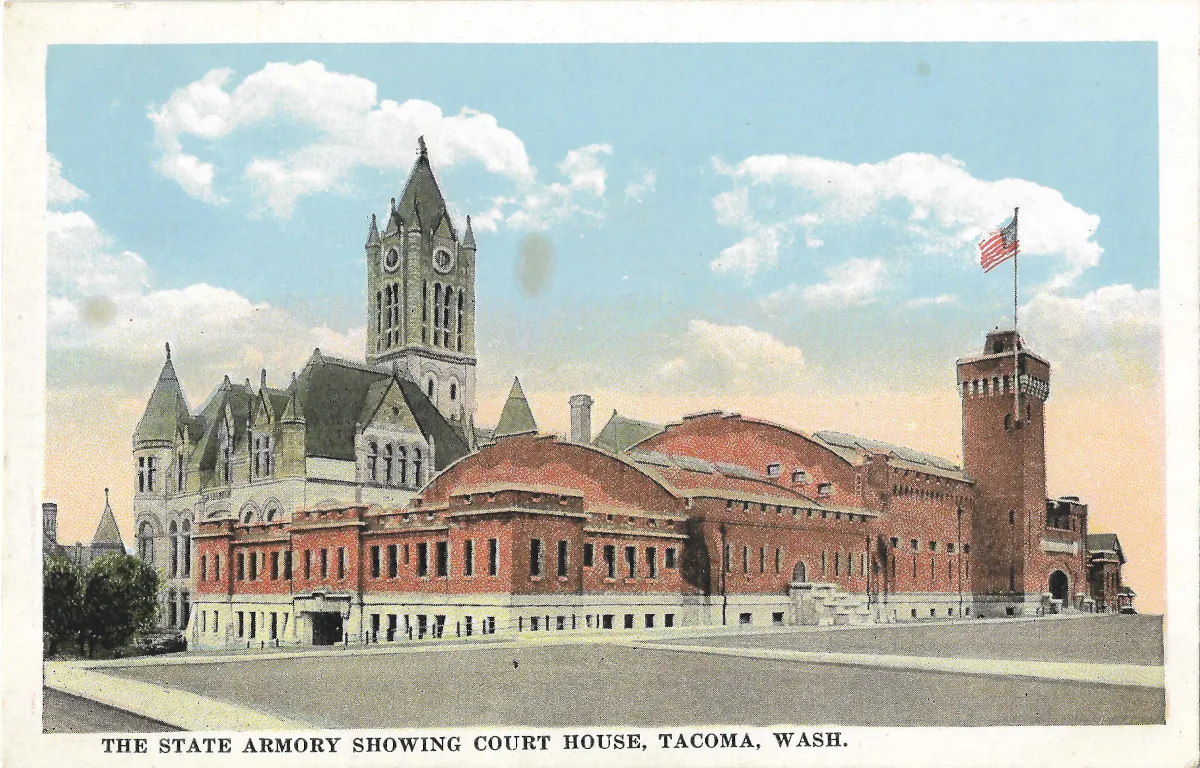
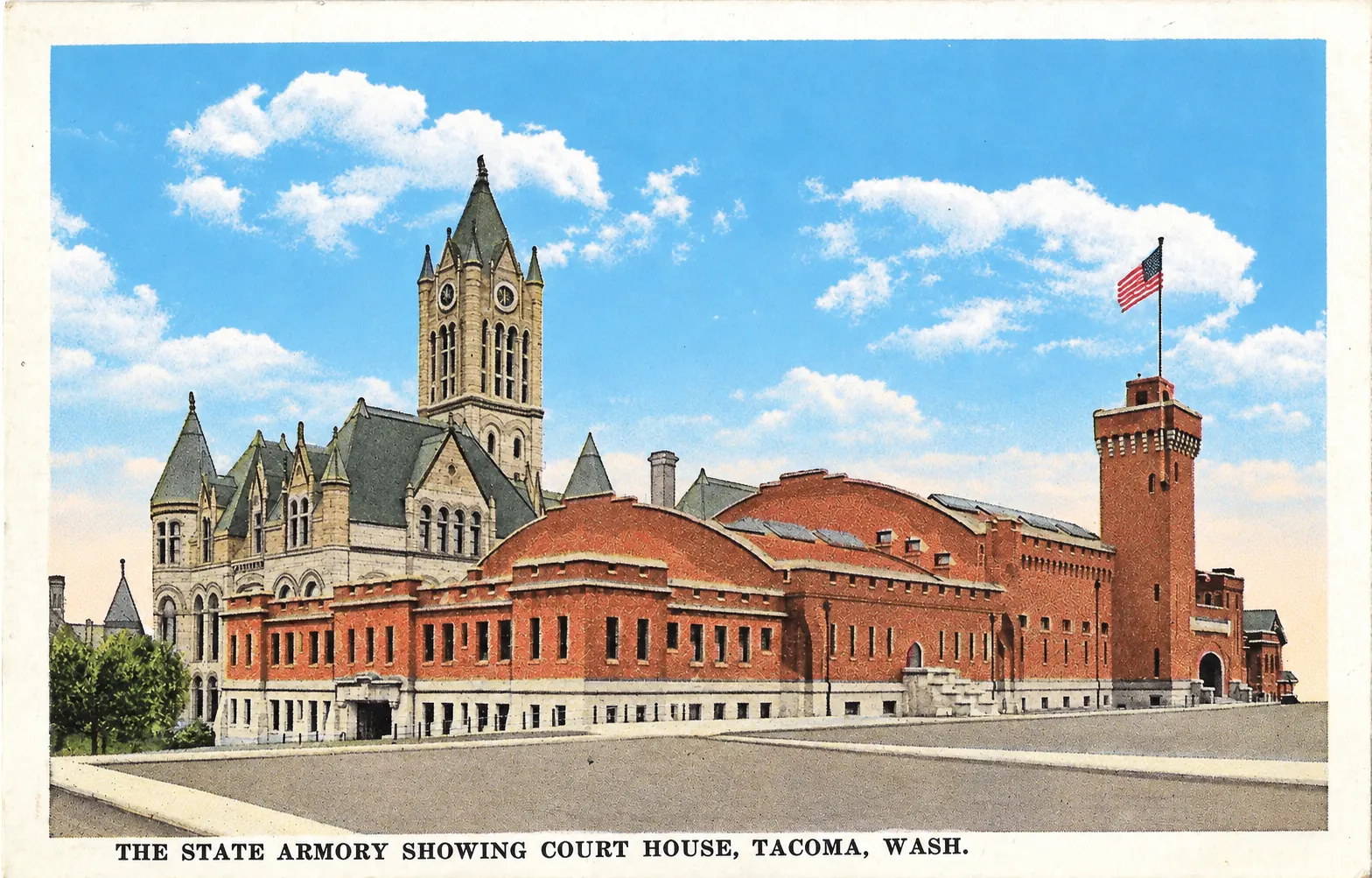
The Tacoma State Armory dominates the foreground of this vintage postcard, while the monumental Pierce County Courthouse rises immediately behind it. The printed caption, “The State Armory Showing Court House, Tacoma, Wash.,” provides a direct identification of the scene. The Tacoma Public Library’s postcard collection contains a matching view under reference STENGER-0512 with exactly the same caption.
The Armory stood at 715 South 11th Street, near Yakima Avenue in central Tacoma, Washington. Constructed in 1908 and dedicated on January 1, 1909, it was designed by the architectural firm Russell & Babcock as a headquarters and training facility for the Washington National Guard. Local building records identify Joseph Wells as the contractor.
In the postcard, the Armory is characterized by its long red-brick elevations and the broad curved roof enclosing the main drill hall. At the right stands a substantial square brick tower. Its crenellated upper section gives the building a distinctly military appearance, reinforced by the large American flag flying above it. Rows of narrow windows emphasize the length and mass of the structure.
Behind the Armory rises a building of a completely different architectural character. This is the former Pierce County Courthouse, located at 1012 South G Street, just northeast of the Armory. Built in the early 1890s, it was faced with gray Wilkeson stone and contrasting Tenino stone. Architects Proctor & Dennis based their design on the Richardsonian Romanesque tradition associated with Henry Hobson Richardson and, more specifically, on his celebrated Allegheny County Courthouse in Pittsburgh.
Its tall central tower forms the principal landmark in the image. Conical roofs crown the smaller turrets, while round arches, heavy masonry and steep rooflines give the courthouse a much more picturesque silhouette than the comparatively functional Armory in front of it. The postcard therefore records two successive generations of civic architecture: the elaborate stone public building of the late nineteenth century and the large brick military complex of the early twentieth century.
The streets and sidewalks across the foreground are unusually quiet, with no obvious automobiles and virtually no pedestrian activity. This should not necessarily be interpreted as evidence that the area was normally empty. Architectural postcards were frequently photographed or retouched in ways that emphasized buildings rather than everyday traffic.
The colors are likewise largely the product of postcard printing rather than natural color photography. The pale blue sky, white clouds, red brickwork and warm tones near the horizon create an idealized appearance. Nevertheless, the underlying photographic detail is sufficiently clear to preserve the architecture of both buildings.
The two structures ultimately had very different fates. The courthouse disappeared during the twentieth century, whereas the Armory survived. The latter was designated a Tacoma historic landmark in 1976 and remains listed on the city’s Register of Historic Places.
Historical description
The relationship between the two buildings explains why they appeared together so frequently in early Tacoma postcards. The Pierce County Courthouse was the older landmark. Construction took place during the early 1890s and county offices began occupying the building in 1893. Its monumental tower, more than 200 feet high, quickly became one of Tacoma’s most recognizable civic landmarks.
The State Armory arrived almost two decades later. Tacoma Public Library records show construction beginning during 1908, with hundreds of thousands of bricks required for the project. The building was formally dedicated on January 1, 1909. Although primarily intended for the Washington National Guard, the large interior space soon served a much broader civic role, hosting public gatherings, exhibitions, sporting events and other large-scale activities.
Dating the original photograph is more difficult than identifying the buildings. Circular clock faces are visible high on the courthouse tower. Historical research indicates that the courthouse’s large clock was purchased in 1910 and completed in January 1911. This makes a photographic date after that installation plausible, although the possibility of retouching on a hand-colored postcard prevents the clock alone from providing an absolute date.
A surviving cataloged example of the same postcard design provides another useful clue. That example is attributed to Tacoma publisher Leland Lund and carries correspondence dated August 31, 1925. It therefore demonstrates that this particular design was in circulation by the mid-1920s. It does not prove that the underlying photograph was taken in 1925, since postcard publishers often continued to reproduce older negatives or views.
A cautious dating would therefore place the original view somewhere in the 1910s or early 1920s, with the postcard design itself demonstrably circulating by 1925. This distinction between the photographic image and the publication or mailing date is important when interpreting early postcards.
The Pierce County Courthouse later suffered serious structural problems. The major Puget Sound earthquake of April 13, 1949, caused additional damage, particularly to the tower. The upper portion was subsequently dismantled for safety reasons. After the construction of a replacement County-City Building, the old courthouse was finally demolished in 1959, removing one of the most distinctive landmarks visible in this postcard.
The Tacoma Armory followed a different path. Records document remodeling campaigns around 1917 and 1938, followed by substantial rehabilitation work in the early 1980s. Its designation on the Tacoma Register of Historic Places in 1976 helped preserve the building as an important survivor of the city’s early twentieth-century civic architecture.
The postcard therefore offers more than a view of two impressive buildings. It captures a section of Tacoma’s former civic landscape in which a vanished nineteenth-century courthouse and a surviving twentieth-century armory stood side by side, making the image a particularly useful record of the city’s architectural transformation.