Promenade des Anglais and the Jetée-Promenade
Geographic description
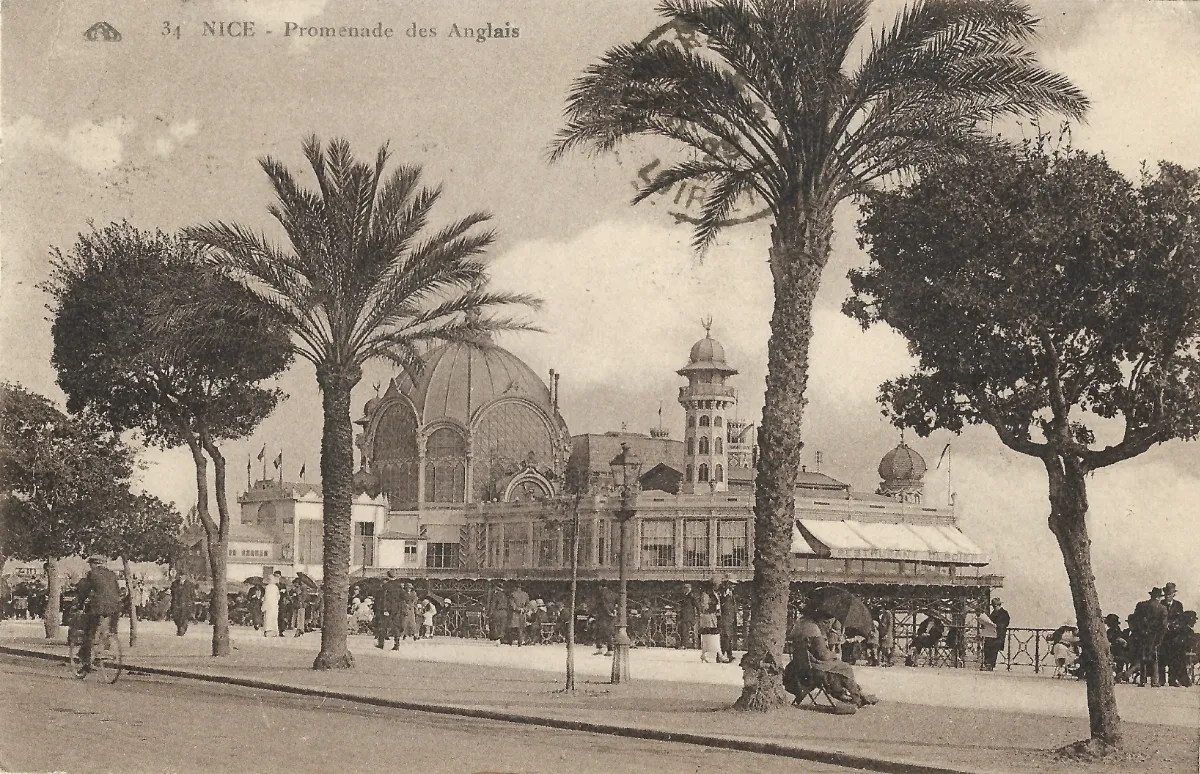
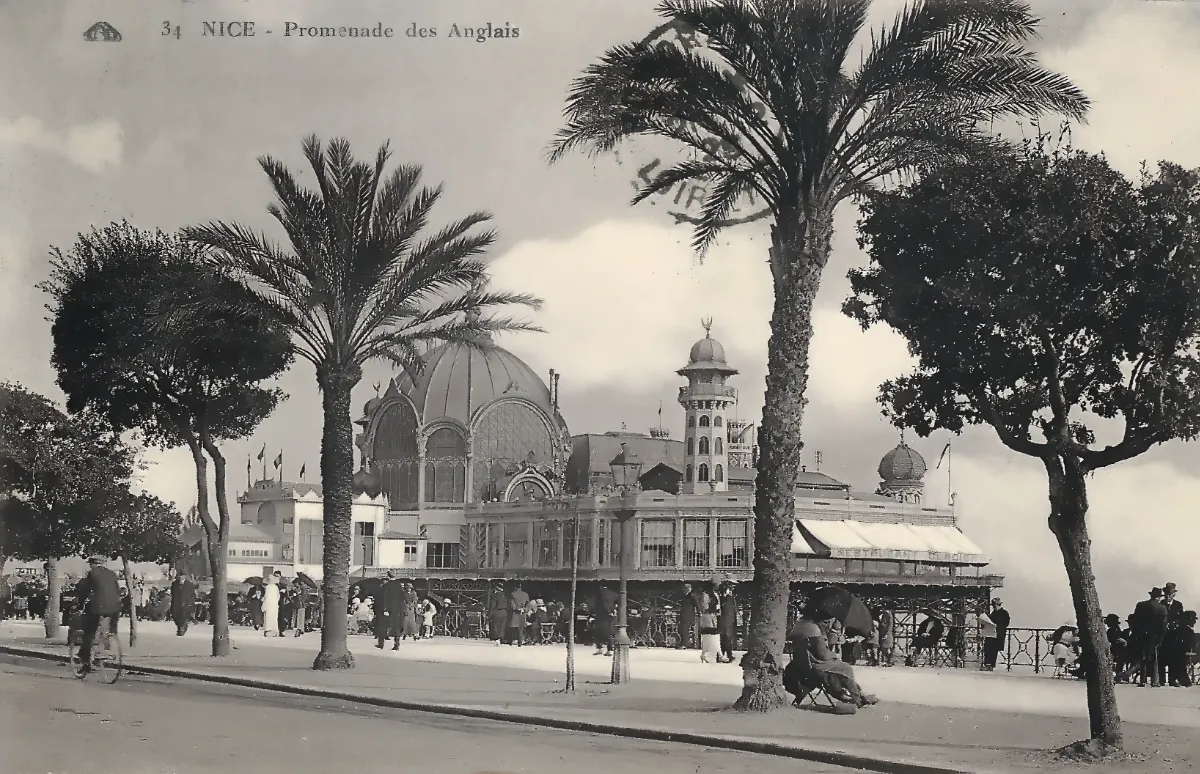
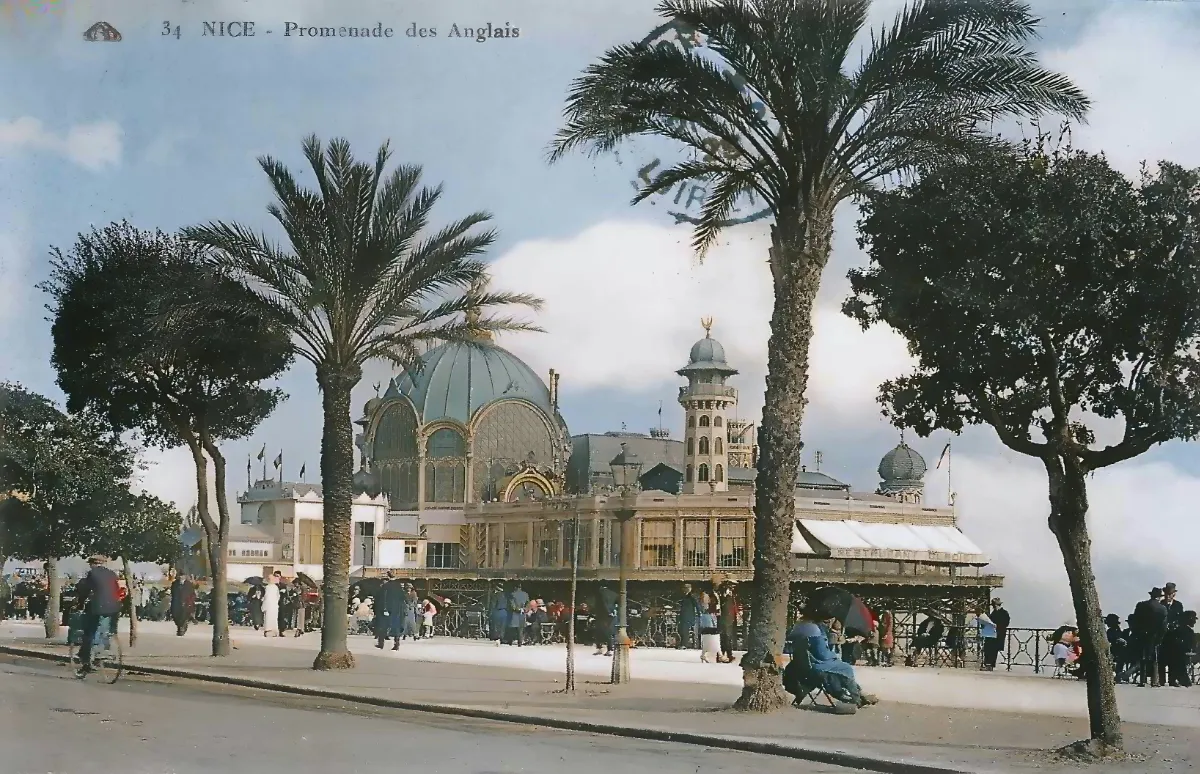
The Promenade des Anglais in Nice is shown here in one of its most characteristic Belle Époque settings, lined with tall palm trees and crowded with visitors, while the extraordinary Jetée-Promenade casino dominates the background. The printed caption merely reads “34 NICE – Promenade des Anglais,” yet the distinctive architecture makes the identification of the building highly reliable.
The photographer was standing on the seafront promenade, close to the Mediterranean. A roadway occupies the foreground, with a cyclist visible on the left, while numerous pedestrians gather along the broad pavement in front of the casino. Mature palms divide the scene into vertical sections and provide the exotic appearance that became closely associated with Nice. The city’s World Heritage documentation identifies palms and other introduced vegetation as fundamental features in the historic landscape of the Promenade.
On the right, the promenade opens directly onto the sea behind a light metal railing. The casino projects outward over the water, and part of the open structure beneath its seaward terraces can be distinguished. This was one of its defining characteristics. The Jetée-Promenade was built on piles at the end of a short pier, taking inspiration from British pleasure piers such as those found at seaside resorts in England. Nice’s UNESCO nomination documentation specifically describes it as a casino standing on piles above the sea.
Its architecture is the visual centrepiece of the postcard. A huge glazed, vaulted pavilion with tall arched windows dominates the left portion of the complex. Beside it rises a slender multi-storey tower capped by a small dome, while another rounded cupola can be seen further to the right. Flagpoles rise above the roofline. The resulting silhouette combines iron-and-glass construction with deliberately exotic forms. Official material published by the City of Nice describes the Jetée-Promenade as a metal structure on a pontoon distinguished by its Orientalist architecture and decoration.
The postcard also captures the social function of the Promenade. Groups of men wearing dark suits and hats mingle with women in long dresses. Some appear to be strolling along the seafront, while others gather beneath or around the casino terraces. Rather than being simply a road beside the beach, the Promenade des Anglais was already an important stage for public life: a place where winter visitors walked, socialised and displayed the fashions and habits associated with an international seaside resort.
Today the same section of the Nice waterfront looks markedly different. The Jetée-Promenade has completely vanished, and the roadway was extensively widened and reorganised during the twentieth century. The palms and the uninterrupted relationship between the promenade and the Bay of Angels, however, remain recognisable features of the cityscape.
Historical description
The photograph can reasonably be dated to the early twentieth century, most probably around 1900–1914, although the front of the postcard alone does not provide enough evidence for a precise year. The style of clothing, long dresses, hats, the prominent bicycle and the fully reconstructed Jetée-Promenade all support a pre-First World War date. The fact that no motor cars are visible is interesting but cannot by itself be used as firm dating evidence.
The Promenade des Anglais had already undergone almost a century of development by the time this photograph was taken. In 1822, Reverend Lewis Way raised funds among Nice’s British winter residents to create a narrow path along the shoreline. Known locally as the “Camin dei Inglès,” the path was subsequently taken over, enlarged and developed by the municipality, eventually becoming the Promenade des Anglais. During the nineteenth century it gradually replaced older parts of the city as Nice’s principal fashionable promenade.
The Jetée-Promenade was a product of the same transformation of Nice into an international winter resort. An earlier structure constructed in the early 1880s was destroyed by fire in 1883. The rebuilt casino was formally inaugurated in 1891. Nice’s heritage documentation describes it as one of the most striking buildings of the period, combining a metal pier structure with elaborate Orientalist architecture.
Its purpose extended well beyond gambling. Research presented by Université Côte d’Azur describes the palace as a major entertainment venue where visitors could enjoy games, performances and fashionable social life while literally standing above the Mediterranean. Its remarkable setting and architecture rapidly made it one of the visual symbols of Nice and an extremely popular subject for early photographs and postcards.
The postcard therefore belongs to an important phase in the creation of the international image of the French Riviera. During the late nineteenth and early twentieth centuries, wealthy visitors from Britain, Russia and many other European countries spent the winter season in Nice. Hotels, villas, gardens, casinos and theatres transformed the seafront. The Musée Masséna notes the particularly rapid urban and social development between the arrival of the railway in 1864 and the eve of the First World War, when Nice established itself as a cosmopolitan winter resort.
The Jetée-Promenade survived the First World War and continued operating during the interwar period, but tastes in seaside leisure gradually changed and the ageing complex lost some of its former importance. Its story ended during the Second World War, when it was demolished in 1944 under the German occupation. Both the City of Nice and Université Côte d’Azur document its wartime destruction.
This makes the postcard particularly valuable as a historical record. It preserves a close view of a vanished landmark whose glass pavilion, domes and tower once formed one of the most recognisable silhouettes on the Bay of Angels. Together with the palms, bicycles and elegantly dressed pedestrians, the casino provides an exceptionally evocative image of Belle Époque Nice.
A small publisher’s monogram can be seen in the upper-left corner beside the number 34, but it is not sufficiently clear to identify the publisher with confidence. An attribution would therefore remain speculative.