The Equitable Building in New York around 1915
Geographic description
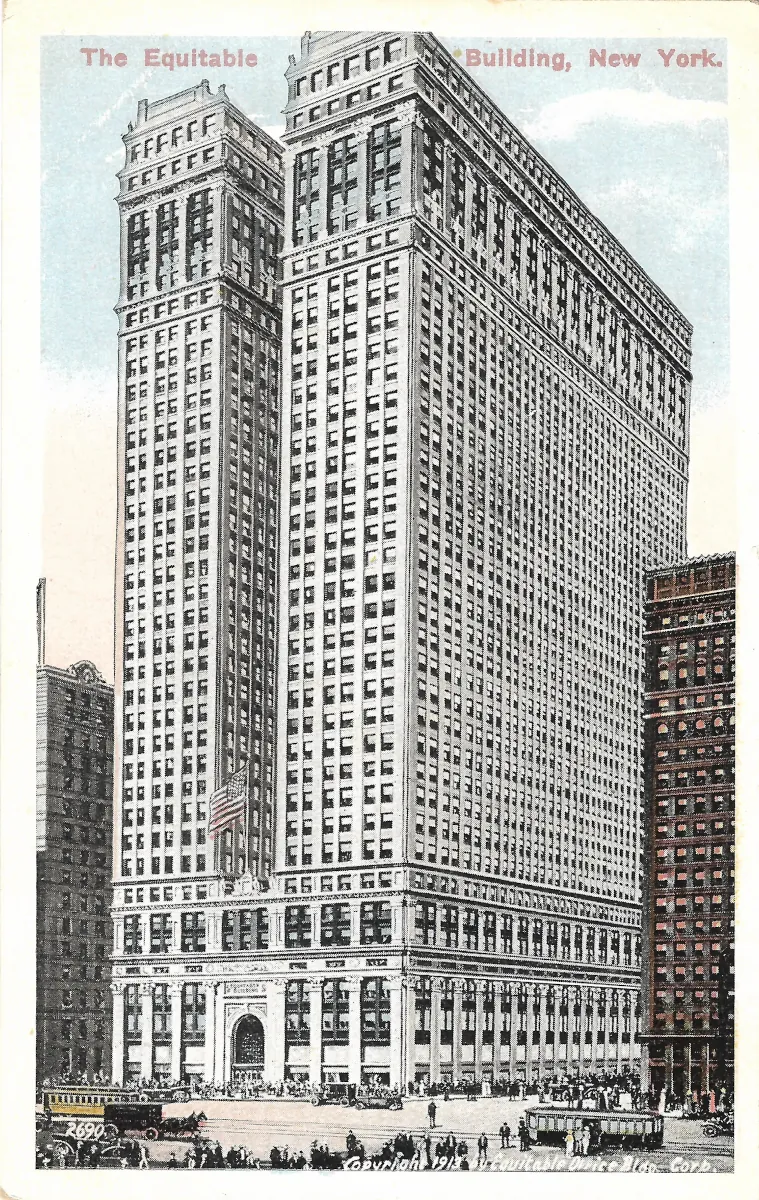
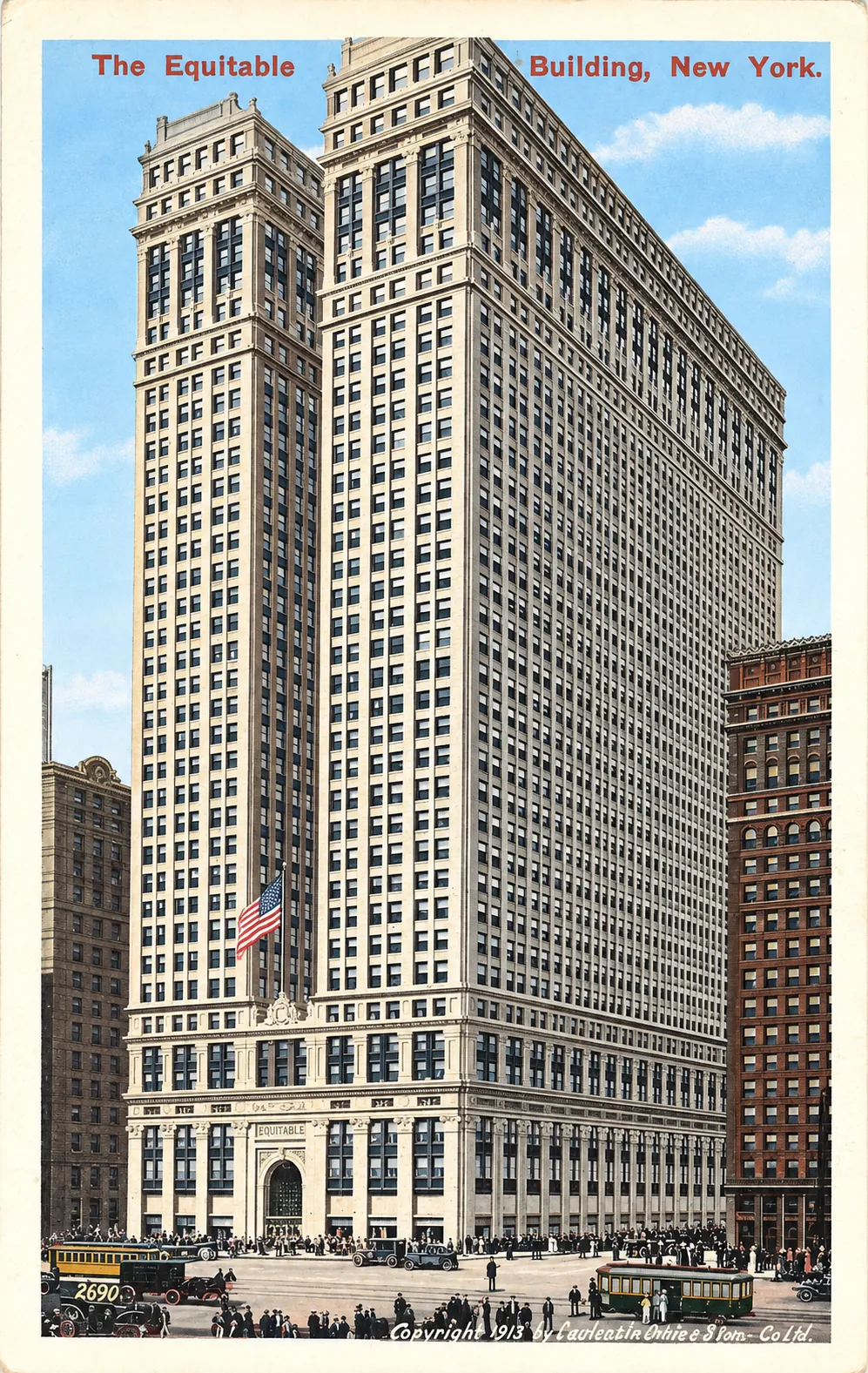
The Equitable Building in New York dominates this vintage postcard showing one of the most imposing early skyscrapers in Manhattan’s financial district. The building stands at 120 Broadway in Lower Manhattan, in today’s Financial District. It occupies an entire city block bounded by Broadway on the west, Nassau Street on the east, Cedar Street on the north, and Pine Street on the south. According to the New York City Landmarks Preservation Commission, the building extends approximately 168 feet along Broadway, 310 feet along Cedar Street, 152 feet along Nassau Street, and 305 feet along Pine Street.
The postcard composition deliberately emphasizes the extraordinary scale of the structure. The viewpoint is placed close to street level, allowing the façades to rise almost vertically through the image. Two prominent upper wings appear to form separate towers, divided by a deep central opening. This distinctive appearance results from the building’s H-shaped plan. Above a six-story base, the upper structure is arranged in projecting wings that can create the visual impression of several towers when viewed from street level. The building rises approximately 38 stories without the stepped setbacks that would become so characteristic of New York skyscrapers after 1916.
Architecturally, the Equitable Building is a major example of Beaux-Arts commercial architecture. Its elevations follow the traditional tripartite arrangement often applied to early skyscrapers: a richly treated base, an immense vertical shaft, and a more ornamental upper section or capital. The lower floors visible in the postcard have a particularly monumental character. Large classical pilasters and an imposing arched entrance give the base the appearance of a Renaissance-inspired commercial palace rather than a purely utilitarian office block.
The Landmarks Preservation Commission records that the six-story base was faced in granite and terra cotta, while the upper floors used buff-colored brick accented with terra-cotta details. Classical Roman ornament was concentrated around the base and upper levels. This helps explain the visual contrast on the postcard between the heavily articulated lower stories and the vast regular grid of windows above.
Those windows are one of the most striking features of the image. Thousands of regularly spaced openings cover the façades, visually expressing the building’s primary purpose as an enormous office complex. The landmark designation report records approximately 5,000 windows throughout the building.
At street level, New York appears busy and densely populated. Numerous pedestrians line the sidewalks, while several vehicles occupy the streets. Streetcars can be seen in the foreground, providing an important reminder of the surface public-transport network that served Lower Manhattan during the early twentieth century. The tiny scale of the people and vehicles beside the enormous building further increases the postcard’s sense of verticality and mass.
Printed across the top is the title “The Equitable Building, New York.”, while the number 2690 appears at the lower left. A postcard with this same title and number is held by the Amon Carter Museum of American Art, which dates it to approximately 1915 and identifies its medium as a halftone print. The museum lists the publisher as unknown.
Remarkably, the Equitable Building still stands at 120 Broadway today. It therefore offers an unusually direct link between the early skyscraper city portrayed on postcards such as this one and the modern streetscape of Lower Manhattan.
Historical description
The present Equitable Building was constructed between 1913 and 1915 and was designed by Ernest R. Graham with Peirce Anderson. Graham was closely associated with the architectural practice of Daniel Burnham, one of the most influential American architects of the period, while Anderson played an important role in shaping the building’s Beaux-Arts design and ornamentation.
It replaced an earlier headquarters of the Equitable Life Assurance Society that had occupied the same Broadway site since the nineteenth century. That earlier building, originally constructed in 1868–70 and later enlarged, was itself important in the development of the modern office building. It was destroyed by a major fire in January 1912, clearing the site for the skyscraper shown on this postcard.
When the new Equitable Building was completed in 1915, it was not New York’s tallest skyscraper. Its importance instead came from its extraordinary bulk and floor area. The New York City Landmarks Preservation Commission describes it as the world’s largest office building at the time of completion. Its immense H-shaped superstructure rose directly from the lot line, with no significant setbacks, and filled virtually an entire Lower Manhattan block.
The consequences of this massive form were controversial even before construction was finished. Owners of neighboring buildings feared the loss of sunlight and ventilation. The building’s enormous shadow became a powerful symbol of the problems created when tall commercial structures could rise without meaningful controls on height or bulk.
It is sometimes said that the Equitable Building directly caused New York’s 1916 Zoning Resolution, but the historical situation is more complex. Campaigns for regulating skyscraper height and mass had begun years earlier. Nevertheless, the Equitable became one of the most prominent examples cited during the debate and acted as a major catalyst for reform. The 1916 regulations linked permitted building height to street width and encouraged upper stories to step progressively away from the street, helping create the famous “wedding-cake” profile of many later Manhattan skyscrapers.
This historical context gives the postcard particular significance. It records one of the final monumental skyscrapers erected under New York’s largely unrestricted pre-1916 building environment. Its walls appear to rise almost uninterrupted from the pavement toward the sky, a form that would become far more difficult to reproduce under the new zoning rules.
The circa 1915 dating given by the Amon Carter Museum is therefore consistent with a postcard celebrating a strikingly new addition to New York’s skyline. The museum’s catalogued example carries the same number 2690 and the same printed title visible on this card.
Unlike many early Manhattan skyscrapers, the Equitable Building survived subsequent redevelopment. It was designated a National Historic Landmark in 1978 and became an official New York City Landmark on June 25, 1996. More than a century after this postcard was produced, the building at 120 Broadway remains a physical reminder of the moment when the enormous scale of New York’s first skyscrapers forced the city to reconsider how height, light, air and urban space should be regulated.