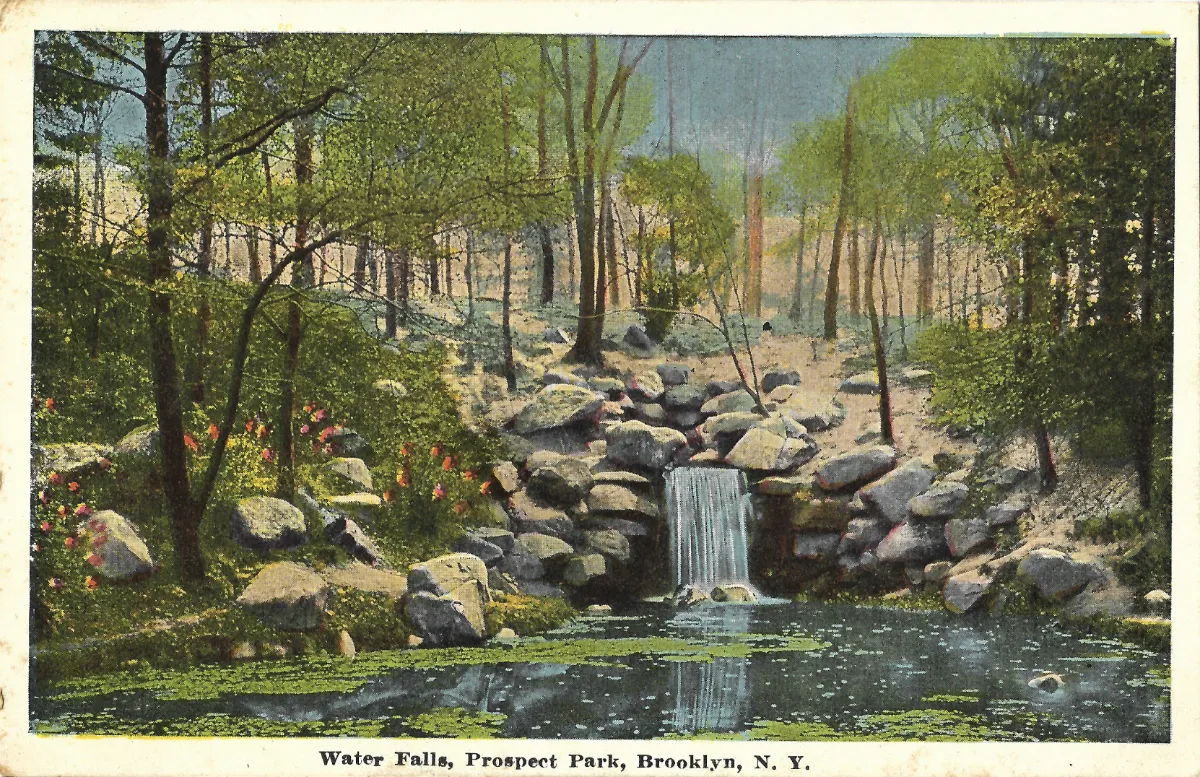
Antique postcard Prospect Park: the Waterfall, Brooklyn NY
Geographic description:
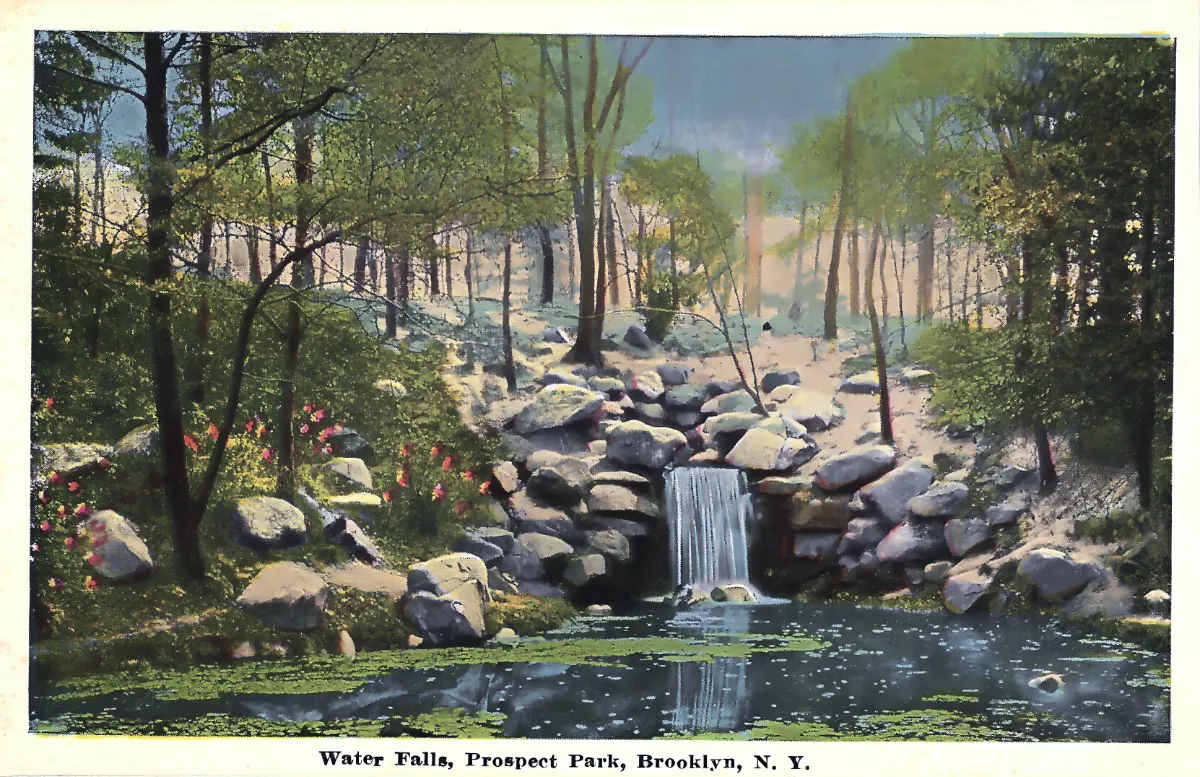
Antique postcard Prospect Park imagery like this one captures a man-made cascade tucked into a wooded hollow, most likely within the section of the park known as the Ravine, its wildest and most heavily forested area, designed to evoke a mountain landscape within the borough of Brooklyn. The printed caption at the bottom of the card, “Water Falls, Prospect Park, Brooklyn, N. Y.”, confirms the general location without specifying which particular cascade along the park’s watercourse is depicted: the stream running through the Ravine includes several successive falls, the best known of which is today called Fallkill Falls, though nothing in the image itself allows for certainty that this specific drop is the one shown rather than another point along the same waterway or a neighboring feature. The composition centers on a heap of natural fieldstone, arranged in tiers to channel the water and produce a drop of roughly a meter, spilling into a pool covered with duckweed and aquatic plants. This rockwork is not a natural formation: it reflects a deliberate landscaping choice, consistent with the picturesque style favored by the park’s original designers, who sought to artificially recreate the look of a mountain stream inside an urban park. Dense vegetation frames the water on both sides: tall, light-leaved trees occupy the background, while the foreground on the left bank shows clusters of pink and orange blossoms, likely rhododendrons or azaleas, planted along the footpath. This floral abundance, combined with the soft, fresh foliage of the trees, suggests the photograph was taken in spring or early summer. A pale, sandy path runs along the right bank, indicating that this spot was accessible to visitors and maintained as a scenic stopping point along a walking route through the park. No built architectural elements, such as a bridge, pavilion, or railing, appear in this portion of the image, keeping the composition focused entirely on the natural motif of the waterfall and its surrounding woodland. Aside from a very indistinct figure barely visible in the background, the scene contains no clearly identifiable people, reinforcing the impression of a secluded natural retreat, set apart from the bustle of Brooklyn even though the park itself sat at the heart of an already densely built borough by the time this card was printed.
Historical description:
No postmark or stamp is visible on the copy submitted here, since only the front of the card was provided; without the reverse side, it is not possible to date the mailing precisely from a postal cancellation, which is a methodological limitation worth noting upfront. The dating proposed below therefore rests solely on stylistic clues external to any postmark. The white border framing the image, paired with a plain, capitalized caption printed directly beneath the tinted photograph, matches an editorial format that was extremely common in American postcard publishing from the early-to-mid 1900s through roughly 1930; collectors commonly refer to this period as the “white border era.” The coloring itself, applied over a black-and-white photographic base through hand-tinting or an early chromolithographic process, was a standard technique of the period used to make park and landscape views more visually appealing for the tourist postcard market. No publisher’s name, series number, or printer’s mark is legible on the visible portion of the card, which rules out any firm identification of the publishing house; a check against specialized archives of Brooklyn postcard publishers could potentially match this image to a known printer. The Ravine, where this waterfall most plausibly sits, was laid out in the late 1860s and early 1870s by the landscape architects responsible for Prospect Park’s overall design, as part of a deliberate effort to recreate a rugged, mountain-like scene within a large urban park, at a time when this kind of picturesque landscaping was highly fashionable in major American cities. This particular water feature was a frequently photographed attraction on Brooklyn tourist postcards around the turn of the twentieth century, alongside other emblematic park views such as the lake or the Soldiers’ and Sailors’ Memorial Arch. This antique postcard Prospect Park view therefore belongs to a broad body of published imagery devoted to the park’s picturesque scenery, typically used for casual correspondence or as a travel souvenir, sent by residents or visitors to friends and family, a common practice before the widespread adoption of the telephone. On a social level, the popularity of this kind of landscaped green space reflects the broader urban planning trend, in major American cities of the period, of providing public access to constructed natural retreats considered beneficial to city dwellers’ health and well-being. Without a visible reverse side or any identifiable publisher’s mark, the dating range proposed here should be treated as a reasoned working hypothesis, to be refined if needed through consultation of Brooklyn municipal archives or a specialized antique postcard database.