New York – Bankers Trust and Equitable Buildings on Wall Street
Geographic description
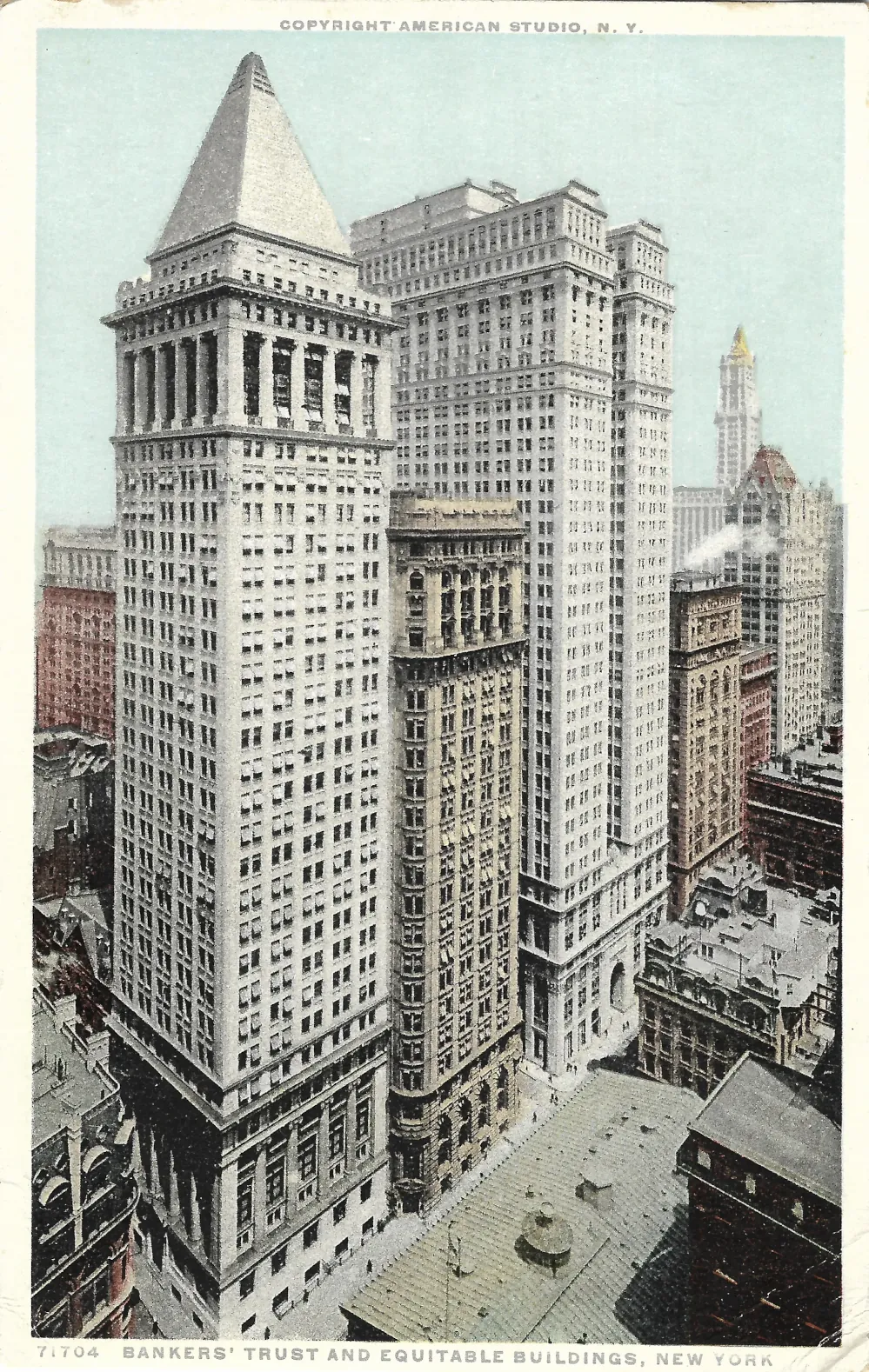
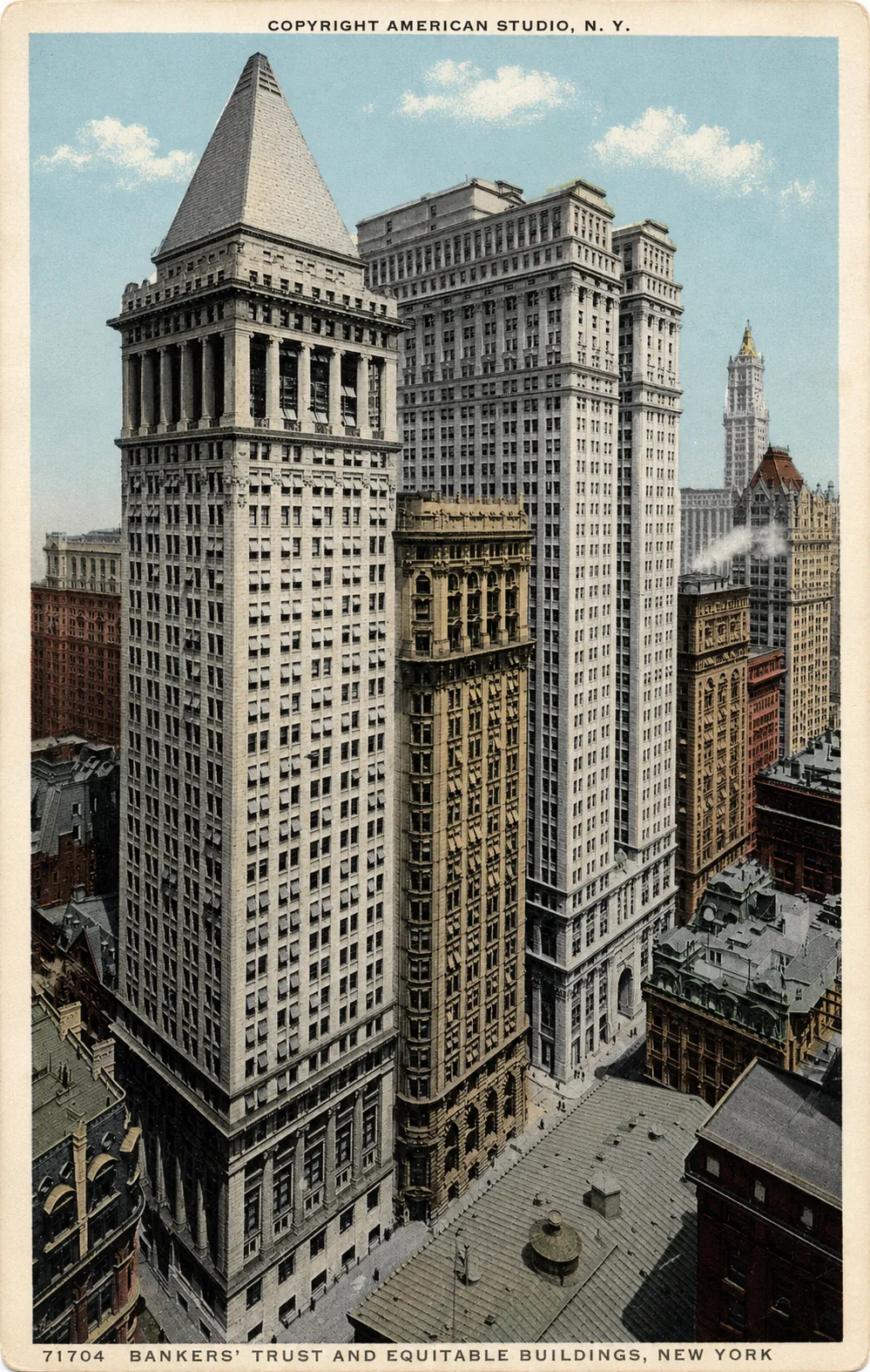
Bankers Trust and Equitable Buildings in New York dominate this dramatic elevated view of Lower Manhattan’s Financial District. The caption printed along the lower edge, “Bankers’ Trust and Equitable Buildings, New York,” identifies the two principal skyscrapers with certainty. The photograph was taken from a high vantage point, probably from another downtown office building, emphasizing the extraordinary concentration of tall structures that had already transformed this part of Manhattan during the early twentieth century.
The most distinctive building in the foreground is the Bankers Trust Building, now generally known by its address, 14 Wall Street. Standing near the intersection of Wall Street and Nassau Street, it is immediately recognizable from its enormous stepped pyramidal roof. The Library of Congress identifies the building as the work of Trowbridge & Livingston and records its completion in 1912.
Its architecture is characteristic of New York skyscraper design before the city’s 1916 zoning regulations changed the shape of tall buildings. Long, almost uninterrupted vertical façades rise from the narrow streets below, while closely spaced windows reinforce the impression of great height. Near the top, a monumental classical section provides a transition to the massive stepped pyramid.
That unusual crown was a deliberate architectural statement. Heritage documentation relates the composition of the tower to classical and Mediterranean architectural precedents, including the campanile of St Mark’s in Venice and ancient Greek forms. The pyramid became so closely associated with Bankers Trust that it was eventually adopted as a visual symbol of the company.
Behind the Bankers Trust tower stands the much broader Equitable Building at 120 Broadway. It occupies the entire block bounded by Broadway, Nassau, Pine and Cedar Streets. From this viewpoint it does not appear primarily as a slender tower but as an enormous wall of offices. Repetitive rows of windows cover its façades, emphasizing the extraordinary amount of usable floor space within the building.
The Equitable Building rises to approximately 545 feet, or about 166 metres. Its large H-shaped plan divided the upper floors into several wings while helping provide windows and light to the offices. Contemporary and preservation records describe it as one of the world’s largest office buildings by floor area when it opened.
One particularly valuable feature of this postcard is the contrast in scale. Around the bases of the two skyscrapers are numerous older commercial buildings that had been erected during previous stages of Lower Manhattan’s development. Although substantial buildings in their own right, they appear remarkably small beside the new towers. The image therefore records the rapid transition from the dense nineteenth-century city to the vertical metropolis that would become one of New York’s defining characteristics.
Several additional towers can be seen in the distance. Their forms contribute to the historic Lower Manhattan skyline, but the reproduction does not provide enough architectural detail to identify every background structure with sufficient certainty. They are therefore best treated as part of the wider urban setting rather than individually named.
The postcard appears to reproduce a color-tinted photograph. Pale blue has been applied to the sky, while restrained touches of color enliven several roofs and façades. At the top is the inscription “Copyright American Studio, N.Y.”, and the publisher’s or series number 71704 is printed near the lower caption.
Historical description
The two principal buildings provide useful evidence for dating this postcard. The Bankers Trust Building was completed in 1912, whereas the present Equitable Building was erected between 1913 and 1915. The photograph therefore cannot have been taken before 1915.
There is also a possible upper limit. In the postcard, the Bankers Trust tower appears essentially in its original form. A major twenty-five-story addition designed by Shreve, Lamb & Harmon was constructed around the original building between 1931 and 1933. Although the photograph alone does not permit an absolute conclusion, its architectural configuration strongly suggests a date before that enlargement. A circa 1915–1930 date is therefore a reasonable estimate rather than a precisely established year.
The Bankers Trust Building belonged to the first great generation of corporate skyscrapers in New York’s financial district. Rising to roughly 540 feet, it was an exceptionally prominent bank building when completed. Its restrained Classical Revival detailing was intended to communicate stability, dignity and financial strength, while its striking pyramid ensured that the headquarters could be recognized from a considerable distance.
The Equitable Building had a very different impact on the history of New York architecture. It replaced an earlier Equitable structure destroyed by fire in 1912 and was principally designed by Ernest R. Graham. Construction took place from 1913 to 1915. With vast office floors and space for thousands of workers, the completed building demonstrated how efficiently steel-frame construction and elevators could concentrate enormous amounts of commercial activity on a single Manhattan block.
Its enormous bulk was also controversial. Unlike the setback skyscrapers that would become familiar during the 1920s and 1930s, the Equitable Building rose almost vertically from the edges of its site. New York City’s Department of City Planning specifically identifies buildings such as 120 Broadway as major factors behind the 1916 Zoning Resolution. The new regulations sought to prevent streets from becoming permanently dark urban canyons by requiring tall buildings to step back according to street width and building height.
The postcard consequently captures an unusually important moment in the history of Manhattan. New engineering techniques, steel-frame construction, high-speed elevators and increasingly powerful financial corporations had made enormous skyscrapers economically possible, but comprehensive rules controlling their shape had only just begun to emerge.
Seen together, the two buildings illustrate contrasting approaches to the early skyscraper. Bankers Trust used a memorable tower and monumental pyramid to create a corporate landmark on the skyline. The Equitable Building maximized office capacity through its immense, almost block-like mass. Their juxtaposition in this postcard offers a vivid record of Wall Street during the period when New York was defining both the possibilities and the limits of vertical urban development.