New York – Times Square Building and the Times Tower, c. 1910
Geographic description
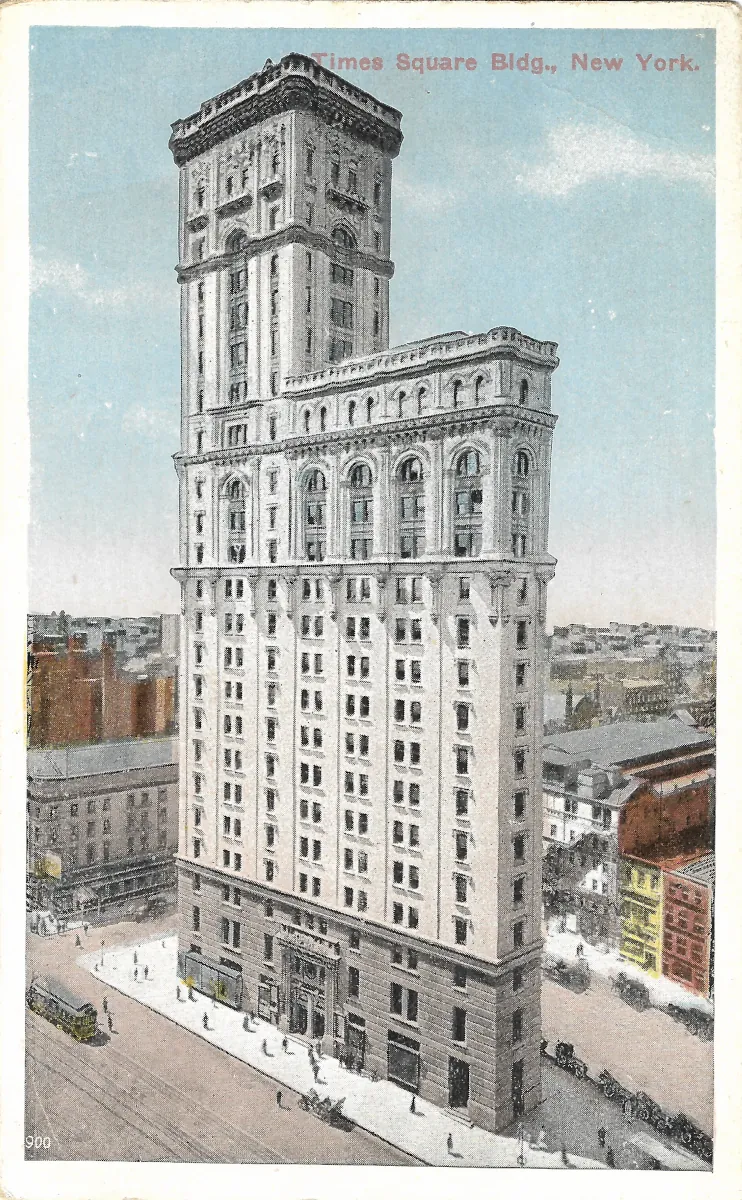
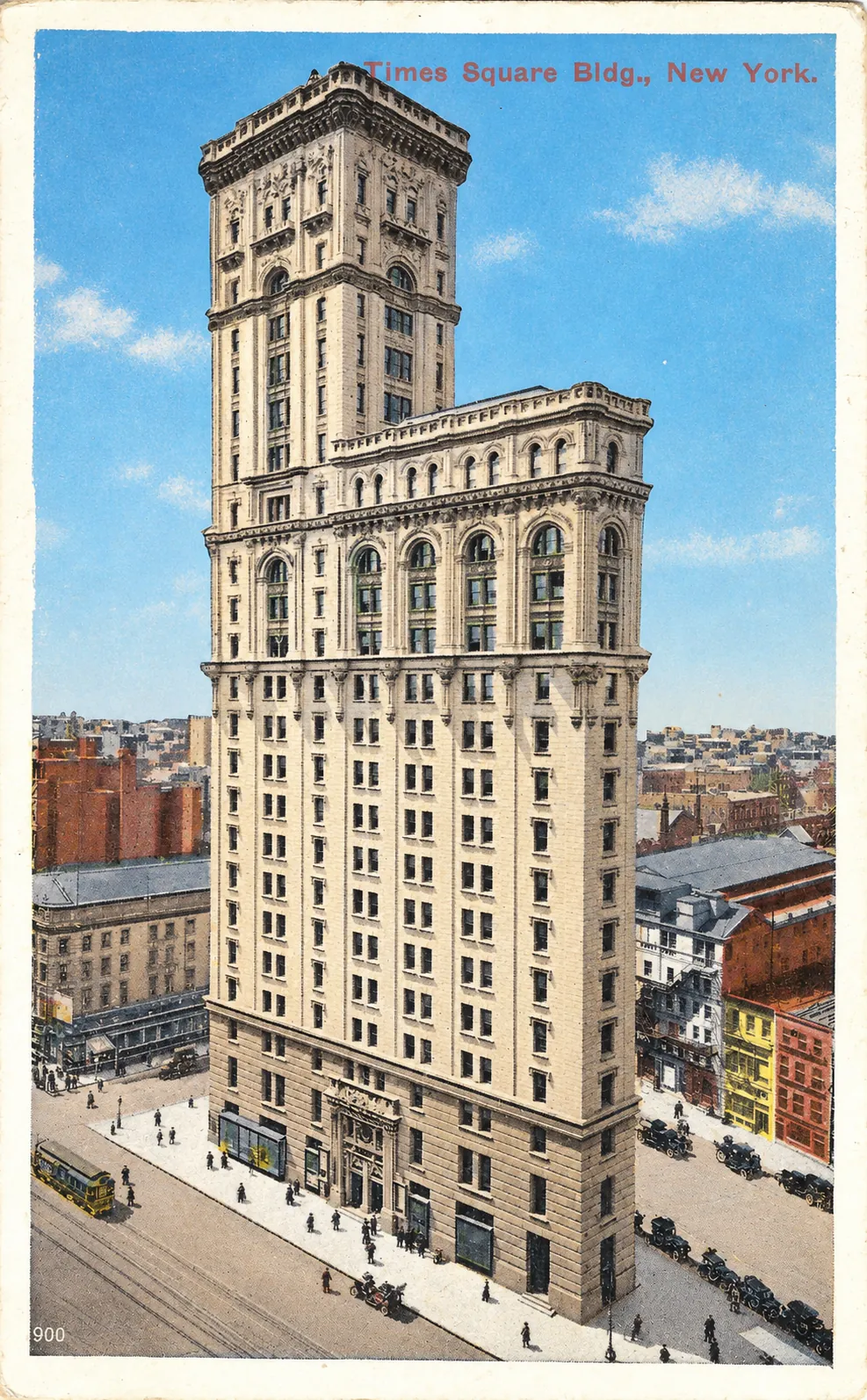
Times Square Building New York is the caption printed across the top of this vintage postcard, showing the skyscraper now known as One Times Square in Midtown Manhattan. Its identification is certain: this is the original Times Tower, built as the new headquarters of The New York Times at the beginning of the twentieth century. It occupies the narrow site between Broadway and Seventh Avenue, from West 42nd to West 43rd Street, at the southern end of Times Square.
The view appears to have been taken from an elevated position nearby, with the building deliberately placed at the centre of the composition. One of the most striking features of the postcard is how completely the tower dominates its surroundings. Most neighboring structures are considerably lower, allowing its ornate upper stories to stand almost alone against the pale blue, color-tinted sky.
The building has a strongly vertical composition. A substantial lower block rises above a monumental base before narrowing into the tall upper tower. Large arched openings, pilasters, projecting cornices and elaborate decoration give the structure a very different appearance from present-day One Times Square. Historical documentation describes a 25-story skyscraper, with a sixteen-story base and a narrower tower above it. Its original elevations combined limestone, brick and terra cotta with Neo-Gothic and Renaissance Revival detailing. Architects Cyrus L. W. Eidlitz and Andrew C. McKenzie drew inspiration from the form of Italian campaniles, particularly Giotto’s famous bell tower in Florence.
At street level, the postcard records a Times Square almost unrecognizable to a modern visitor. Small groups of pedestrians can be seen on the sidewalks, while several vehicles move through the streets surrounding the building. Rails are visible in the roadway, and at least some of the traffic appears to be horse-drawn, although the scale of the figures and vehicles is too small to identify every one of them with certainty.
The relative openness of the surrounding streets is particularly significant. Today the site is associated with enormous illuminated advertisements and a dense wall of commercial architecture. On this postcard, however, the building itself is the attraction. Its stonework, windows and decorative crown remain fully visible.
That contrast is historically important because the original exterior no longer survives in this form. During a major modernization in the 1960s, much of the ornate terra-cotta façade was removed and the building was reclad. Over subsequent decades, its exterior became increasingly valuable as advertising space, and One Times Square is now largely concealed behind giant signs and electronic displays. The steel structure shown here nevertheless survives within the modern building.
A small number “900” can also be seen in the lower-left corner of the postcard. It may be a publisher’s series or catalogue number, but no publisher’s name is clearly visible on the front, so the issuing company cannot be identified reliably from this image alone.
Historical description
The history of the tower is inseparable from the history of Times Square itself. At the beginning of the twentieth century, this part of Manhattan was still known as Longacre Square. Publisher Adolph S. Ochs selected the highly visible site for the new headquarters of The New York Times, and construction took place in 1903-1904. The newspaper officially occupied the tower in January 1905. In April 1904, while the building was still being completed, the intersection of Broadway and Seventh Avenue was renamed Times Square, linking the district permanently with the newspaper.
At the time of its completion, the Times Tower was regarded as one of New York’s most impressive skyscrapers and was the second-tallest building in Manhattan. Its extremely narrow site accentuated its height, while its location above the newly opened subway helped make it both a landmark and an efficient newspaper headquarters. Printing machinery occupied the lower levels, and the nearby rapid-transit system assisted with the distribution of newspapers throughout the city.
The tower also became the birthplace of one of New York’s best-known traditions. A large New Year’s Eve celebration was staged on December 31, 1904 to mark the opening of the newspaper’s new headquarters. On December 31, 1907, an illuminated ball was lowered from the tower to welcome 1908, beginning the famous Times Square Ball Drop tradition.
The newspaper soon outgrew the narrow tower. In 1913, its main operations moved to a larger building on West 43rd Street. The original tower nevertheless survived and is today known as One Times Square. Its present appearance, dominated by electronic advertising, makes postcards such as this especially valuable because they preserve the building’s original architectural character before its twentieth-century alterations.
A reasonable date for this postcard is therefore between about 1905 and 1913, with circa 1910 being a plausible estimate. The early color-printing style, the limited motor traffic and the still relatively low-rise surroundings are all consistent with that period. Without a dated postmark or identifiable publisher information, however, a more precise date should remain provisional.