New York – Woolworth Building and City Hall Park at Night
Geographic description
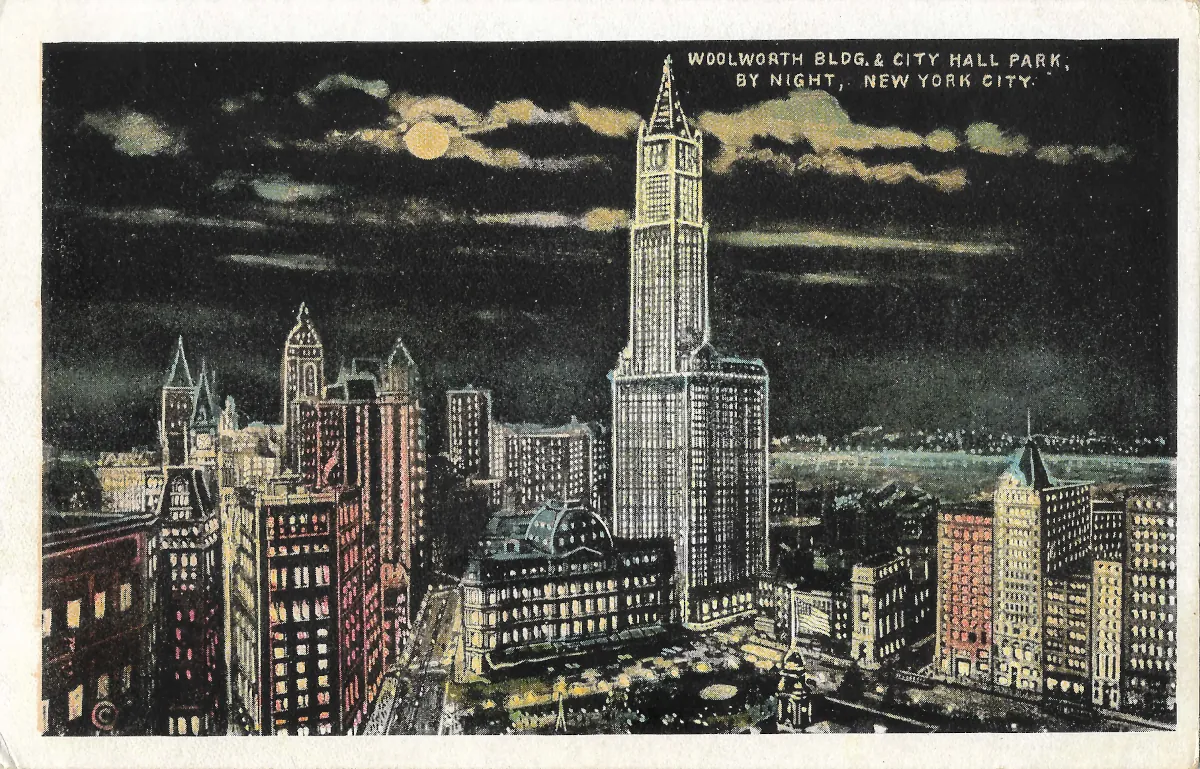
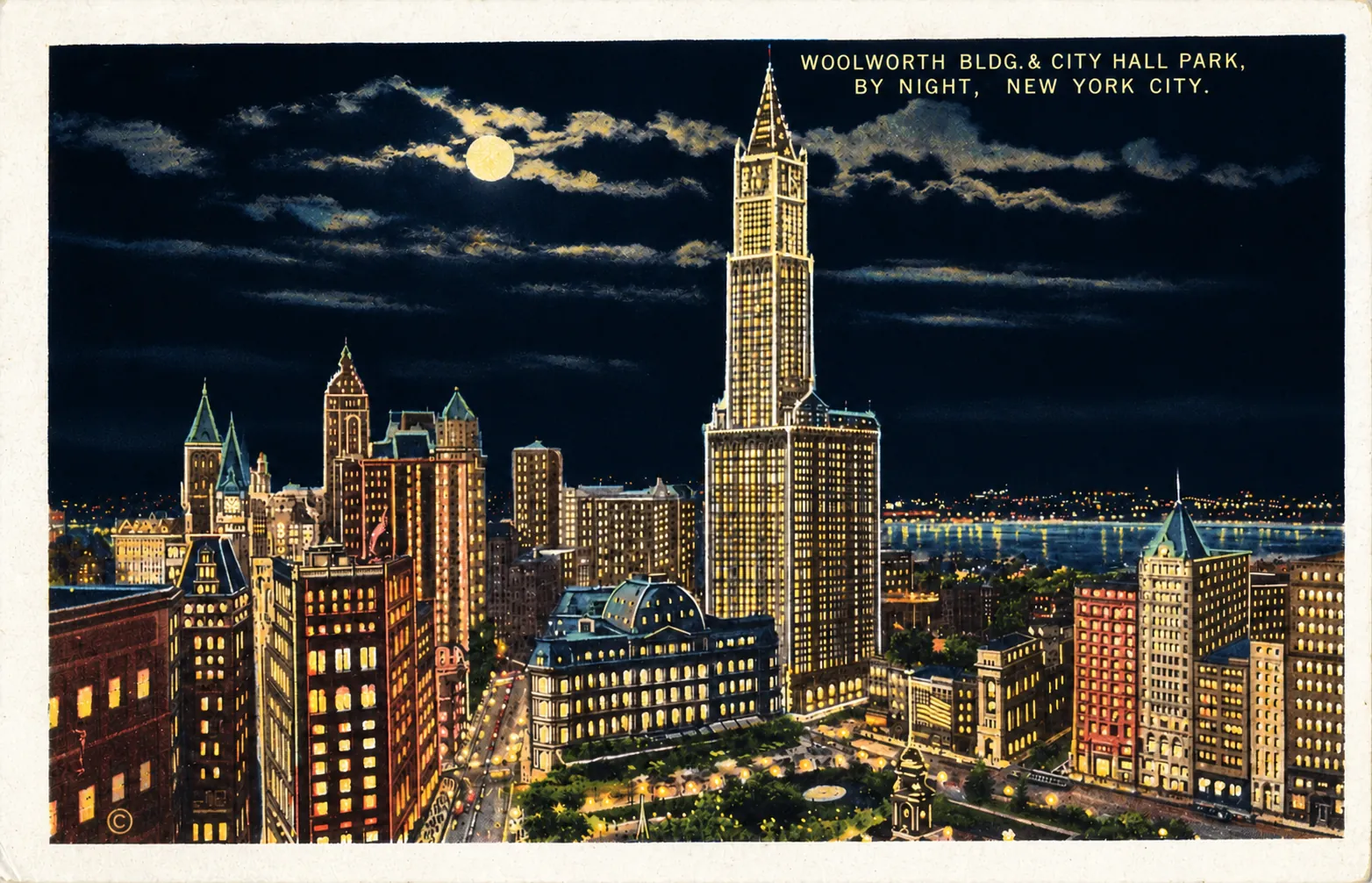
The Woolworth Building and City Hall Park are shown here in a striking nighttime view of Lower Manhattan in New York City. The printed caption at the top of the postcard — “Woolworth Bldg. & City Hall Park, by Night, New York City” — identifies the location beyond doubt. The Woolworth Building dominates the skyline, while City Hall Park and the surrounding Civic Center buildings spread across the foreground.
The Woolworth Building stands at 233 Broadway, on the western side of City Hall Park between Barclay Street and Park Place. Its location explains why it towers so dramatically over the surrounding district in this early twentieth-century scene. The slender Gothic-inspired tower, crowned by a steep pyramidal roof and elaborate architectural detailing, forms the visual centerpiece of the postcard.
Immediately to the east lies City Hall Park, one of Lower Manhattan’s important civic open spaces. Its trees, paths and relatively open ground create a noticeable contrast with the dense mass of buildings surrounding it. Broadway, Park Row and the streets of the Civic Center were already lined with government offices, newspaper buildings and commercial structures when this postcard was produced.
The scene is particularly valuable because the neighborhood has changed significantly since the early twentieth century. At that time, the southern portion of the park area was still occupied by the City Hall Post Office and Courthouse, a large nineteenth-century federal building that was demolished in 1939. Historical photographs preserved by the Library of Congress confirm its presence in early views of the Woolworth Building and City Hall Park.
The postcard is clearly designed for dramatic effect. Hundreds of illuminated windows suggest a city that remains active long after dark, while a bright moon appears between heavily stylized clouds. The reddish, yellow, green and gray tones on the buildings should not necessarily be interpreted as exact records of their appearance. They are characteristic of the color enhancement and commercial printing techniques used for postcards of this period.
The result is less a straightforward documentary photograph than a carefully constructed image of modern metropolitan New York. Older nineteenth-century buildings still form much of the urban fabric, but they are visually overwhelmed by the extraordinary height of the Woolworth Building. That contrast makes the postcard especially revealing: it captures Manhattan during the transformation from a traditionally scaled commercial city into the vertical metropolis that would soon become famous around the world.
Historical description
The Woolworth Building provides the strongest clue for dating the postcard. Designed by American architect Cass Gilbert for businessman Frank W. Woolworth, founder of the F. W. Woolworth retail empire, the skyscraper was completed and formally opened on April 24, 1913. During the opening ceremony, President Woodrow Wilson activated the building’s lighting system remotely from Washington, D.C.; the Library of Congress notes that more than 5,000 windows were illuminated.
Rising approximately 792 feet, or 241 metres, the Woolworth Building became the tallest building in the world. Its Gothic Revival design led to the famous nickname “Cathedral of Commerce.” For New Yorkers and visitors alike, it quickly became one of the most recognizable symbols of the city’s commercial power and architectural ambition.
The postcard itself can apparently be identified quite closely. An image entitled “Woolworth Bldg. & City Hall Park at night New York” is represented in the New York Public Library’s historical postcard collections and is associated with the Success Postal Card Co. The catalogued date range is 1911-1915. Because the Woolworth Building is shown as a completed skyscraper and did not formally open until April 1913, a date of approximately 1913-1915 is the most plausible estimate for the view shown here. An exact year, however, cannot be established from the front of this particular card alone.
The dating also fits the enormous publicity surrounding the skyscraper immediately after its completion. Photographers and postcard publishers rapidly adopted the Woolworth Building as a new New York landmark. The Library of Congress preserves several early nighttime photographs of the tower, including one dating from around 1913.
The nighttime setting is historically significant in its own right. Electric illumination was becoming one of the defining features of the modern American metropolis. A skyscraper glowing from dozens of floors presented New York not simply as a large city, but as a technologically advanced place whose commercial life appeared capable of continuing around the clock.
City Hall Park represents an older layer of New York history. The land had served public purposes since the colonial period and gradually developed into the city’s principal civic district. New York City Hall, completed in the early nineteenth century, reinforced that role, while the surrounding area subsequently attracted courts, government offices, postal facilities, newspaper headquarters and major commercial buildings.
This postcard therefore records an especially important stage in Manhattan’s architectural history. Nineteenth-century civic New York remains clearly visible around City Hall Park, while the newly completed Woolworth Building points toward the skyscraper city of the twentieth century.