Versailles – Napoleon I’s Wedding Carriage at the Grand Trianon
Geographic description
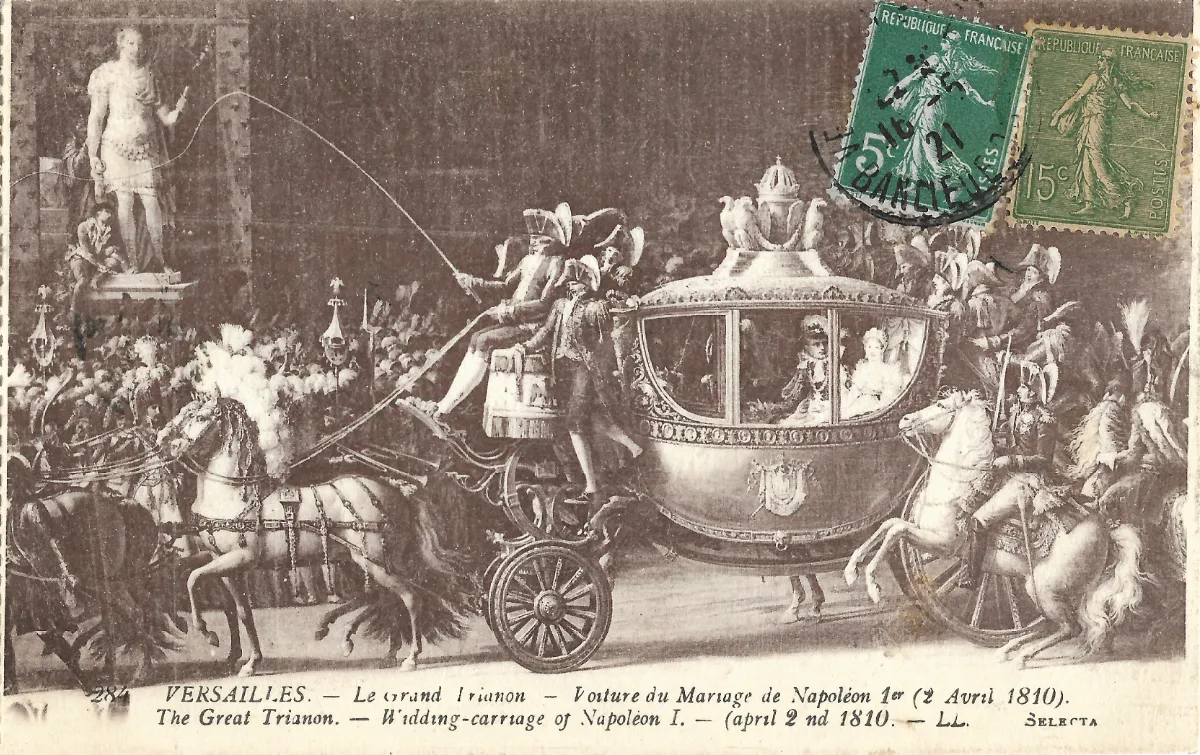
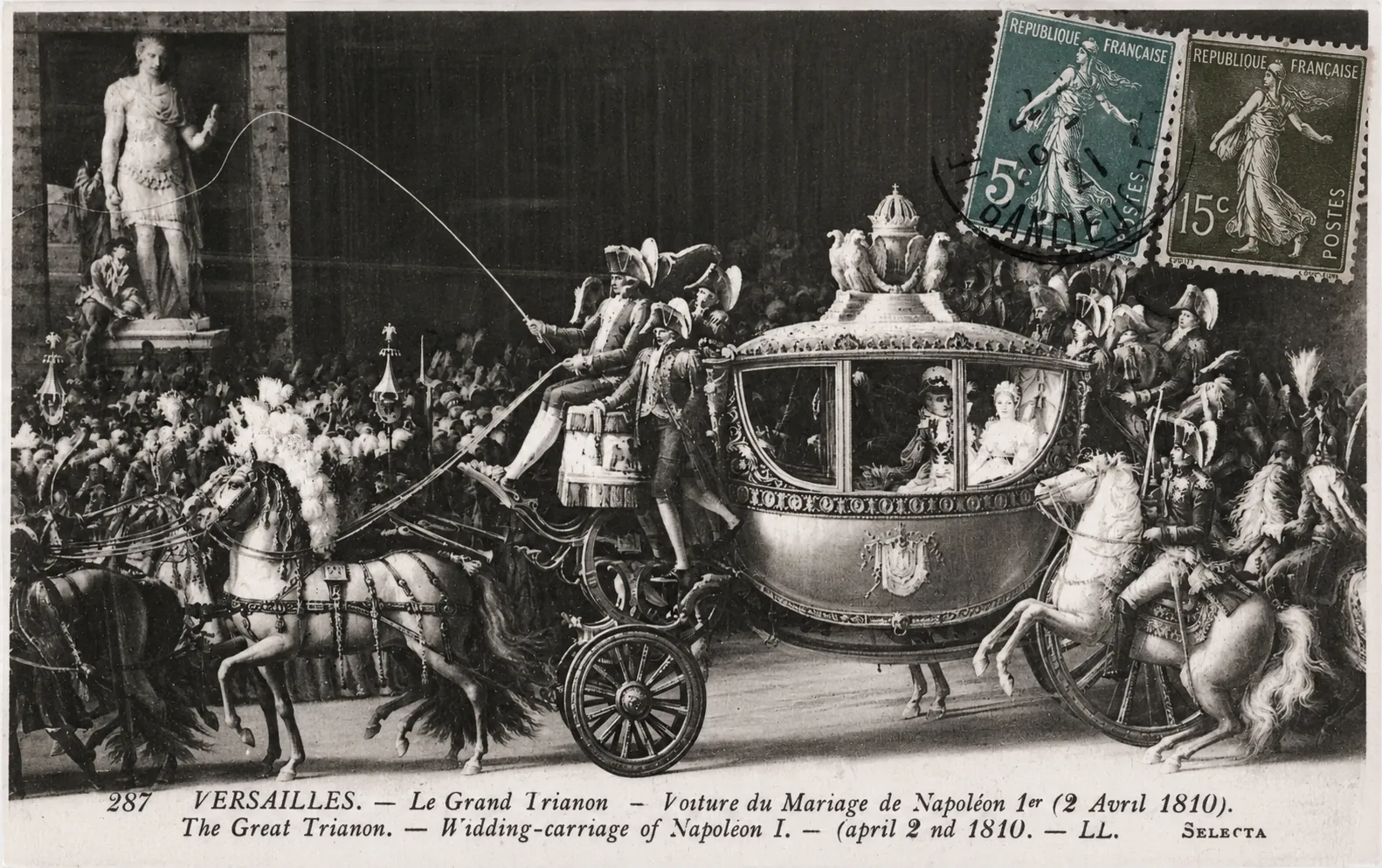
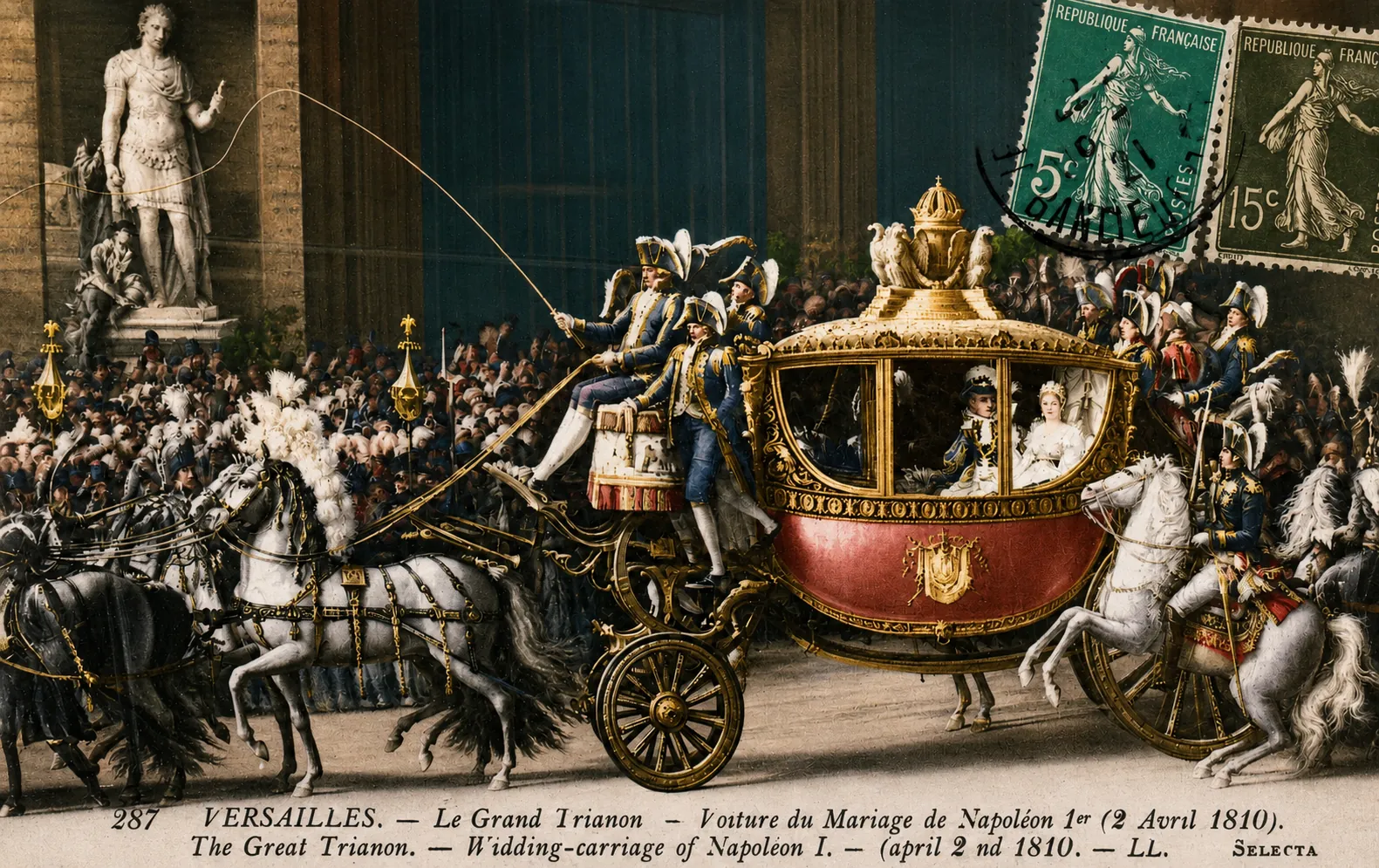
The Napoleon I wedding carriage at Versailles is shown here in an elaborate museum display once installed in the Trianon estate. The printed caption at the bottom identifies the subject as “VERSAILLES – Le Grand Trianon – Voiture du Mariage de Napoléon 1er (2 Avril 1810),” followed by an English caption describing Napoleon I’s wedding carriage. The bilingual wording was clearly intended to make the postcard understandable to the large international audience visiting Versailles.
Despite the wording of the caption, this is not a photograph of an actual imperial procession taking place outside the Grand Trianon. It records a museum reconstruction. A richly decorated ceremonial Berlin coach dominates the centre of the image. Its tall enclosed body has large windows, through which two figures representing the imperial couple can be seen. Elaborate sculptural decoration covers the roof and body, emphasising that this was a vehicle intended for state ceremonial rather than ordinary travel.
The surroundings reinforce the theatrical character of the display. Horses with ornate harnesses and tall plumes fill the foreground and right side, while liveried attendants occupy positions around the coach. Their costumes, together with the figures placed inside the carriage, were evidently intended to help visitors imagine the splendour of an imperial procession rather than merely examine a historical vehicle standing motionless in a gallery. A large classical statue visible at the far left forms another part of the museum setting.
The reference to the Grand Trianon is particularly valuable because this display no longer exists there. The Château de Versailles records that architect Charles-Auguste Questel designed a special building at Trianon to house the historic carriage collection. The first Trianon Museum of Carriages opened to the public in 1851. The vehicles remained there for more than a century before the collection was transferred to the Great Stables in 1978 and Questel’s museum building was demolished. The carriages are now displayed in the Gallery of Coaches at the Great Stables.
The postcard therefore preserves more than the appearance of an imperial coach. It records a vanished museum and an earlier approach to historical interpretation, when authentic objects were surrounded by figures, horses and decorative scenery to create a highly visual reconstruction for visitors.
Several details also help to date the postcard itself. The number 284 is printed at lower left, while “LL.” and “SELECTA” appear beside the caption. French museum records identify LL and Selecta with the Paris postcard publisher Lévy Fils & Cie. Surviving examples preserved in French public collections place such editions in the first quarter of the twentieth century, including cards mailed around 1914 and 1920.
The two French postage stamps attached to the front—a 5-centime and a 15-centime Semeuse—are also consistent with an early-1920s postal use. The cancellation appears to contain the figures “21”, although the impression is not clear enough to treat this as an absolutely certain reading. A mailing date around 1921 therefore appears likely, rather than proven.
Historical description
The date 2 April 1810 printed on the postcard refers to the religious marriage of Emperor Napoleon I and Archduchess Marie-Louise of Austria. Their civil marriage had taken place the previous day. On 2 April the religious ceremony was held in the Salon Carré of the Louvre, temporarily transformed into a chapel. The imperial wedding party crossed the Grande Galerie before entering the ceremonial space.
Carriages played an important role in the political spectacle surrounding the marriage. According to the Château de Versailles, roughly forty ceremonial Berlin coaches took part in the procession. The Imperial Guard led the route, followed by the court vehicles. An empty carriage representing the Empress appeared in accordance with royal ceremonial tradition, followed by the Emperor’s coach drawn by eight horses and accompanied by senior imperial officials and mounted dignitaries.
Preparing such a procession required an extraordinary effort. When the imperial carriage fleet was inspected in 1810, only six existing vehicles were considered suitable for the occasion. These were restored, while thirty-four new gala coaches were ordered from fourteen Parisian coachbuilders. They were completed in an exceptionally short period. Seven ceremonial vehicles associated with the wedding procession survive today at Versailles. The Château identifies Prelot, Devaux and Getting among the coachbuilders responsible for the surviving examples and notes that the vehicles were used only three or four times, helping to explain their exceptional state of preservation.
The postcard’s traditional title nevertheless requires some caution. Calling the exhibit “Napoleon I’s Wedding Carriage” may suggest that the coach shown was unquestionably the particular vehicle occupied by Napoleon and Marie-Louise. Modern Versailles documentation instead refers collectively to the coaches of Napoleon I’s wedding—several vehicles that took part in the ceremonial procession. Nothing visible on this postcard allows the individual coach to be identified with sufficient certainty. The figures of Napoleon and Marie-Louise visible through the windows should therefore be understood as part of the historical museum reconstruction, not as evidence that this particular surviving vehicle carried the imperial couple.
The historical value of the postcard is consequently twofold. It recalls one of the most spectacular dynastic ceremonies of the First French Empire, while also documenting the way Napoleonic history was presented to visitors at Versailles approximately a century later. Museums, palaces and historical monuments were extremely popular postcard subjects during the early twentieth century, helping tourists carry images of famous French heritage sites throughout Europe and beyond.
The English translation printed beneath the French caption is especially revealing in this respect. Versailles was already an international tourist destination, and publishers such as Lévy Fils & Cie adapted their products accordingly. This image therefore brings together three distinct historical periods: the imperial wedding of 1810, the nineteenth-century creation of the Trianon Museum of Carriages, and the early-twentieth-century era in which this museum display became the subject of a widely circulated postcard.