Nancy — Place de la Carrière and the Skyline of Saint-Epvre
Geographic description
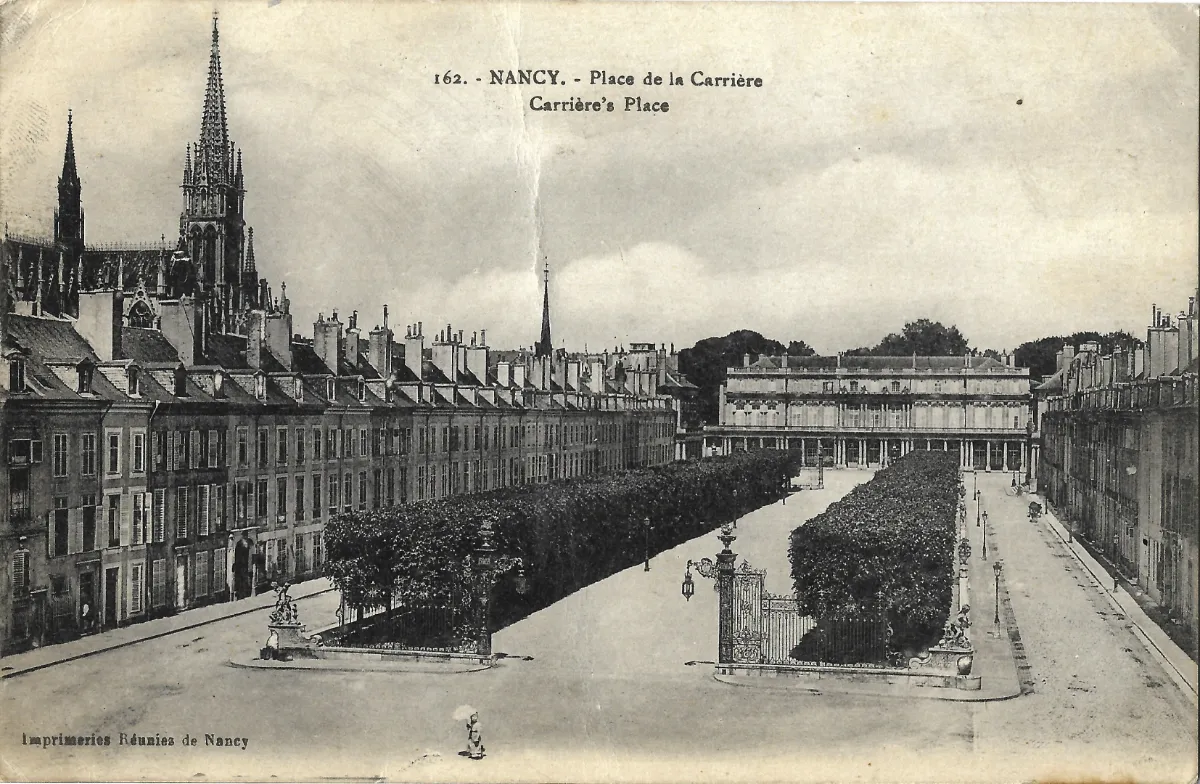
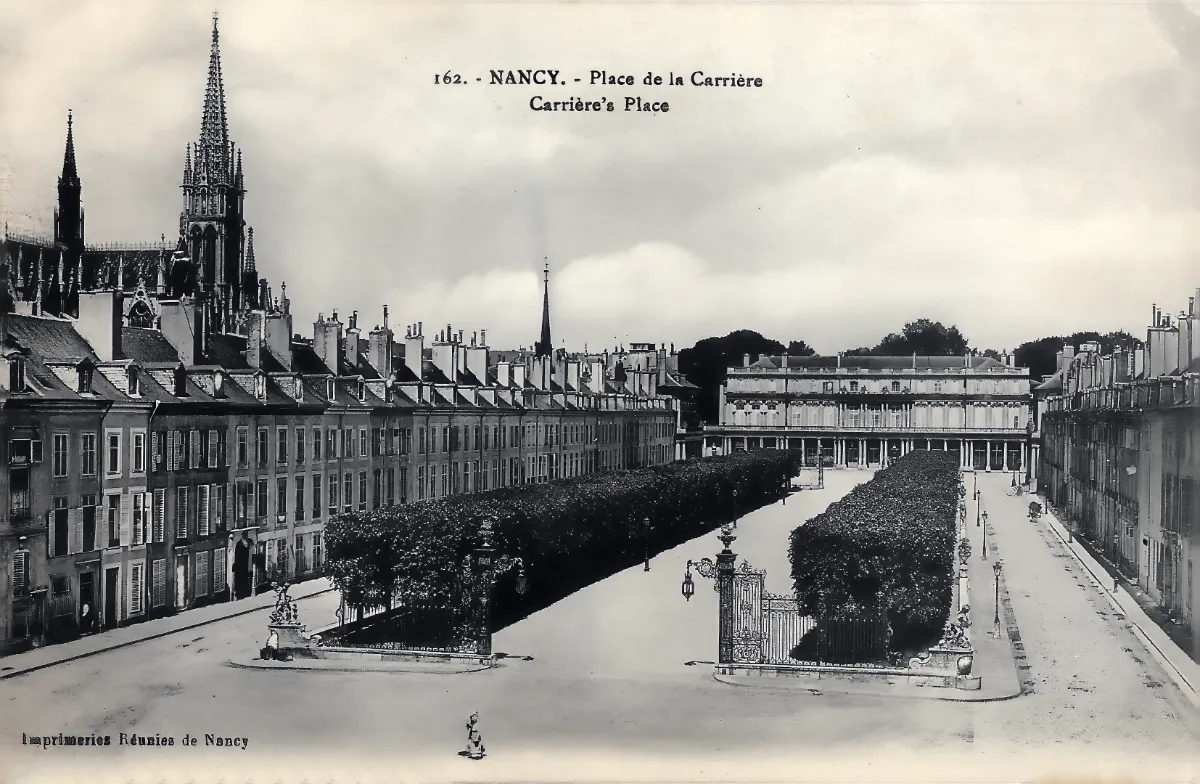
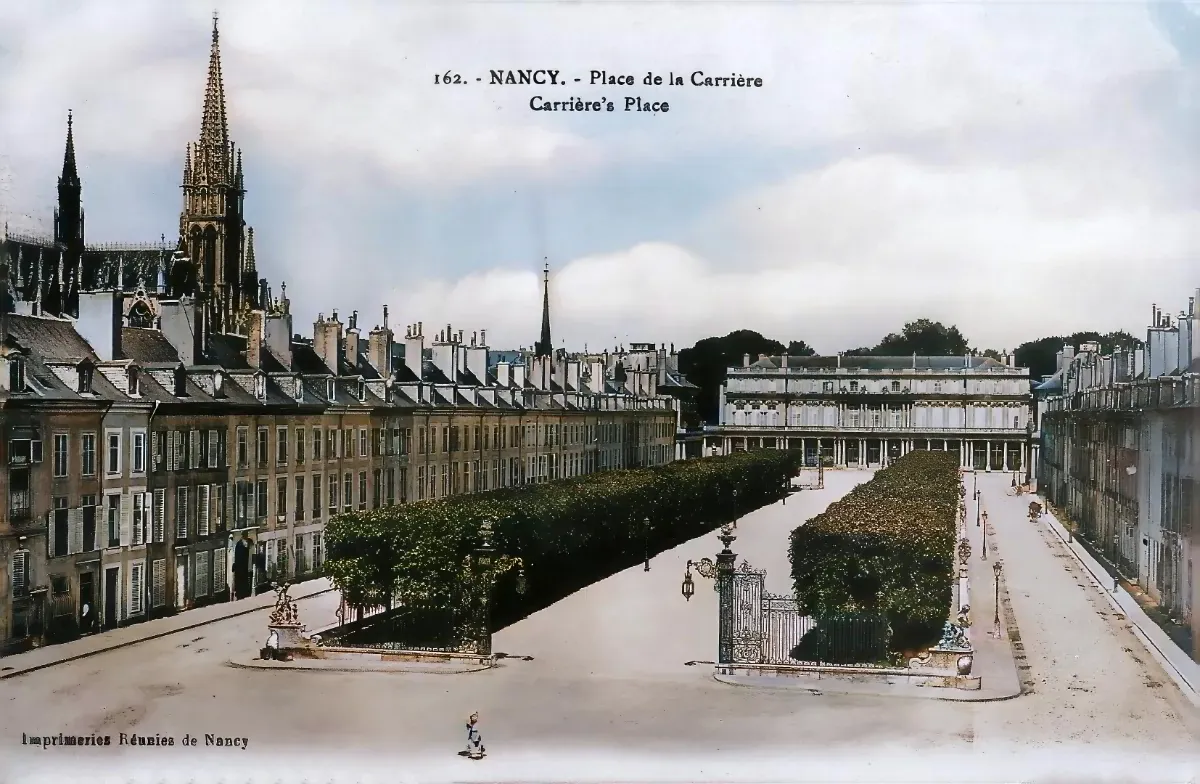
Place de la Carrière in Nancy is shown from an elevated viewpoint that emphasises the length of the square and the orderly arrangement of its buildings. The printed caption identifies the location as “162. – NANCY. – Place de la Carrière”, followed by the English wording “Carrière’s Place”.
The view looks towards the Palais du Gouvernement, whose broad façade closes the far end of the square. The camera was positioned near the southern end, in the vicinity of the Arc Héré. Its precise location cannot be established from the photograph alone.
Two long belts of closely planted trees frame a broad central walkway. Their dense foliage forms almost uninterrupted blocks of greenery, reinforcing the perspective towards the palace. Side streets run between the trees and the buildings, clearly separating the central promenade from the adjoining properties.
Ornamental ironwork, stone piers and sculpted features mark the entrance to the planted area in the foreground. Lanterns are incorporated into this elaborate setting. The delicate outlines of the metalwork contrast with the solid appearance of the clipped foliage. A line of street lamps along the right-hand side provides another visual guide towards the far end of the square.
The buildings on either side create a notably unified streetscape. Repeated windows establish a regular rhythm, while dormers and numerous chimney stacks animate the roofs. Variations in height and architectural detail nevertheless distinguish the individual properties within the continuous frontage.
On the left, the basilica of Saint-Epvre rises dramatically behind the houses. Its tall, intricately detailed spire introduces a strong vertical accent above the largely horizontal composition of the square. The church stands beyond the immediate frontage, so its appearance also reveals how closely the formal square adjoins the surrounding old town.
Human activity is sparse. A small figure carrying what appears to be a parasol crosses the foreground, while other pedestrians can be made out near the buildings. No motor vehicle can be identified with confidence. The quiet scene allows the architecture and greenery to dominate, although it cannot establish how busy the square normally was.
The photograph is especially effective at showing the relationship between built and planted space. Trees occupy a substantial part of the square without concealing its overall structure. The palace remains the principal focal point, while Saint-Epvre provides a second landmark above the rooftops.
Historical description
The square developed through several distinct phases. Its origins lie in the sixteenth-century expansion of Nancy and the alteration of the town’s fortifications. The name “Carrière” recalls its use for equestrian exercises, jousts and tournaments. It also served as a setting for public festivities and gatherings.
During the eighteenth century, Stanislas Leszczynski and his architect Emmanuel Héré incorporated the square into a larger urban scheme. The Palais du Gouvernement became its northern focal point, and the adjoining façades were brought into a coordinated architectural composition. The consistency visible in the postcard therefore reflects deliberate remodelling rather than the simultaneous construction of every property.
Saint-Epvre belongs to a later chapter in the city’s development. Designed by Prosper Morey, the present basilica is a nineteenth-century Gothic Revival building. The French Ministry of Culture’s heritage record dates the completion of its spire to 1871 and its consecration to 1875. Its presence above the roofs illustrates the layering of architectural periods within central Nancy.
The photograph was plausibly taken around 1900 or during the early decades of the twentieth century. The postcard’s layout, the limited clothing details and the general appearance of the scene are compatible with that estimate. None provides a precise date, however, and the image cannot securely be assigned to the years before the First World War. A quiet street without visible cars is not sufficient evidence on its own.
“Imprimeries Réunies de Nancy” appears at the lower left. This is a production credit, but it does not establish the photographer’s identity. The number 162 probably identifies the view within a series and should not be interpreted as chronological information. The English caption is a further publishing feature, although it does not prove where this particular copy was sold or circulated.
The yellowed surface, worn edges and prominent central crease relate to the condition of the surviving postcard. They cannot independently establish its printing process or age. Its strongest documentary value lies in the streetscape itself: dense planting, restrained street activity and a carefully framed view linking the square’s formal architecture with the neighbouring basilica.