Meillers – Rue de la Mairie and Saint-Julien Church around 1950
Geographic description
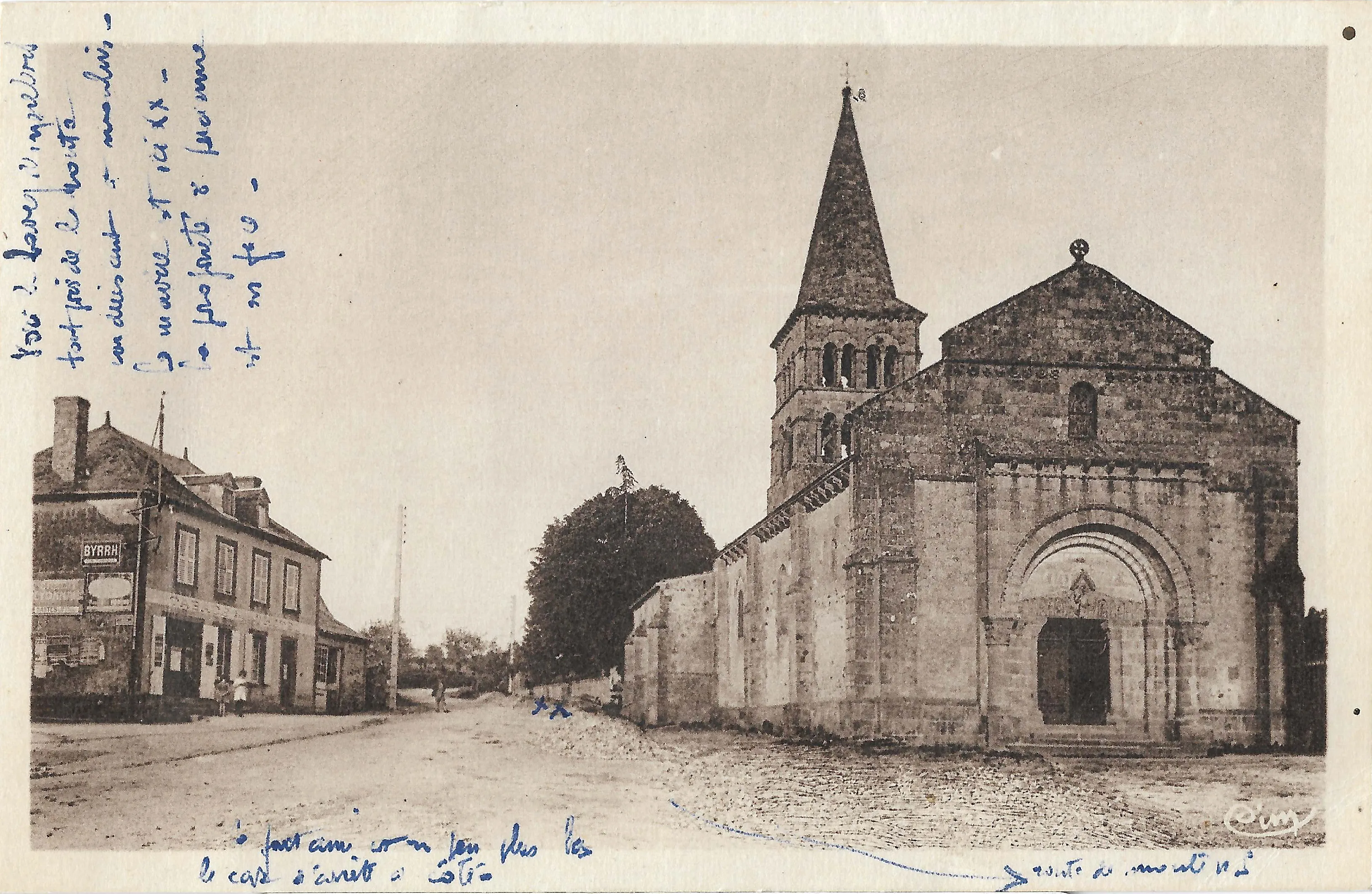
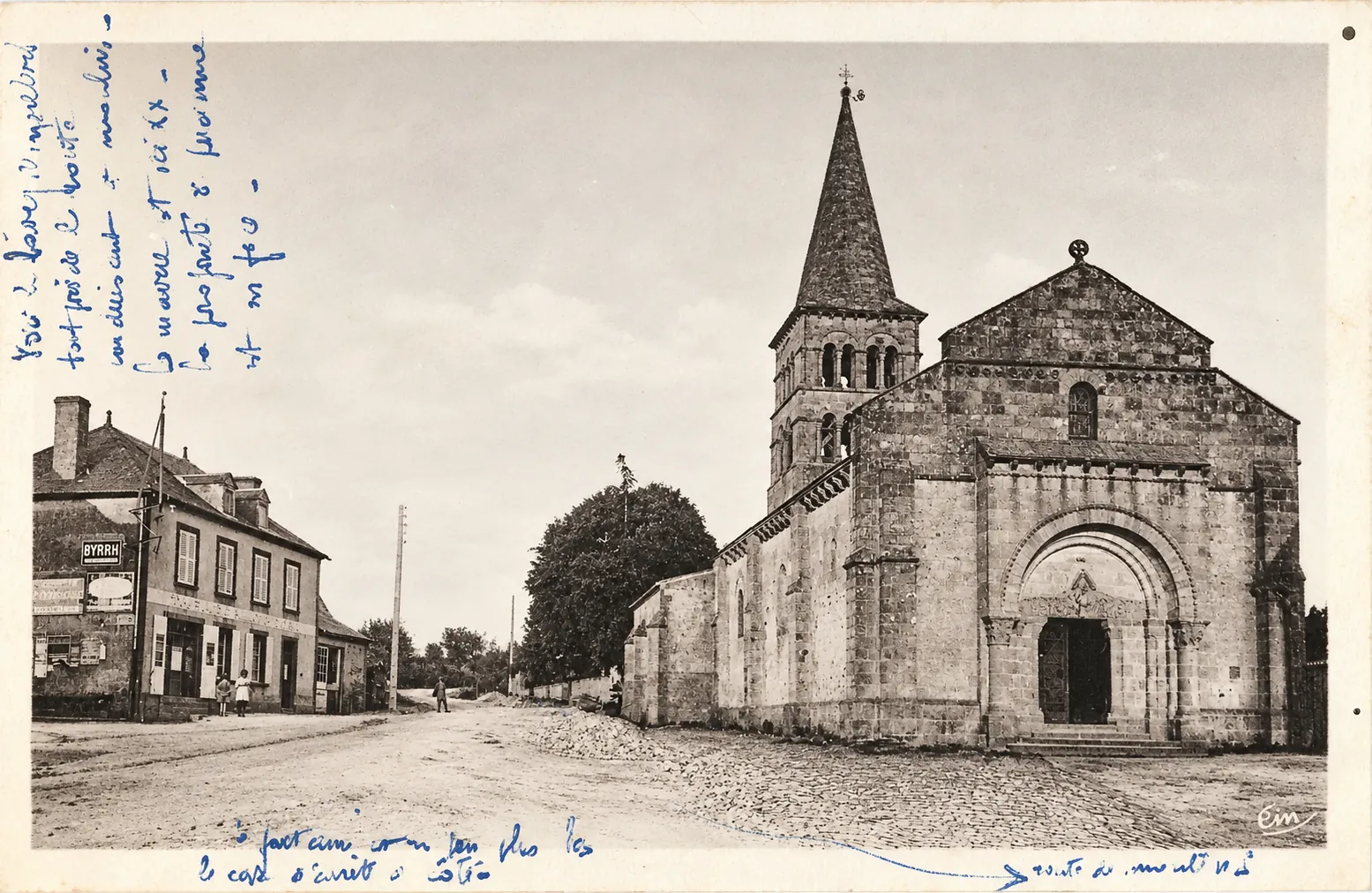
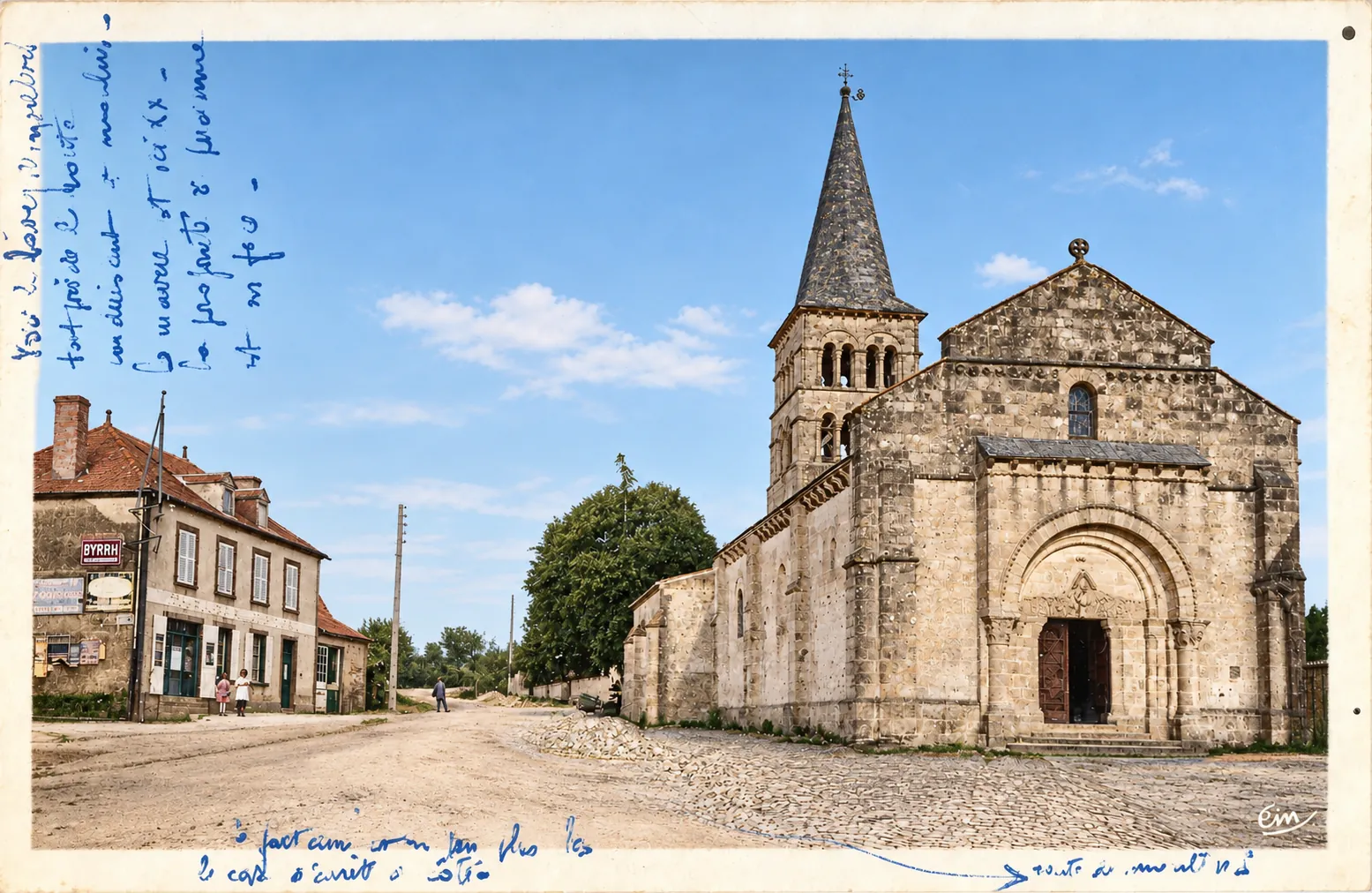
Meillers Rue de la Mairie is shown here in the centre of this rural village in the Allier department of central France. The scene is dominated by Saint-Julien Church, whose western façade and bell tower stand immediately beside the road. The postcard provides a particularly clear view of the traditional layout of the village centre, where the church, houses and small businesses were grouped along a limited number of streets.
The church occupies almost the entire right-hand side of the photograph. Its massive stone façade is centred on a Romanesque round-arched portal formed by several successive archivolts. Despite the limitations of the original photograph, the sculpted tympan can still be distinguished above the entrance. Behind the façade rises a square bell tower crowned by a tall pointed spire, making the church the most prominent landmark in the village.
Heritage records identify the building as Saint-Julien Church in Meillers, formerly both a priory church and the parish church. Its oldest surviving parts date from the 11th century, while an important phase of construction took place during the 12th century. The portal visible on the postcard is one of the building’s most notable features. It includes three columns with broad capitals and a sculpted tympan depicting Christ surrounded by the twelve Apostles.
On the left side of the street stands a row of modest buildings typical of a small Bourbonnais settlement. Their façades are simple, with regularly spaced windows and relatively low rooflines. A large BYRRH sign can be seen on the nearest building. Such advertising signs, promoting the well-known French aperitif brand, were commonly displayed outside cafés, inns and grocery shops during the first half of the 20th century. Its presence therefore suggests that a commercial establishment operated here.
The road itself still has a distinctly rural appearance. The main carriageway seems to have a light, relatively rough surface, while the area directly in front of the church appears paved or covered with stone setts. No motor vehicles are visible. Only a few very small human figures can be distinguished farther along the street, reinforcing the impression of a quiet village centre.
Beyond the first group of buildings, the view opens towards trees and more scattered development. This setting corresponds closely to the rural character of Meillers, a commune in the Allier department which today forms part of the canton of Souvigny and the Communauté de communes du Bocage Bourbonnais.
The postcard therefore records not only a major historic monument but also the traditional spatial organisation of Meillers, with Saint-Julien Church standing at the heart of a compact village surrounded by houses, local businesses and quiet streets.
Historical description
A date of 17 September 1950 is written on the reverse of the postcard. This provides a valuable chronological reference and places this particular copy firmly at the beginning of the 1950s. The photograph itself may have been taken somewhat earlier, as postcards could remain in circulation for several years, but the appearance of the village is entirely consistent with the period.
The wording on the reverse, “Meillers (Allier) – Rue de la Mairie,” precisely identifies the location. The large monument occupying the foreground is Saint-Julien Church, one of the principal historic buildings in the commune.
The origins of the church date back to the Middle Ages. Heritage documentation records it as a former priory church connected with the Benedictine abbey of Saint-Menoux and historically belonging to the former diocese of Bourges. The church was dedicated to Saint Julian of Brioude. Construction began during the 11th century, followed by an important rebuilding or expansion campaign in the 12th century.
The building retains substantial Romanesque features. Its nave is covered by a pointed barrel vault divided by transverse arches, while the side aisles have half-barrel vaults. The apse is covered by a semi-domed vault. Square piers and several early capitals belong to the oldest surviving phases of the church.
The western portal shown prominently on the postcard is one of its most significant architectural features. Its columns, broad capitals and sculpted tympan form an unusually rich Romanesque composition. The tympan represents Christ surrounded by the twelve Apostles.
The historic importance of the building was recognised very early. Saint-Julien Church was listed as a Monument historique in 1846, during the first decades of organised monument protection in France. It had therefore already enjoyed official protection for more than a century when this postcard was dated in 1950.
Later alterations were also made to the medieval building. In 1491, Jacques de Lorme, lord of Pravier, and his wife Isabeau Fradel commissioned a seigneurial chapel against the north side of the church. Several windows were enlarged at approximately the same period. These later additions did not fundamentally alter the predominantly Romanesque character of the monument.
The photograph is therefore especially interesting because the church is shown not as an isolated heritage attraction but as part of the everyday fabric of the village. Houses stand only a short distance away, a commercial premises occupies the opposite side of the street, and the roadway passes immediately beside the monument.
The almost complete absence of motor traffic, the relatively simple road surface and the period advertising sign on the left help evoke the atmosphere of a French rural village at the beginning of the 1950s, before increasing car ownership and post-war road improvements significantly transformed many village centres.
This postcard therefore offers both an architectural record of an important Romanesque church in the Bourbonnais and a valuable view of everyday life along Rue de la Mairie in Meillers in the mid-20th century.