Mâcon – Saint-Vincent Church and its Neoclassical Architecture
Geographic description
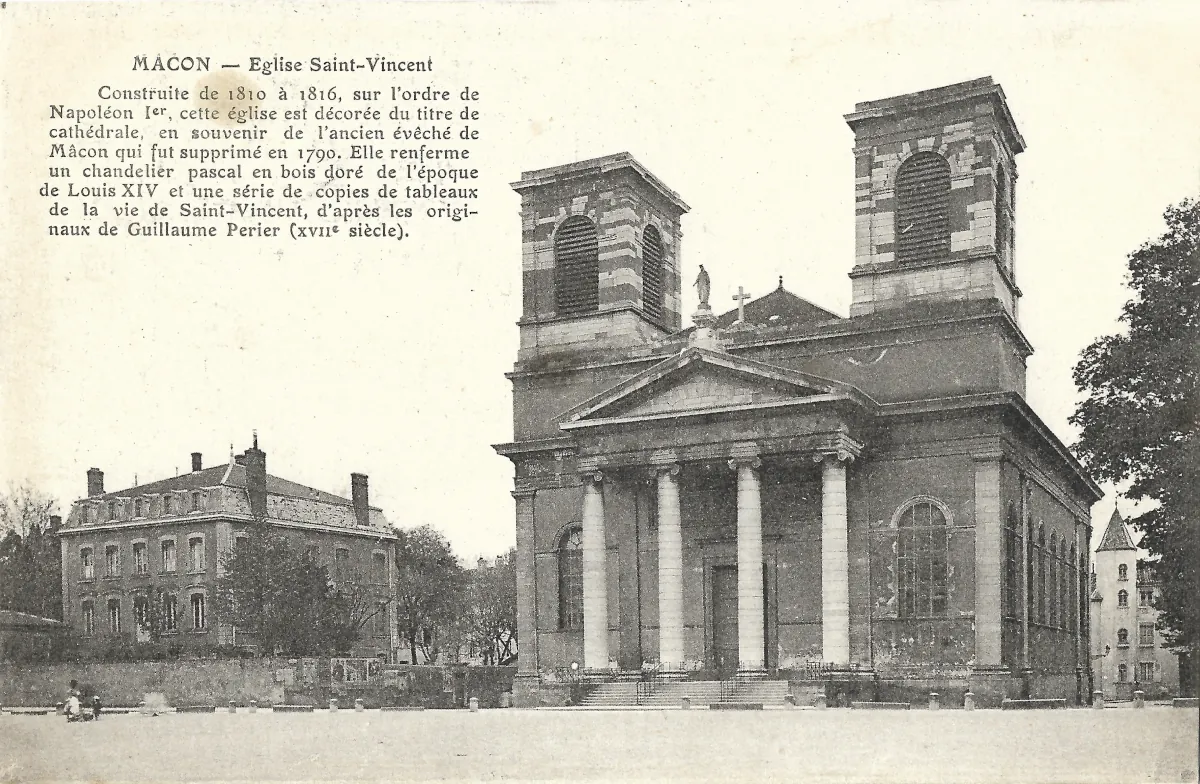
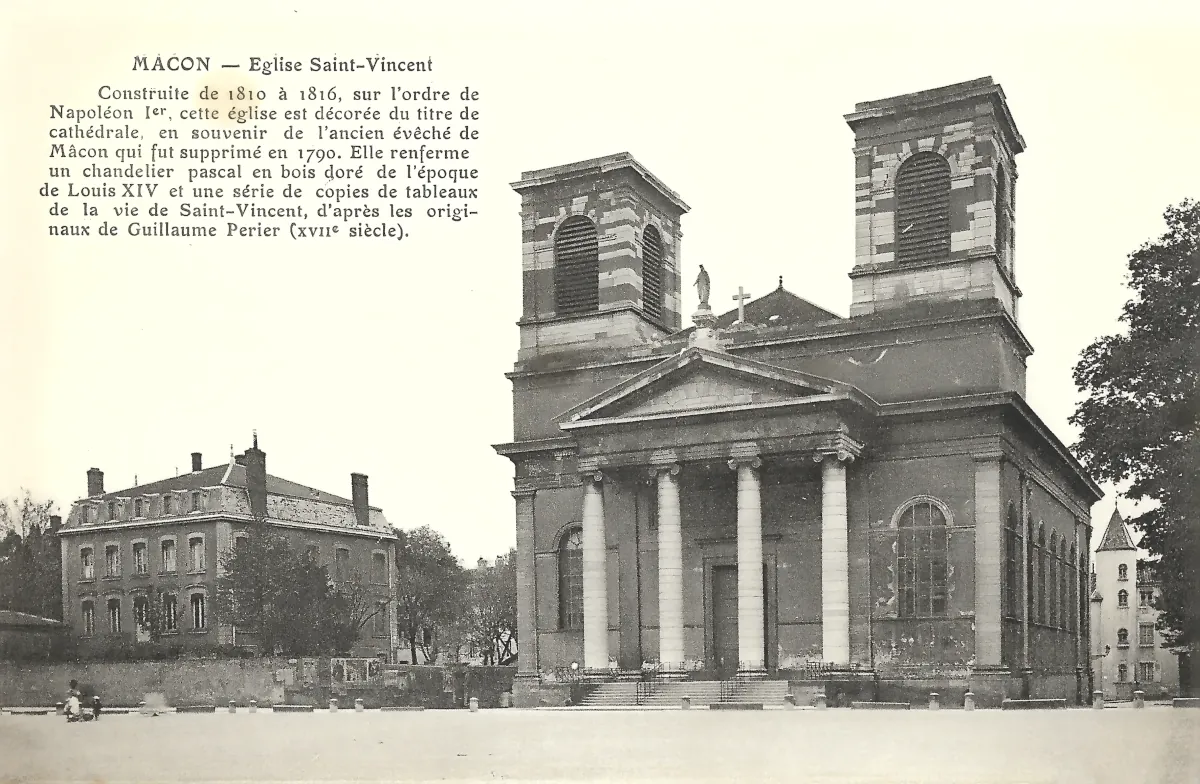
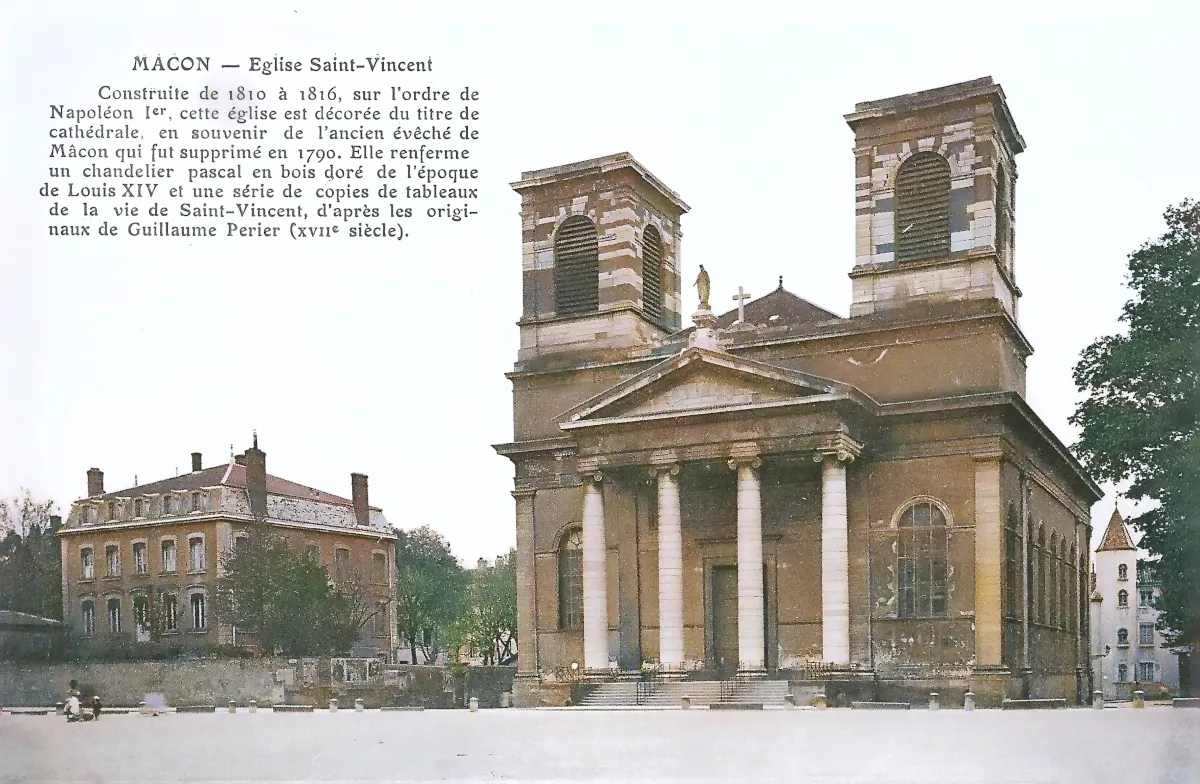
Saint-Vincent Church in Mâcon dominates this vintage postcard with its monumental Neoclassical façade. The building stands in central Mâcon, the prefecture of the Saône-et-Loire department in southern Burgundy, now part of the Bourgogne-Franche-Comté region. The church is currently located on Rue du 8-Mai-1945 and faces Square de la Paix, formerly known as Place Napoléon. Modern heritage sources refer to the building both as Saint-Vincent Cathedral and as the “new Saint-Vincent Church.”
The photograph was taken from a broad open area, allowing almost the entire main façade to be seen. The large, relatively empty foreground strengthens the monumental character of the church. Only a handful of very small figures can be distinguished, mainly towards the left-hand side of the image. No clearly identifiable motor vehicle is present, so the street scene itself provides little evidence for accurately dating the postcard.
Saint-Vincent’s façade is a characteristic example of early nineteenth-century Neoclassical architecture. A monumental portico formed by four columns supports a heavy entablature and triangular pediment, recalling the architectural language of Classical Antiquity. Behind it rise two symmetrical square towers with large arched louvred openings. Contrasting horizontal stonework emphasises the upper stages of both towers.
The overall effect is monumental and restrained, reflecting the architectural ideals associated with the Napoleonic period. France’s Ministry of Culture confirms the church’s Neoclassical character and attributes its design to architect Guy de Gisors.
A cross and several sculptural elements can be seen along the roofline between the two towers. On the right side of the church, a large round-headed window illuminates the interior. The visible length of the building also reveals the considerable scale of the nave.
To the left stands a substantial multi-storey building surrounded by trees. Its precise function cannot be established from the postcard alone, so identifying it more specifically would be speculative. At the far right, another narrower building with a steep roof is partly visible behind the church. Together, these structures convey the relatively open urban setting that once surrounded Saint-Vincent.
The open space in front of the church corresponds to the historic area facing the building, associated with the former Place Napoléon and present-day Square de la Paix. The official tourism service confirms that the church was deliberately erected opposite Place Napoléon when the new sanctuary was planned during the Empire.
The postcard is therefore valuable not only as an architectural portrait but also as evidence of the historic urban landscape surrounding one of Mâcon’s principal religious monuments. Saint-Vincent remains an important landmark in the modern city. The building is owned by the municipality and has been officially listed as a French Monument historique since 2 September 1994.
Historical description
The history of Saint-Vincent Church in Mâcon is closely connected with the religious upheavals that followed the French Revolution and with the rebuilding of Catholic institutions during the Napoleonic era. The caption printed directly on the postcard states that the church was constructed between 1810 and 1816 on the orders of Napoleon I and explains that it bears the title of cathedral in memory of Mâcon’s former bishopric.
The general historical context is correct, although modern heritage sources give slightly different construction dates. Mâcon’s official tourism service dates the new Saint-Vincent church to 1806–1816. It explains that the project followed the Concordat of 1801 and Napoleon and Joséphine’s visit to Mâcon in 1805. Napoleon subsequently granted the town 240,000 francs for the creation of a new place of worship, and Guy de Gisors, one of the architects associated with the Imperial administration, was appointed to prepare the plans.
The French Ministry of Culture gives a slightly different chronology, recording work beginning in 1808 and being completed in 1818. These differences probably reflect the distinction between the initial project, the principal construction campaign, the inauguration and final finishing work rather than a fundamental historical disagreement. The official inauguration took place on 24 August 1816, when the church was dedicated to Saint Vincent, deacon and martyr, and Saint Louis, King of France.
The site itself was deliberately chosen. The new church was built on the grounds of the former Saint-Pierre collegiate church, facing Place Napoléon, today’s Square de la Paix. During the planning stages, dedicating the building to Saint Napoleon was apparently even considered.
The postcard’s use of the word “cathedral” also recalls Mâcon’s much older ecclesiastical history. Mâcon once had its own diocese and an earlier Saint-Vincent Cathedral. Parts of that medieval structure survive elsewhere in the city as the monument known today as the Vieux Saint-Vincent. The Bishopric of Mâcon disappeared during the revolutionary reorganisation of the Church and was not restored following the Concordat of 1801. The nineteenth-century Saint-Vincent building therefore preserves the memory and traditional cathedral title associated with Mâcon’s former episcopal status.
The printed caption also mentions several treasures supposedly preserved inside the church: a gilded wooden Paschal candlestick dating from the reign of Louis XIV and a series of copies depicting episodes from the life of Saint Vincent, based on seventeenth-century originals by Guillaume Perrier. These objects are not visible in the photograph itself, so the information should be understood as part of the postcard publisher’s accompanying description rather than as evidence provided by the image.
The building continued to evolve throughout the nineteenth century. The Ministry of Culture records stained-glass windows by Jean-Baptiste Barrelon dating from 1858 to 1878 and a further interior decorative campaign undertaken in 1897.
The postcard itself cannot be securely dated from its front side alone. Its monochrome photographic reproduction, typography and overall presentation are consistent with postcards produced during the first half of the twentieth century, possibly between the 1920s and 1940s. This remains an estimate, however: no clearly identifiable publisher, postal date or datable vehicle is visible on the front of the card.