Bourbon-Lancy – Restaurant at the Thermal Establishment
Geographic description
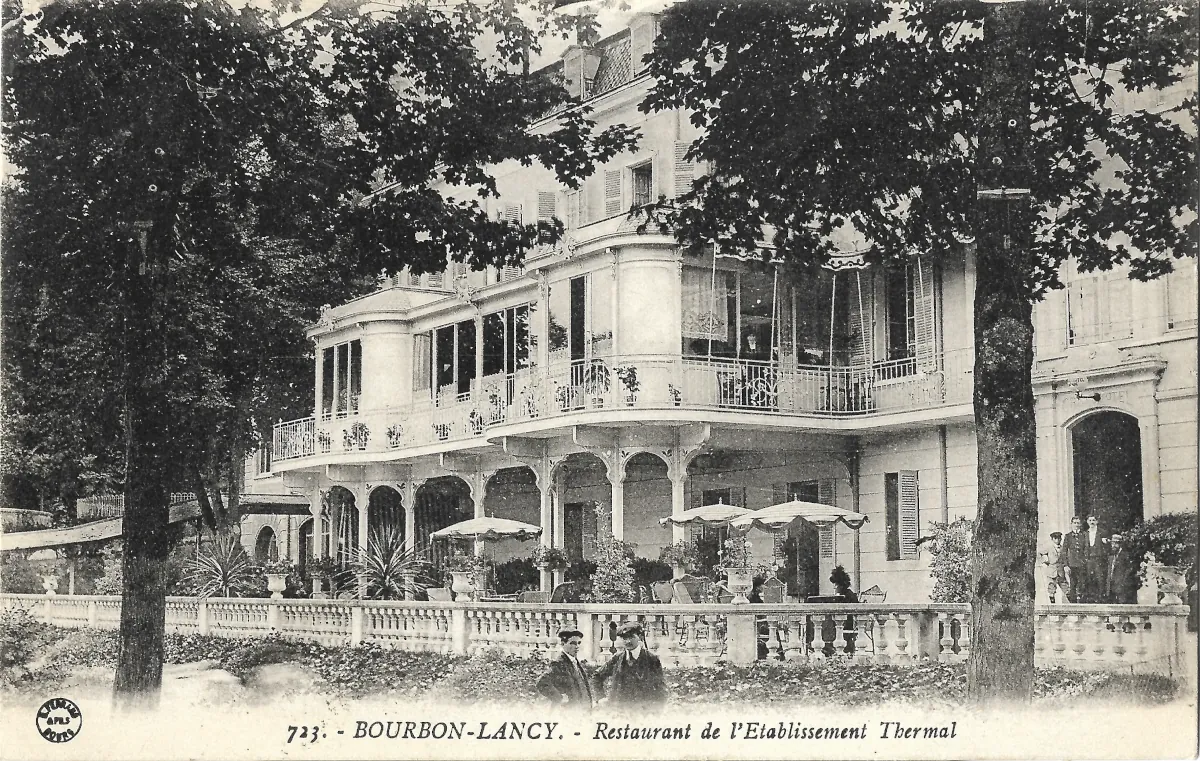
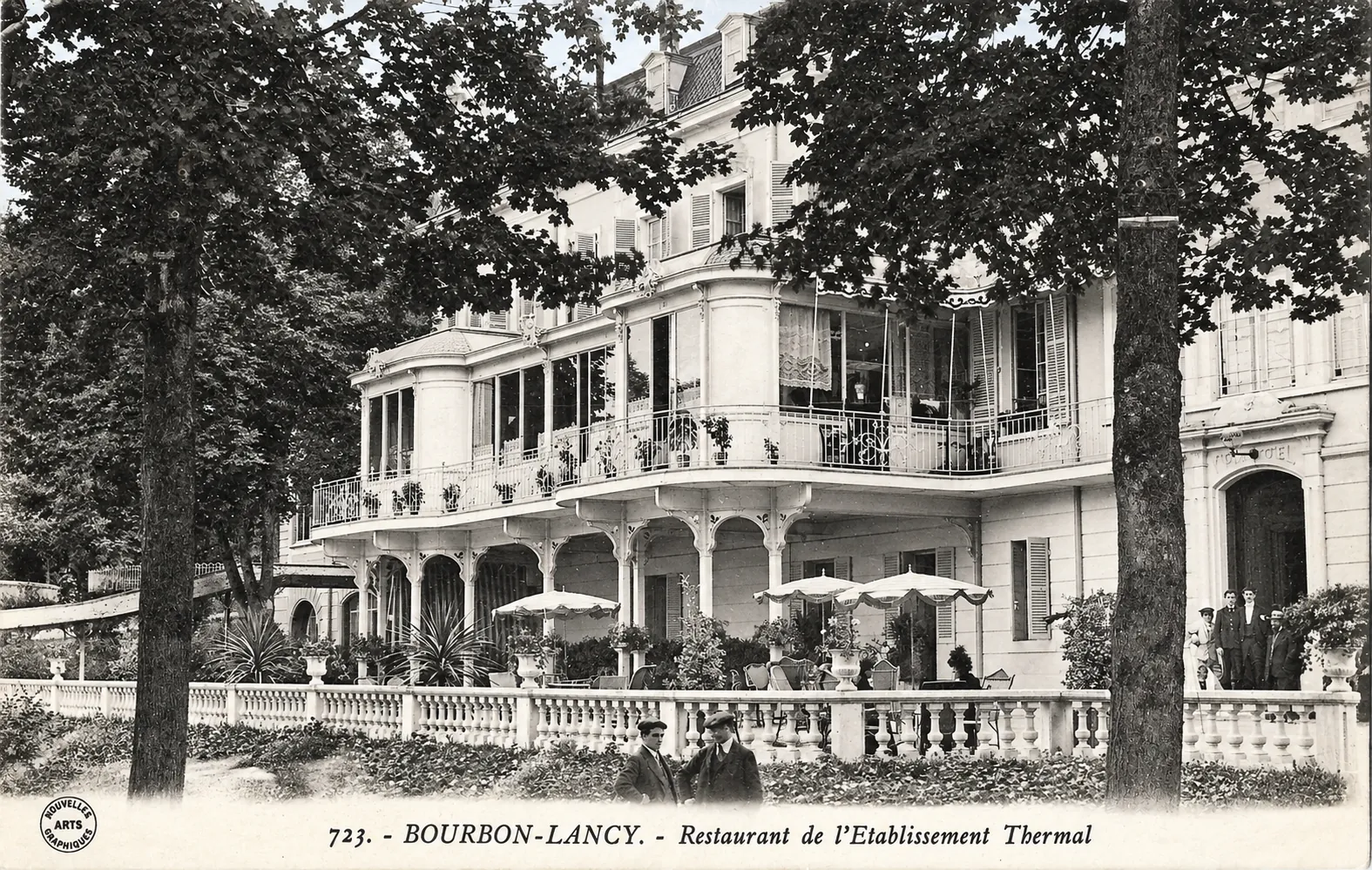
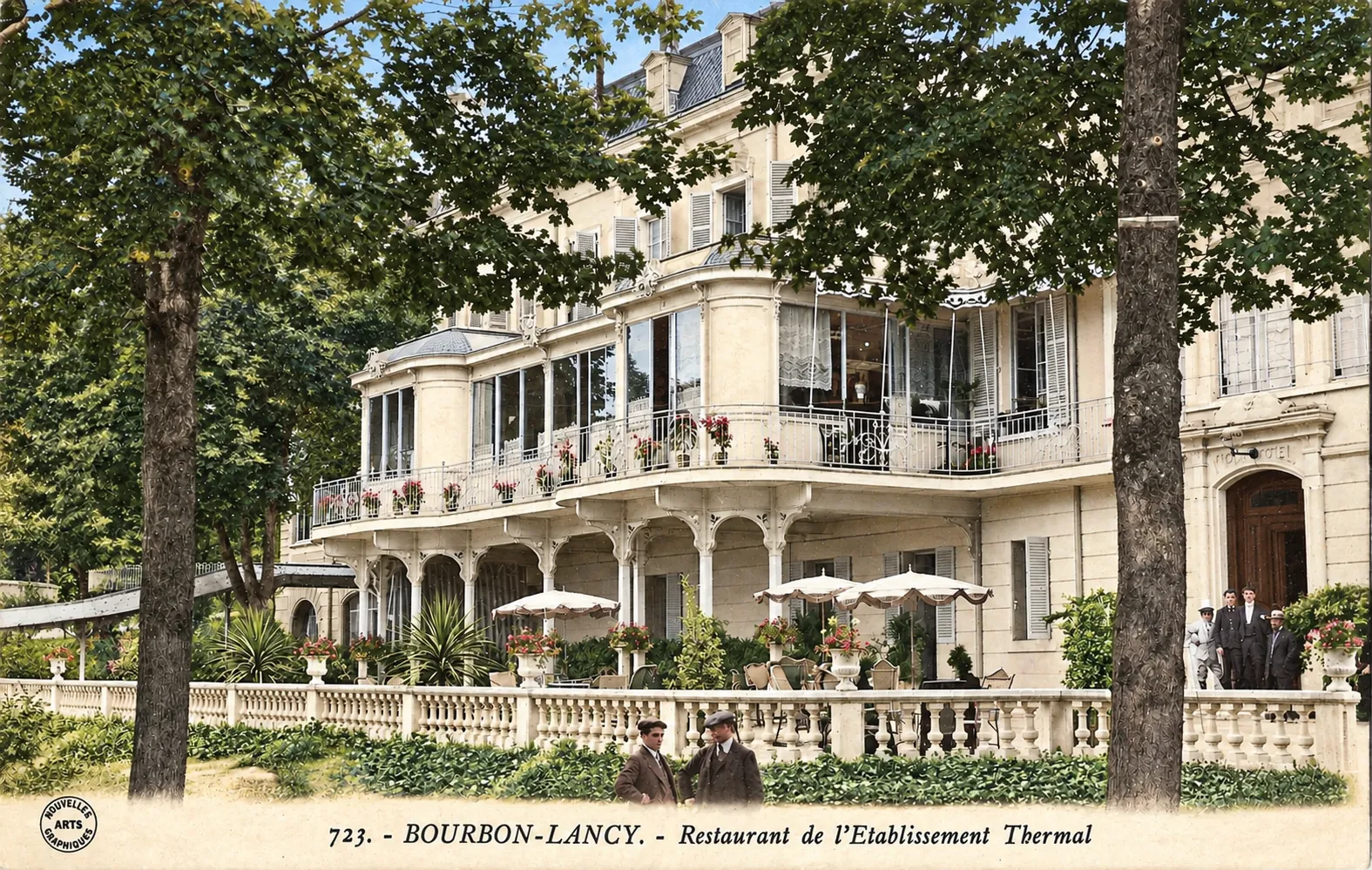
The Bourbon-Lancy Thermal Establishment restaurant is shown here in the leafy spa district of Bourbon-Lancy, a town in the Saône-et-Loire department of Burgundy-Franche-Comté. The photograph presents an elegant building designed to welcome spa guests and visitors, surrounded by mature trees and landscaped grounds. Bourbon-Lancy’s Thermal Park occupies the sloping side of the Borne valley and overlooks several of the principal buildings associated with the spa, including the Grand Hôtel and the thermal establishment.
The composition is centred on a spacious terrace bordered by a stone balustrade. Large trees frame the building and provide generous shade, creating the atmosphere of a fashionable resort rather than that of a strictly medical establishment. Decorative plants in urns and pots are arranged along the terrace, including several large spiky plants reminiscent of yuccas, a type of ornamental planting frequently used to give hotel gardens and promenades a more exotic appearance.
The most distinctive architectural feature is the long glazed gallery on the upper level. Large windows are combined with a light metal structure and delicate railings. Beneath it, a series of open arches forms a covered gallery facing the terrace. Tables, chairs and several parasols or awnings can be seen outside. The entire arrangement clearly reflects the building’s role as a restaurant and social space where spa visitors could dine, rest and meet between treatments.
There is strong evidence that this structure corresponds to the dining-room extension of Bourbon-Lancy’s Grand Hôtel. The official Burgundy-Franche-Comté heritage inventory records the construction, around 1900, of a new dining room against the eastern side of the hotel. It describes a largely glazed metal structure and notes that the lower level was originally completely open before being enclosed at a later date. These details correspond closely with the architecture visible on the postcard.
Human activity is present but deliberately understated. Two men wearing hats stand in the foreground near the balustrade, while several other figures can be distinguished beside the doorway on the right. They provide scale and a sense of everyday life without distracting from the architecture. The photographer’s main purpose appears to have been to promote the pleasant surroundings, elegant restaurant and leisurely atmosphere of the spa.
The wider complex had much older origins. The Grand Hôtel occupies part of a former Visitandine convent completed in the seventeenth century. The convent was secularised during the French Revolution and subsequently served as a hospital until 1863. It was then converted to accommodate visitors to the increasingly fashionable spa resort. Parts of this historic complex survive today as the Grand Hôtel within Bourbon-Lancy’s Thermal Park.
Historical description
Bourbon-Lancy has been associated with thermal springs since Antiquity. The hot waters were already known in the Gallo-Roman period, and bathing remained a defining feature of the town’s identity over the centuries. After periods of decline, the spa underwent a major revival during the nineteenth century. New thermal facilities were developed and the surrounding district gradually became a complete resort environment combining medical treatment with accommodation, dining, landscaped walks and entertainment.
The Grand Hôtel formed an important part of this development. After the former Visitandine convent ceased to serve as a hospital, the building was adapted for travellers. In 1879 a new Société anonyme des Thermes de Bourbon-Lancy was established and further improvements followed. A spa guide published in 1880 described the hotel as having 68 apartments and a dining room seating about 100 people. Around 1900, an additional glazed dining room was built against the eastern wing. The structure shown in this postcard is very probably that restaurant extension.
The postcard itself provides an additional dating clue. A circular “LL PARIS” emblem can be seen at the lower left, while the printed caption is preceded by the series number 723. The LL mark belonged to the Paris publishing firm Léon & Lévy. According to the archives of France’s National Archaeology Museum, the firm increasingly concentrated on illustrated postcards from 1901, when the “L.L.” trademark was registered. Following Georges Lévy’s death in 1913, the business subsequently operated under the Lévy Fils et Cie name.
Taken together, these clues allow a reasonably narrow estimate even though no postal date from the reverse is available. The postcard most likely dates from the early twentieth century, probably between about 1901 and 1913. The construction of the glazed dining room around 1900 provides an architectural starting point, while the LL publishing mark is consistent with the first decade of the century. This remains an approximate dating rather than a documented year of publication.
The image also illustrates the broader culture of French spa resorts during the Belle Époque. Taking the waters was only part of the experience. Guests generally spent several weeks at a resort, making comfortable hotels, dining rooms, gardens, casinos and promenades essential to its appeal. Bourbon-Lancy attracted visitors not merely for treatment but also for leisure and social life. The town’s own historical account records prominent visitors during the late nineteenth and early twentieth centuries, including Guy de Maupassant, Paul Bourget and Pierre Larousse.
This postcard therefore preserves more than an architectural view. Its shaded terrace, glazed veranda, ornamental planting and formally dressed visitors evoke the social side of spa life at Bourbon-Lancy at the beginning of the twentieth century, when the resort sought to combine therapeutic treatment with comfort and refined leisure.