Bordeaux – The Massilia at the Quinconces Terraces
Geographic description
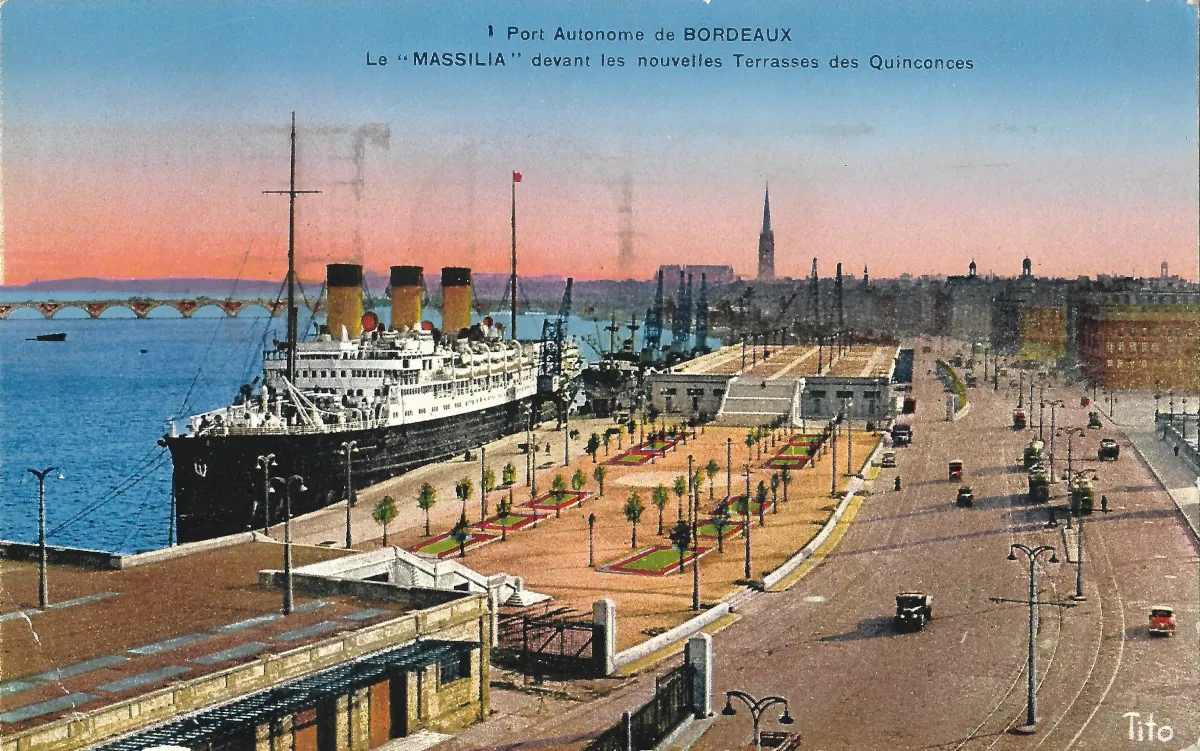
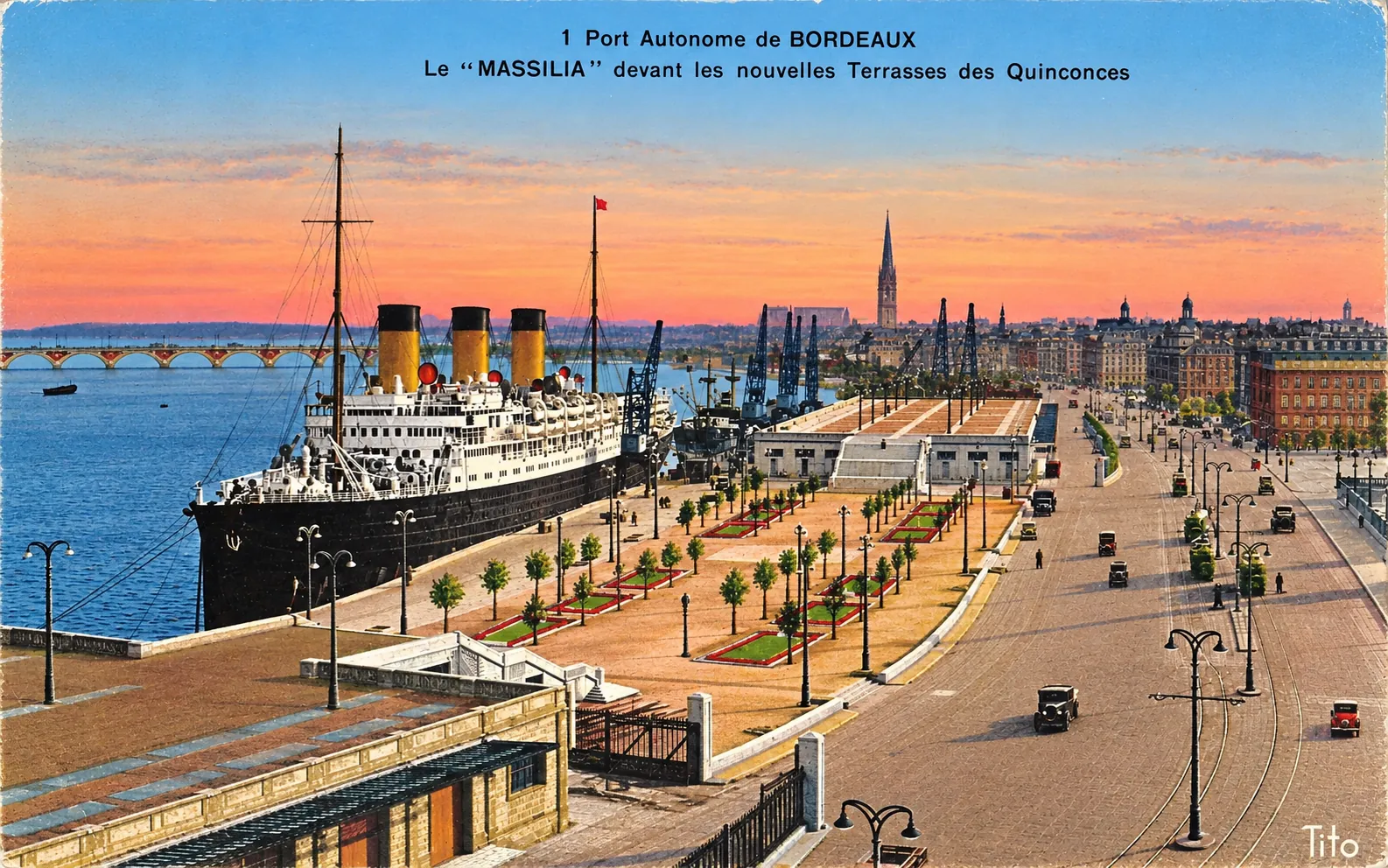
The Massilia liner in Bordeaux is shown moored on the left bank of the Garonne, directly in front of the newly landscaped Quinconces Terraces, in a remarkable panoramic view of the city’s riverfront. The printed caption identifies the scene precisely: “Port Autonome de BORDEAUX – Le ‘MASSILIA’ devant les nouvelles Terrasses des Quinconces”.
The liner dominates the foreground. Its dark hull, white superstructure and three tall funnels make it the unmistakable focal point of the postcard. The ship is berthed parallel to the quay, remarkably close to the historic centre of Bordeaux. Behind it stand several tall harbour cranes and large sheds, reminders that this stretch of riverfront was still a working port rather than the predominantly urban and leisure-oriented waterfront seen today.
Between the vessel and the main roadway are the “new Quinconces Terraces” highlighted in the postcard caption. They form a carefully designed landscaped area containing geometrically arranged paths, rows of young trees, rectangular flower beds and numerous ornamental street lamps. The terraces provide a striking visual transition between the industrial infrastructure of the harbour and the monumental city beyond.
The neighbouring Place des Quinconces is one of Bordeaux’s great nineteenth-century urban spaces. Covering around twelve hectares, it occupies land formerly associated with Château Trompette and opens directly towards the Garonne. Its layout and monumental features have long linked the city centre with the river.
To the right of the postcard is a broad riverside roadway carrying several motor cars characteristic of the interwar period. Rails embedded in the roadway are also clearly visible, reflecting the important role played by rail transport in the operation of Bordeaux’s quays. Decorative multi-armed street lamps and evenly spaced trees give the waterfront a surprisingly formal and carefully planned appearance.
Several major Bordeaux landmarks can be identified in the distance. On the left, the long arcaded structure crossing the Garonne is the Pont de Pierre, or Stone Bridge. Ordered during the Napoleonic period and opened in 1822, it provided Bordeaux with its first permanent bridge across the river and remained an essential connection between the historic city and the right bank.
Rising prominently above the roofs farther upstream is the Saint-Michel spire. Standing 114 metres high, the detached bell tower is one of the most distinctive landmarks on the Bordeaux skyline and remains visible from many points along the river.
The intense blue of the river, orange and pink sky, yellow funnels and vivid green and red flower beds show that the postcard was colourised rather than produced from a modern colour photograph. Such colour treatments were widely used to make black-and-white photographic views more attractive for postcard publication. The name “Tito” appears at the lower right of the image. Another surviving example of the same postcard identifies the publisher as Éditions Tito of Bordeaux.
The function of Bordeaux’s waterfront has changed considerably since this photograph was taken. Much of the heavy commercial traffic gradually moved to specialised terminals farther down the river and estuary, including Bassens, while the Bordeaux city-centre terminal is now primarily associated with cruise ships.
Historical description
A date of 26 January 1938 appears on the reverse of the postcard and provides a valuable chronological clue. It should not, however, automatically be regarded as the date when the photograph itself was taken. A handwritten date or postal cancellation usually indicates when a particular postcard was written or mailed, while the photographic image may have been produced several years earlier.
In this case, another surviving example showing exactly the same view and the same caption of the Massilia in front of the new Quinconces Terraces bears a Bordeaux postmark dated 22 April 1936. This confirms that the postcard was already in circulation by the spring of 1936. The photograph must therefore have been taken before, or at the latest around, that date. The copy dated 26 January 1938 shows that the postcard was still being used about two years later.
Taken together, these clues suggest that the photograph was most likely taken during the first half of the 1930s, probably around the middle of the decade, although a precise year cannot currently be established with certainty.
The wording “Port Autonome de Bordeaux” also fits this chronology. The Port of Bordeaux received its autonomous status in 1924, a centenary commemorated by the port authority in 2024. The postcard therefore belongs to a period when Bordeaux was modernising both its harbour infrastructure and the appearance of the central riverfront.
The Massilia was a major passenger liner operated by the Compagnie de navigation Sud-Atlantique, associated with services linking Bordeaux and South America. Its presence alongside the Quinconces illustrates an aspect of interwar Bordeaux that can seem extraordinary today: large ocean-going passenger ships could travel up the Gironde estuary and the Garonne before mooring directly beside the historic city centre.
The postcard consequently combines several different faces of Bordeaux in a single image. It shows a major international port, a city of monumental architecture and an increasingly modern urban centre. Harbour cranes and warehouses represent the commercial functions of the quays, while the landscaped terraces, street lighting and broad roadway demonstrate the effort being made to create an attractive urban setting alongside the working harbour.
The Massilia would become much more widely known only a few years after this photograph was taken. On 21 June 1940, during the military and political crisis in France, the liner left Bordeaux for North Africa carrying, among others, a group of French parliamentarians. French Ministry of the Armed Forces historical material records 27 parliamentarians aboard the vessel. That later episode should nevertheless be kept separate from the scene shown here: in the mid-1930s the Massilia was still being photographed primarily as an impressive ocean liner and as a symbol of Bordeaux’s international maritime connections.
The postcard is therefore valuable on several levels. It documents the appearance of Bordeaux’s central harbour in the 1930s, the relationship between the river and the Place des Quinconces, the presence of major passenger liners in the heart of the city and the modernisation of the riverfront. The 1938 date on your copy, combined with the independently documented example mailed in 1936, also allows this particular view to be placed within a relatively narrow historical period.