Noste Ouvergne – The Hunter and Two Auvergne Women
Geographic description
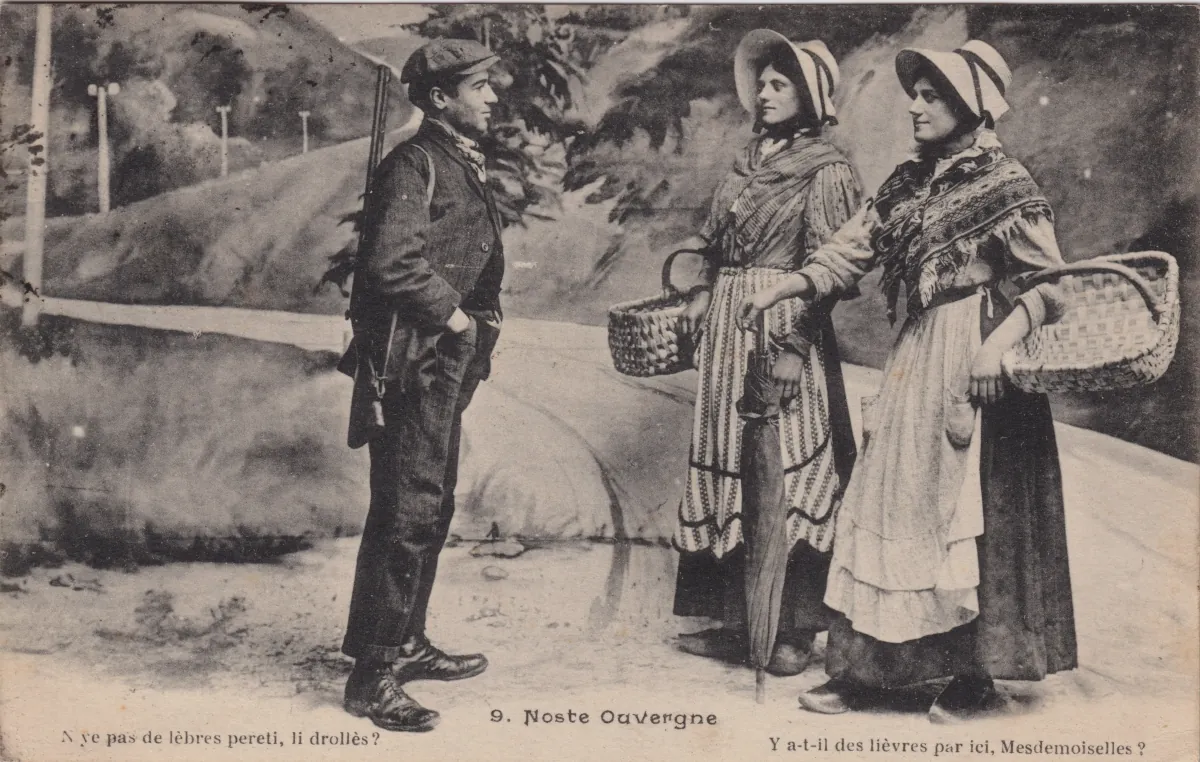
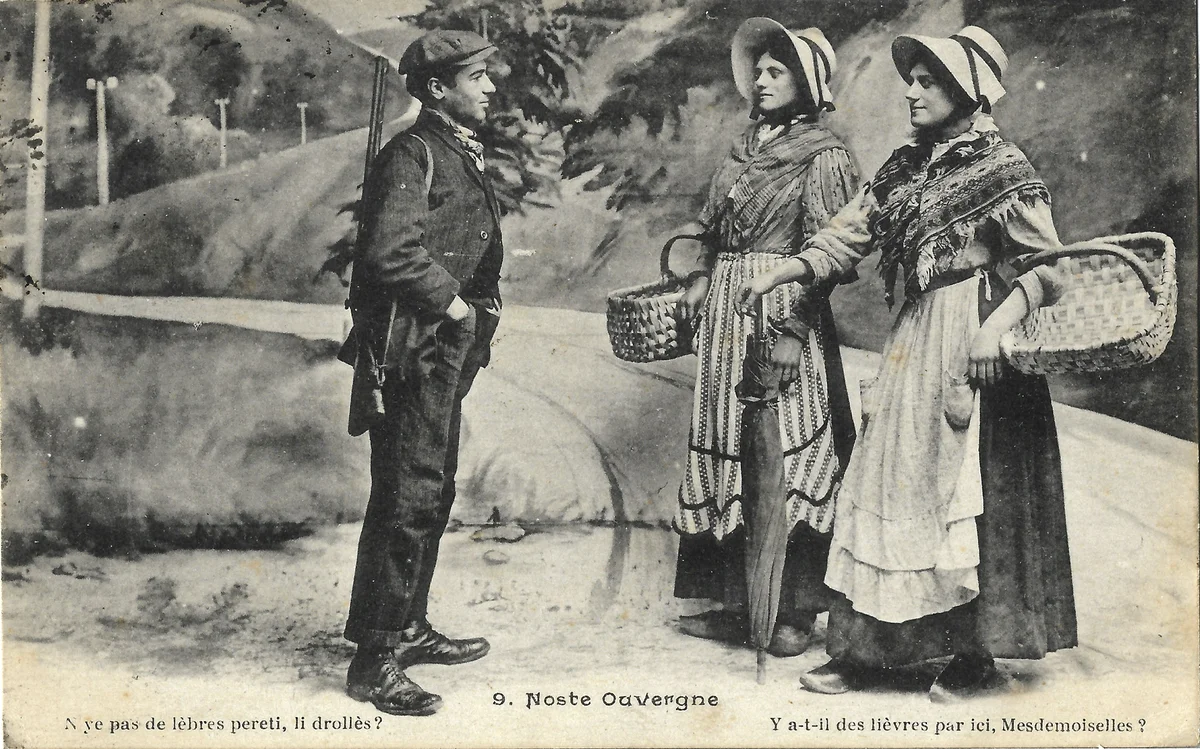
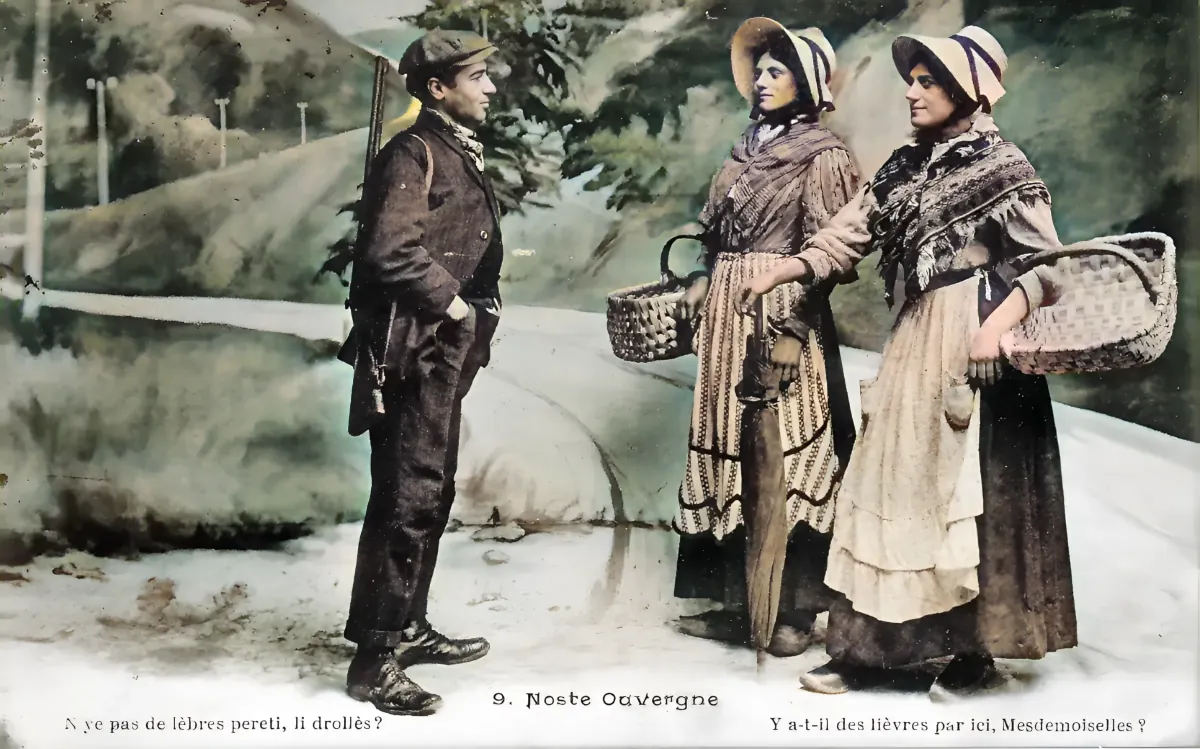
The Noste Ouvergne postcard depicts a rural encounter between a young hunter and two women dressed in traditional Auvergne clothing. Unlike postcards showing a clearly recognizable town, street, church or monument, this photograph contains no reliable landmark allowing the scene to be assigned to a particular village or commune. It is therefore best understood as a folkloric representation of rural Auvergne rather than as a precise topographical view.
The two women stand beside a country road. Both wear long dresses or skirts with aprons, large patterned shawls over their shoulders and light-coloured traditional headdresses framing their faces. Each woman carries a wicker basket. Such accessories were commonly used in postcard imagery to suggest journeys to market, domestic work or agricultural life, although the exact purpose of the baskets cannot be established from the photograph alone.
Their clothing is one of the principal subjects of the picture. Striped fabrics, broad shawls and the contrasting headdresses have been arranged so that the regional costume is immediately visible to the viewer. The scene therefore appears designed as much to display local dress as to tell a story.
Facing them is a young man wearing dark trousers, a jacket and a cap. He carries a hunting gun, together with what appears to be additional hunting equipment or a bag attached at his side. His relaxed pose, with one hand apparently resting in a pocket, creates the impression of a chance conversation while he is out hunting.
The printed caption explains the situation. At the bottom of the card is the series title and number, “9 – Noste Ouvergne”. A sentence written in regional speech is accompanied by a standard French version: “Y a-t-il des lièvres par ici, Mesdemoiselles ?”, meaning “Are there any hares around here, ladies?” The humour of the postcard therefore comes from the hunter asking the two women where he might find game.
The surrounding landscape is deliberately unobtrusive. A gently rising road, an embankment, trees and several posts can be seen in the background, but there is no distinctive church tower, building, mountain profile or other feature from which a location could safely be identified. The background also appears considerably softer than the figures, suggesting a carefully staged and possibly retouched composition rather than a documentary street photograph.
A specialist postcard database records this exact design, including its number and wording, as part of the Noste Ouvergne series. The database places it under Clermont-Ferrand and the Puy-de-Dôme, but this catalogue classification should not be treated as proof that the photograph itself was taken in Clermont-Ferrand.
Historical description
This postcard clearly belongs to a wider regional folklore series called Noste Ouvergne. Other surviving cards bearing the same title depict traditional costumes, agricultural activities, haymaking, journeys to town and humorous scenes involving rural characters. Geneanet, for example, records a card entitled Noste Ouvergne – La fanaison, while auction and collector catalogues document further cards from the same series.
The photograph should consequently not be regarded simply as an unposed record of everyday rural life. The deliberate arrangement of the three figures, the conspicuous traditional costumes, the baskets and the humorous dialogue all suggest a staged folklore scene produced specifically for the postcard market.
Such images were designed to make French regions instantly recognizable. Regional dress, occupations, landscapes and local speech could all be condensed into a single photograph and sold both to visitors and to people interested in the picturesque traditions of provincial France.
Language is especially important here. Alongside the image, the publisher prints a sentence in regional speech and then provides its meaning in standard French. Even where the exact spelling of the dialect text is difficult to establish from the print, there is no ambiguity about the intended joke because the publisher supplies the French sentence asking whether there are any hares nearby.
The title Noste Ouvergne itself reinforces this regional identity, evoking the idea of “our Auvergne” through deliberately local wording. Another documented card in the sequence, numbered 10, also involves a hunter and a short humorous exchange, indicating that the publisher created a succession of small narrative scenes rather than isolated costume portraits.
No exact publication date is visible on the front of this example. Its photographic appearance, typography, composition and particularly the popularity of regional folklore postcard series are nevertheless consistent with the early twentieth century, probably somewhere around 1905-1915. This remains an approximate dating rather than a documented year.
Collector listings also associate some Noste Ouvergne cards with Terrasson of Limoges. This may indicate the publisher or producer of at least part of the series, but the attribution cannot safely be applied to this particular card because no publisher’s name is visible on the front shown here.
The historical value of the postcard therefore lies less in documenting a specific road or village than in illustrating how Auvergne was represented to the wider public in the postcard age. Traditional female dress, hunting, rural scenery, regional speech and light-hearted humour are combined to create a deliberately picturesque image of early twentieth-century Auvergne.