Mâcon – Hôtel Senecé and Its Historic Courtyard
Geographic description
The Hôtel Senecé in Mâcon is an outstanding 18th-century private mansion located in the historic centre of Mâcon, in the Saône-et-Loire department of today’s Bourgogne-Franche-Comté region. Mâcon stands on the western bank of the River Saône in southern Burgundy, close to the neighbouring Ain department and on the historic north-south route connecting the Lyon area with Burgundy.
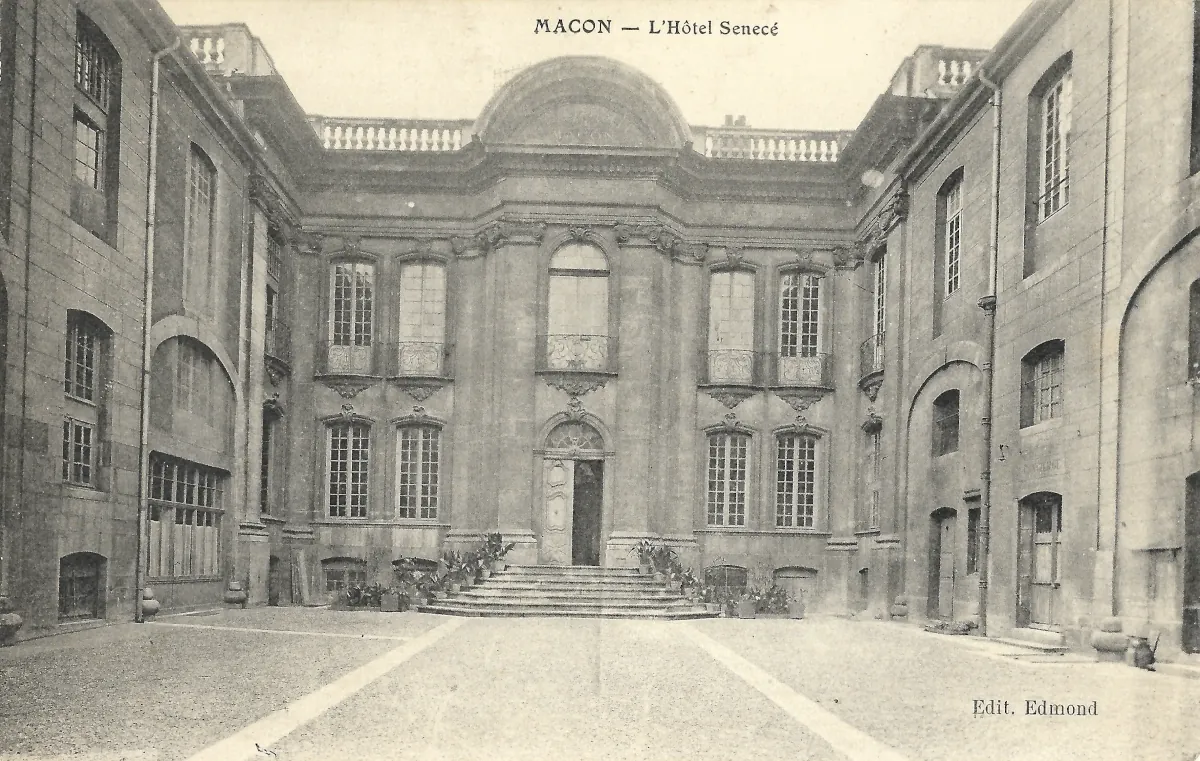
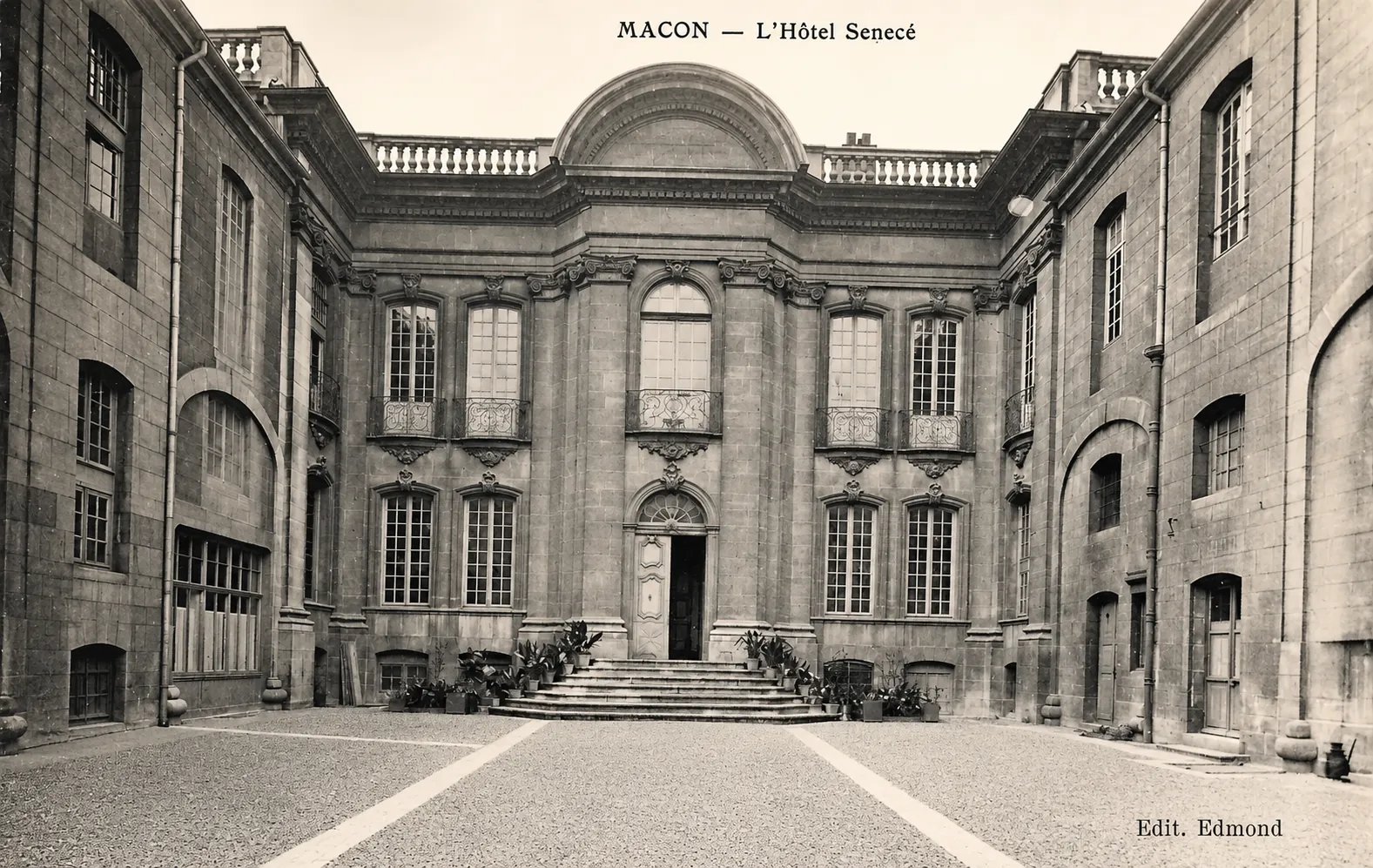
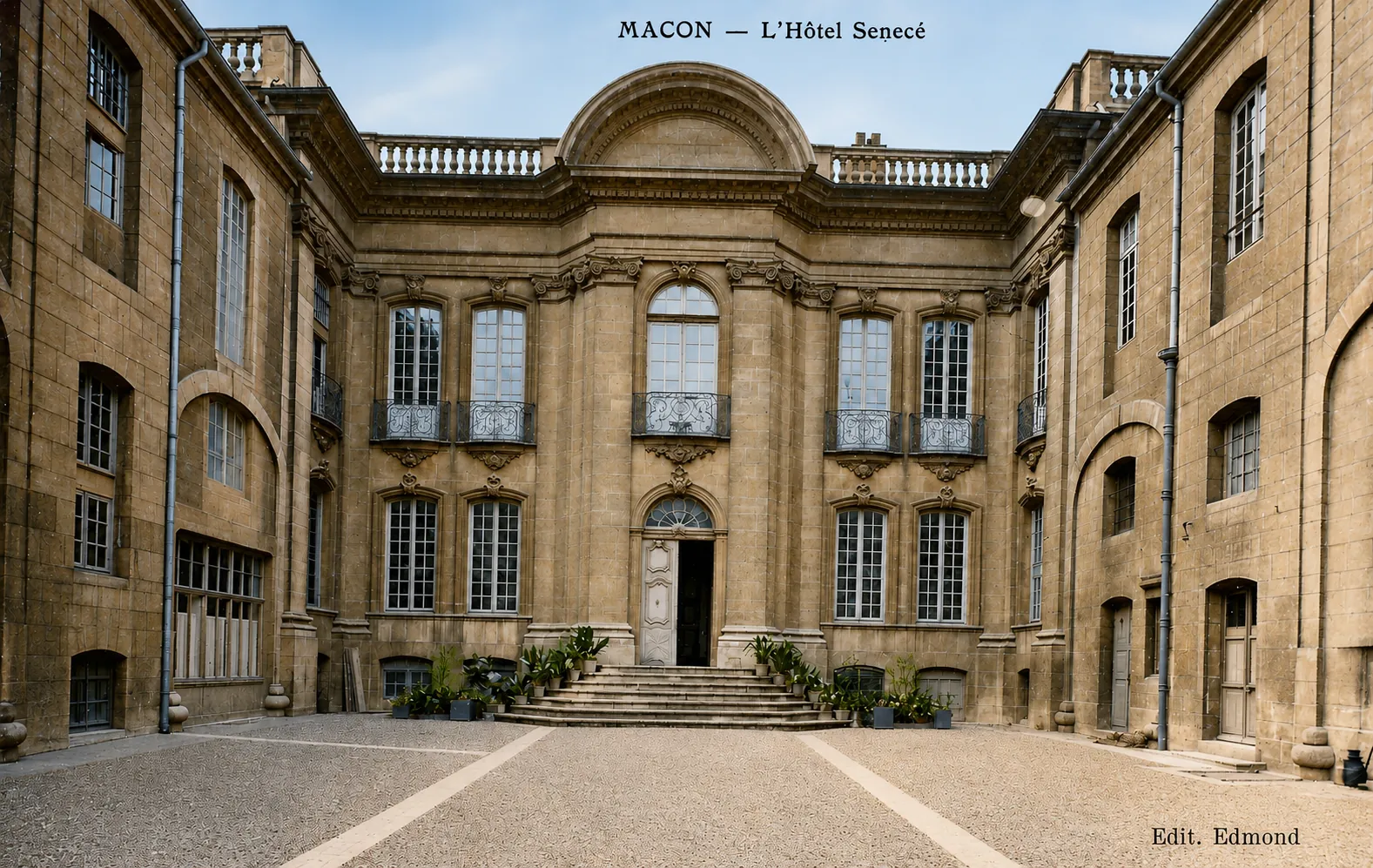
This vintage postcard shows the mansion from its inner courtyard, rather than from the street. The photographer positioned the camera almost directly opposite the main residential block, creating a strongly symmetrical composition. Two side wings frame the courtyard and lead the eye towards the more elaborate central façade. This arrangement is characteristic of prestigious French town houses designed around a formal courtyard.
A broad flight of shallow steps gives access to the main entrance in the centre of the photograph. Above the doorway is an ornamental architectural surround, while the windows on both principal levels are arranged with considerable regularity. Several first-floor windows have decorative iron balconies or railings. Pilasters, cornices and mouldings divide the façade vertically and emphasise its carefully ordered design.
The centre of the building is crowned by a prominent curved architectural feature rising above the otherwise horizontal rooftop balustrade. It gives the central section additional visual importance and reinforces the ceremonial character of the main residence. By contrast, the two wings on either side are noticeably plainer. Their doors and smaller openings reflect the more practical functions traditionally accommodated in the secondary sections of a large urban residence.
A number of potted plants can be seen near the steps and along the front of the mansion. They provide almost the only vegetation in what is otherwise a largely mineral courtyard, apparently surfaced with gravel. There are no vehicles and virtually no people in view, giving the postcard an unusually peaceful atmosphere and allowing the architecture itself to dominate the composition.
The Hôtel Senecé still stands in central Mâcon on rue Sigorgne. It has belonged to the Académie de Mâcon since 1896 and remains the institution’s headquarters. Its historic interiors include reception rooms, a library and former domestic areas associated with the everyday operation of the mansion.
The general arrangement visible on the postcard can therefore still be understood today. The image is especially interesting because it provides more than a conventional view of a local monument: by looking directly into the courtyard, it reveals how an important 18th-century French town house was organised around a formal enclosed space.
Historical description
The Hôtel Senecé in Mâcon was built during the 18th century for the Delaporte de Marnay family. According to the Académie de Mâcon, construction took place in two main stages. The central block was built between approximately 1710 and 1720, while the two wings followed between 1748 and 1755. This phased construction helps explain the contrast between the prestigious central façade and the more restrained architecture of the surrounding wings.
The name “Senecé” was acquired later. The property passed through inheritance to relatives connected with the Senecé family. In 1803, Jean Étienne Claude Bernard de Senecé became sole owner. According to the Académie de Mâcon, he had the courtyard enclosed and a semicircular arch erected above its entrance gate. From this period onward, the property became known as the Hôtel Senecé.
Another important stage in the history of the building came in 1896, when the Académie des Sciences, Arts et Belles-Lettres de Mâcon purchased the mansion. The learned society, whose origins date to the early 19th century, established its headquarters there and continues to occupy the building today.
The postcard itself appears to belong to the great period of French picture-postcard publishing in the early 20th century. However, there is no visible date or postal cancellation on the front, so an exact year cannot be established from the image alone. The monochrome photographic printing, typography and overall presentation are consistent with a postcard produced during the first quarter of the 20th century, perhaps around 1900-1920. This should be regarded as an approximate dating rather than a confirmed date.
The printed caption at the top reads “MACON — L’Hôtel Senecé”, clearly identifying both the town and the building. In the lower right-hand corner is the imprint “Edit. Edmond”. This establishes that the card was issued by a publisher or publishing concern using the name Edmond. Other Mâcon postcards bearing the same imprint are known, but the sources consulted do not provide sufficiently reliable evidence to identify the publisher more precisely or to establish exact dates of activity. It would therefore be unsafe to attach a fuller identity to the name.
The historic importance of the building was subsequently formally recognised. France’s official POP heritage database records the Hôtel Senecé, including the ground of its courtyard, as a protected Monument historique, classified by decree on 22 November 1962.
The postcard therefore has value on two levels. It records the appearance of one of Mâcon’s most significant aristocratic residences during the early decades of the 20th century, while also illustrating how postcard publishers presented local architectural heritage to travellers, residents and collectors. With no crowds, traffic or incidental street activity, the photographer deliberately treated the building itself as the subject. The resulting image is almost an architectural portrait, carefully framing the courtyard, side wings and elegant main façade of the Hôtel Senecé.