Nancy – Jean Lamour’s Ornamental Gates at Place Stanislas
Geographic description
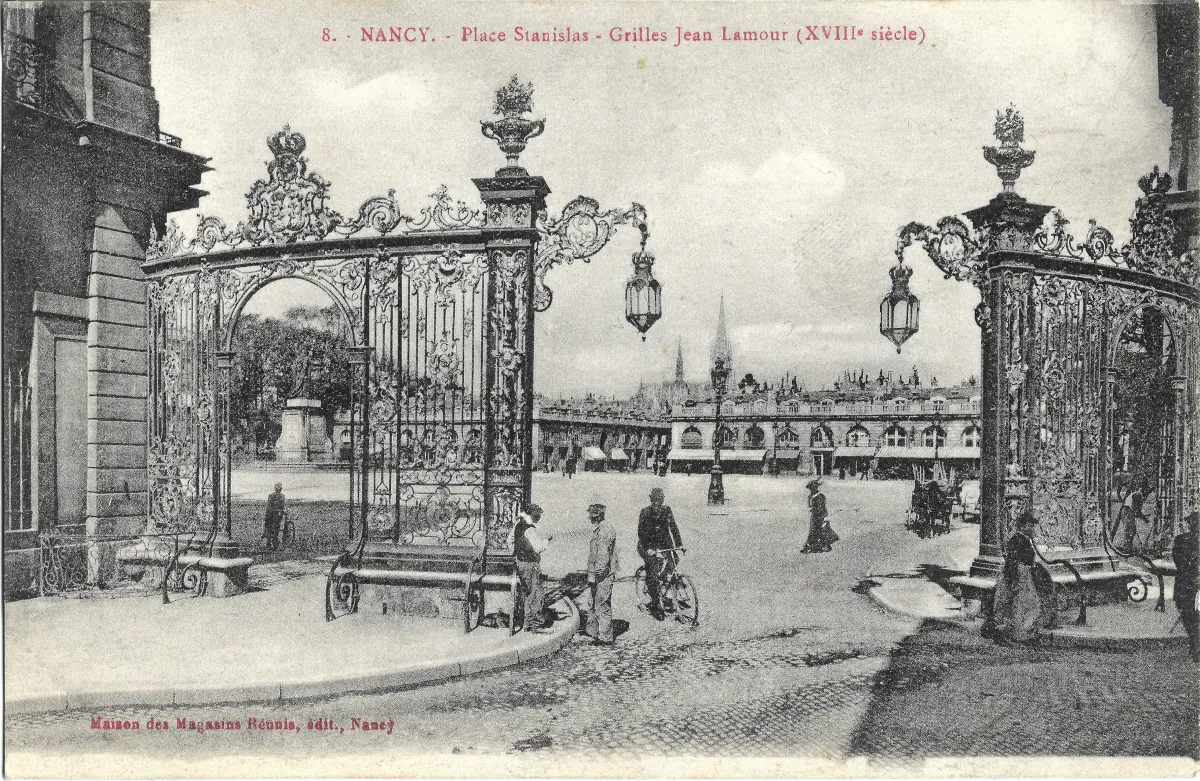
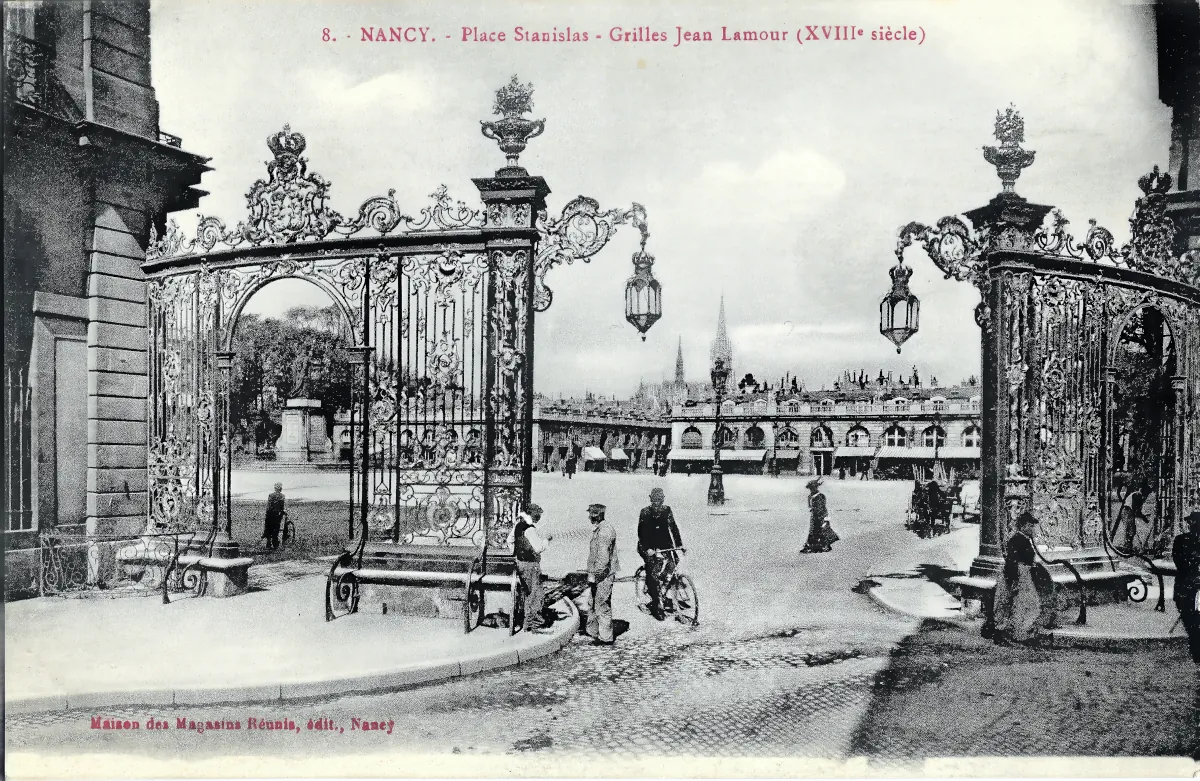
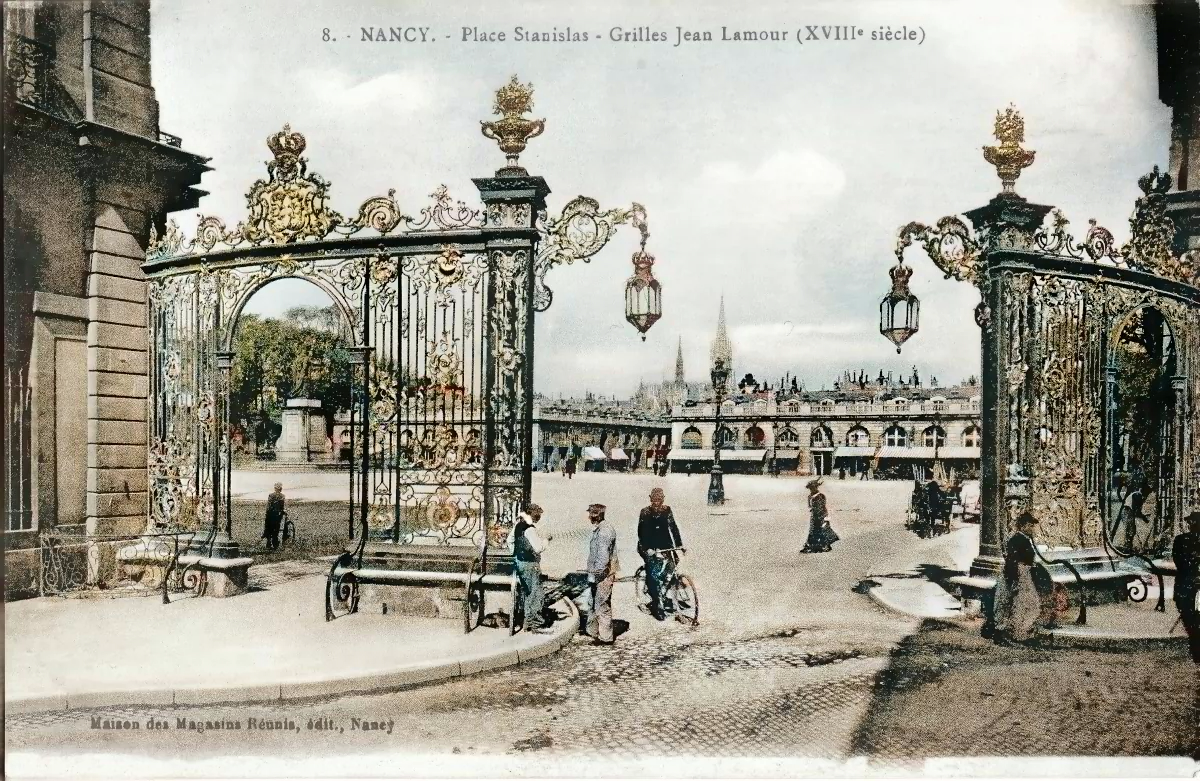
The Jean Lamour gates in Nancy are among the most distinctive architectural features of Place Stanislas, a magnificent eighteenth-century square in the historic centre of Nancy, in the Meurthe-et-Moselle department of northeastern France. This vintage postcard offers a detailed view of the elaborate wrought-iron structures that contribute to the square’s exceptional architectural character.
In the foreground, two monumental sections of wrought-iron railings dominate the composition. Their intricate decoration features sweeping curves, floral patterns, ornamental scrollwork and carefully arranged symmetrical designs. Tall iron pillars crowned with decorative urns give the structures an imposing vertical presence, while two suspended lanterns provide additional examples of the craftsmanship associated with the French Rococo style.
Between the gates, a broad opening reveals the expansive interior of Place Stanislas. Beyond the entrance, an open square stretches towards a series of elegant buildings whose regular façades and arcaded ground floors reflect the principles of classical French architecture.
The buildings surrounding the square form a remarkably harmonious ensemble. Their carefully coordinated proportions, architectural details and alignments create the sense of unity that has made Place Stanislas one of France’s most celebrated urban landmarks.
The postcard also preserves several interesting details of everyday life in Nancy during the early twentieth century. Pedestrians can be seen crossing the open space, while men with bicycles stand near the entrance. On the right, a horse-drawn vehicle appears close to the surrounding buildings.
The cobbled roadway in the foreground provides another glimpse of the city’s historic streetscape. Together, the bicycles, pedestrians and traditional transport convey the atmosphere of a busy urban centre at a time when modern forms of mobility were gradually becoming more common.
The imposing gates serve both an architectural and an urban purpose. Their decorative ironwork defines the boundaries of the square without completely separating it from the surrounding streets, maintaining visual connections between the monumental space and the city beyond.
Place Stanislas occupies a particularly important position within Nancy’s historic layout. It was designed to connect the medieval Old Town, centred around the former ducal palace, with the more regularly planned New Town developed during the Renaissance.
Along with Place de la Carrière and Place d’Alliance, it forms a celebrated group of eighteenth-century urban spaces. These three squares were collectively inscribed on the UNESCO World Heritage List in 1983 in recognition of their outstanding architectural and historical significance.
Historical description
The history of the Jean Lamour gates is closely associated with Stanislas Leszczynski (1677–1766), the former King of Poland who became Duke of Lorraine in 1737.
During the eighteenth century, Stanislas undertook an ambitious programme to modernise and embellish Nancy. One of his most important projects was the creation of a monumental royal square dedicated to his son-in-law, King Louis XV of France.
The design was entrusted to Emmanuel Héré, the architect responsible for coordinating the buildings and public spaces that would transform the centre of Nancy.
Construction began in 1752, and the square was officially inaugurated on 26 November 1755. Its creation was both a statement of royal prestige and a practical urban improvement, establishing a more coherent connection between the city’s two historic districts.
Among the artists and craftsmen commissioned to decorate the new square was Jean Lamour (1698–1771), a master ironworker from Nancy whose extraordinary skill helped establish the city’s reputation for decorative metalwork.
Lamour created the monumental wrought-iron gates that embellish the square’s entrances and corners. Their intricate designs combine technical precision with the expressive movement characteristic of eighteenth-century Rococo decoration.
Floral motifs, elaborate scrolls, sculptural ornaments and carefully balanced compositions transform the iron structures into works of art. Their gilded elements were designed to catch the light and provide a striking contrast with the pale stone façades surrounding the square.
Jean Lamour also contributed the decorative ironwork associated with the monumental fountains of Neptune and Amphitrite, whose sculptures were created by Barthélemy Guibal. Together, these elements demonstrate the close cooperation between architecture, sculpture and craftsmanship in the original design.
Although the postcard’s printed caption identifies the gates as eighteenth-century works, the photograph itself belongs to a much later period.
The clothing worn by the pedestrians, the bicycles visible near the entrance and the general photographic characteristics suggest that the image was probably taken during the early twentieth century, possibly between 1900 and 1920. This remains an approximate dating rather than a confirmed year.
An additional clue appears in the publisher’s imprint at the bottom of the postcard: “Maison des Magasins Réunis, édit., Nancy”.
The Magasins Réunis were a prominent department-store business founded in Nancy and closely associated with the Corbin family. During the late nineteenth and early twentieth centuries, the company became an important part of the city’s commercial development.
The production and distribution of illustrated postcards provided an effective means of promoting local landmarks and presenting Nancy’s architectural heritage to visitors and collectors.
This particular image is especially interesting because it combines a close view of one of the city’s greatest artistic treasures with an informal record of everyday urban activity. The monumental gates remain the principal subject, but the pedestrians and bicycles introduce a human dimension absent from purely architectural photographs.
Place Stanislas has undergone several restoration campaigns since the photograph was taken. A major renovation completed in 2005 restored important architectural features, improved the paving and transformed the entire square into a pedestrian area.
Today, the Jean Lamour gates remain enduring symbols of Nancy’s artistic heritage. Their remarkable workmanship reflects the achievements of Lorraine’s eighteenth-century craftsmen and the cultural ambitions of Stanislas Leszczynski.
Preserved as part of a UNESCO World Heritage Site, these magnificent iron structures continue to represent one of the finest surviving examples of French decorative metalwork from the Age of Enlightenment.