Bordeaux – The Allées de Tourny and Their Fountain
Geographic description
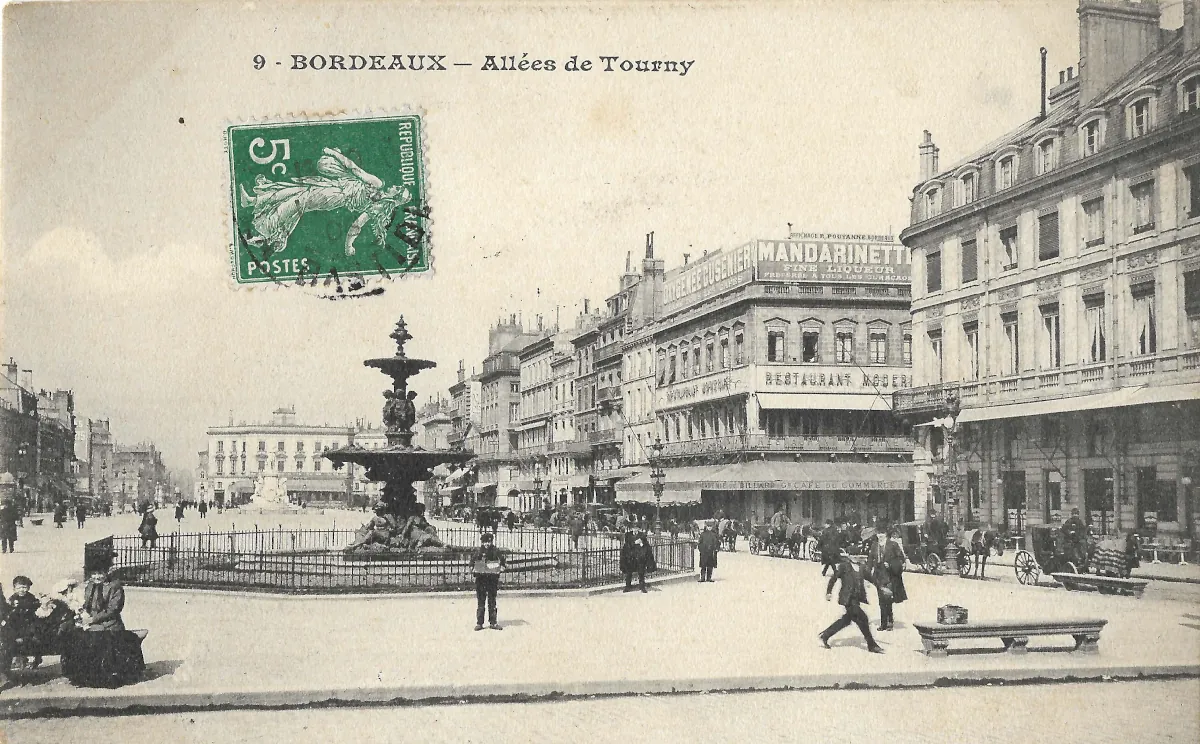
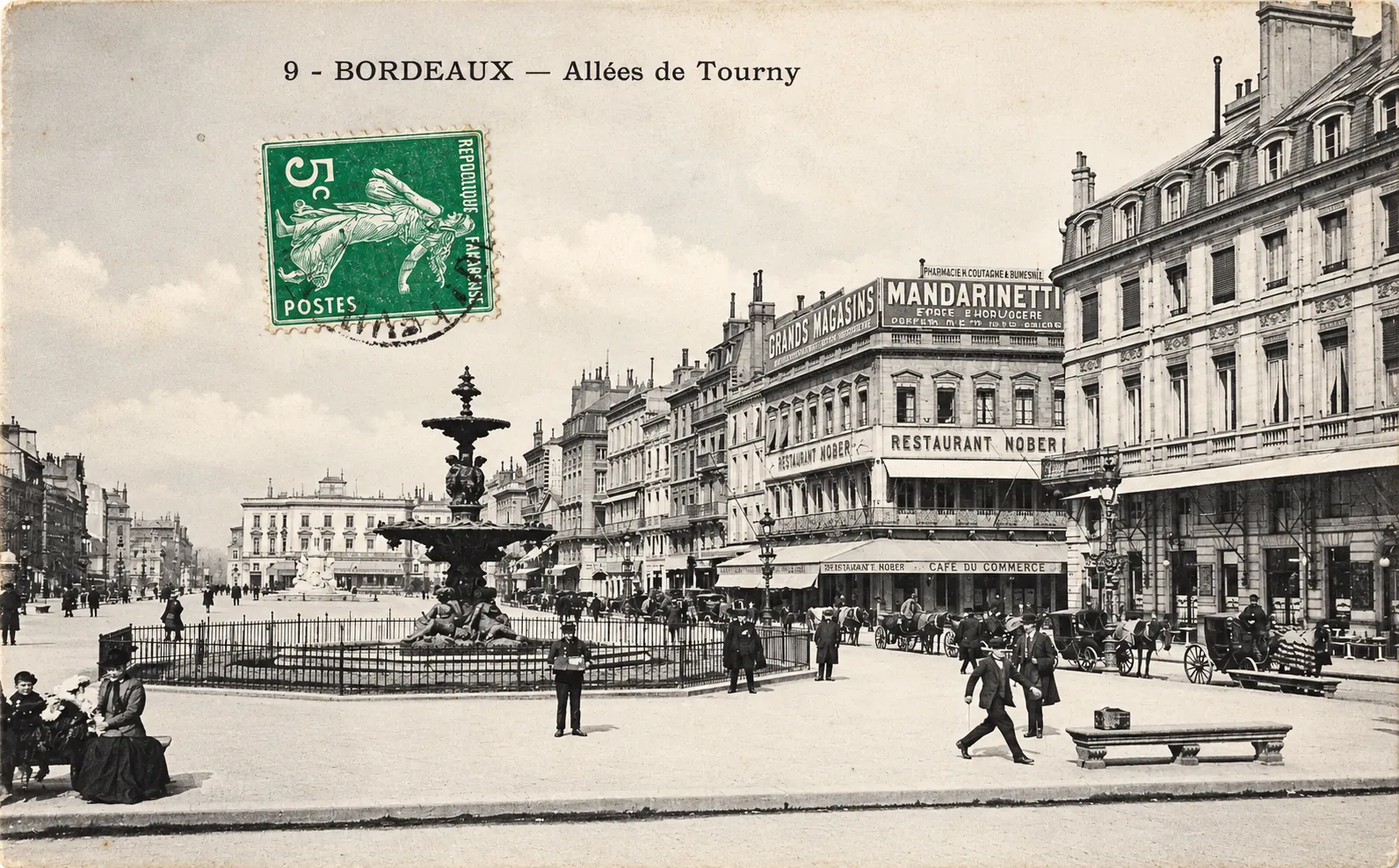
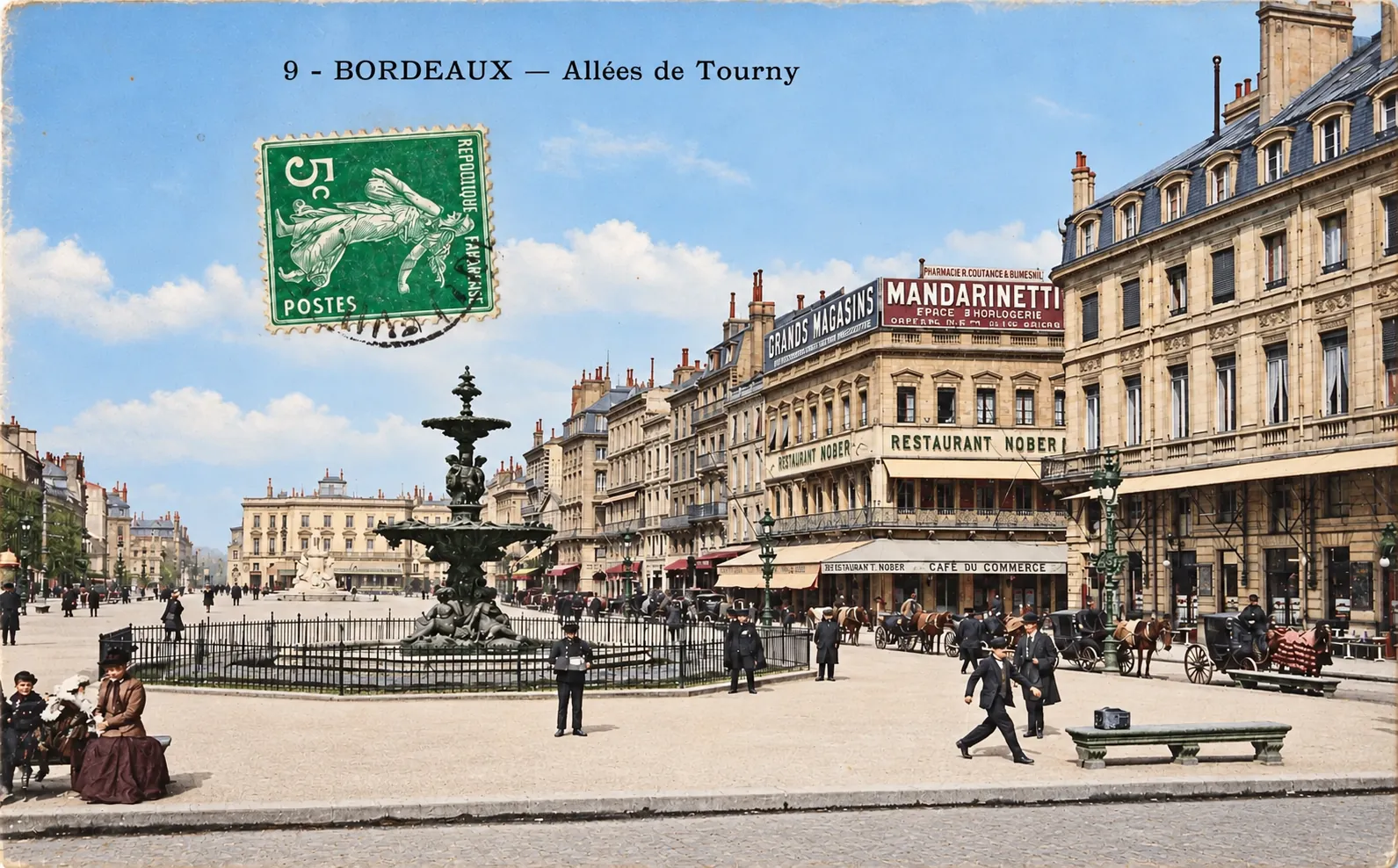
The Bordeaux Allées de Tourny are shown here as a broad and lively urban promenade lined with imposing stone buildings, cafés and restaurants. The printed caption, “9 – BORDEAUX – Allées de Tourny,” clearly identifies one of the best-known thoroughfares in the historic centre of Bordeaux.
A wide open esplanade dominates the scene. In the foreground stands an elaborate cast-iron fountain surrounded by low railings. Its superimposed basins and sculpted figures identify it as one of the two former Tourny fountains that once marked the ends of the avenue and formed a distinctive feature of the Bordeaux cityscape.
The Allées de Tourny connect the area around Place de la Comédie, close to the Grand Théâtre, with Place Tourny. They now form part of the central district commonly known as Bordeaux’s “Golden Triangle”. Their origins date back to the eighteenth century and to the major urban improvements undertaken by Louis-Urbain Aubert de Tourny, Intendant of Guyenne. Bordeaux’s tourist office dates the creation of the promenade to 1747 and notes the eighteenth-century character of many of the façades lining it.
The postcard provides a particularly clear view of the architecture along one side of the avenue. A continuous row of pale stone buildings rises on the right, with regularly spaced windows, wrought-iron balconies and steep roofs punctuated by dormers. Although many of these buildings were altered or enlarged over time, several structures along the Allées still retain portions of the original eighteenth-century architectural scheme. French heritage records confirm that surviving buildings preserve elements of the design established when Tourny’s new promenade was laid out.
The ground floors are occupied by businesses closely associated with a busy city-centre boulevard. The words “Café du Commerce” can be read prominently in the centre of the photograph, while another establishment advertises itself as a restaurant. Above them, large commercial signs cover the upper façades and rooftops. Their scale is striking and illustrates the importance of advertising in the commercial streetscape of the early twentieth century.
Human activity is equally prominent. Numerous pedestrians stroll across the open space or sit on benches, while several horse-drawn vehicles wait or move along the roadway. The absence of dense modern planting and the broad gravelled or paved central area create a very different appearance from the present-day Allées de Tourny. Historical documentation produced by Bordeaux Métropole describes the nineteenth-century promenade as a broad gravel esplanade framed by roads and marked at its ends by the two monumental fountains.
The postcard is therefore valuable not only as a view of a famous Bordeaux avenue but also as a record of everyday urban life: cafés opening directly onto the promenade, horse-drawn transport, public benches, advertising signs and well-dressed pedestrians all coexist within a monumental eighteenth-century setting.
Historical description
This Bordeaux Allées de Tourny postcard most probably dates from the early decades of the twentieth century. Horse-drawn traffic, clothing, commercial signage and the general style of the postcard all support such a chronology. An additional clue is provided by the postage stamp attached to the front.
The stamp is a French 5-centime green Semeuse camée, based on Oscar Roty’s famous Sower design. This particular dark-green 5-centime denomination was issued on 5 March 1907 and remained in postal use until 1921. It therefore provides a useful date range for the mailing of this particular card, although it does not necessarily establish the precise date on which the original photograph was taken.
The visual character of the street scene is consistent with a date in the years before the First World War or the early 1910s. A more precise date cannot safely be established from the front alone because the cancellation over the stamp is not sufficiently legible.
The fountain provides one of the strongest historical links between the postcard and the changing appearance of Bordeaux. Its design was created in 1853 by French sculptor Mathurin Moreau and produced by the celebrated Val d’Osne art foundry. A version displayed at the Paris Universal Exhibition of 1855 attracted the attention of Bordeaux officials, and two examples were subsequently acquired and installed at opposite ends of the Allées de Tourny in 1857.
For approximately a century, these fountains were prominent landmarks of the avenue. Both were dismantled in 1960, in connection with major alterations to the site and the construction of underground parking facilities. One eventually found a new home at Soulac-sur-Mer. The other followed a far more remarkable route: after passing through private hands and being rediscovered in France, it was restored and presented to Québec City. Today it stands in front of Quebec’s National Assembly. The City of Québec records its original Bordeaux location and its presence on the Allées de Tourny from 1857 until 1960.
The postcard therefore records a Bordeaux streetscape that no longer survives in this form. The monumental fountain, open esplanade, horse-drawn vehicles and large commercial advertisements belong to a phase in the city’s history when the Allées de Tourny combined the functions of promenade, transport route and fashionable commercial district.
Behind this early twentieth-century activity lies an older urban structure inherited from the eighteenth century. Tourny’s redevelopment of the area transformed the surroundings of the former Château Trompette and helped create the ordered façades and long urban perspectives that became characteristic of central Bordeaux. The postcard captures a moment when that eighteenth-century framework was still clearly visible but had been filled with the commercial signs, cafés and everyday movement of a modernising city.