Bordeaux – Place de la Comédie and the Allées de Tourny
Geographic description
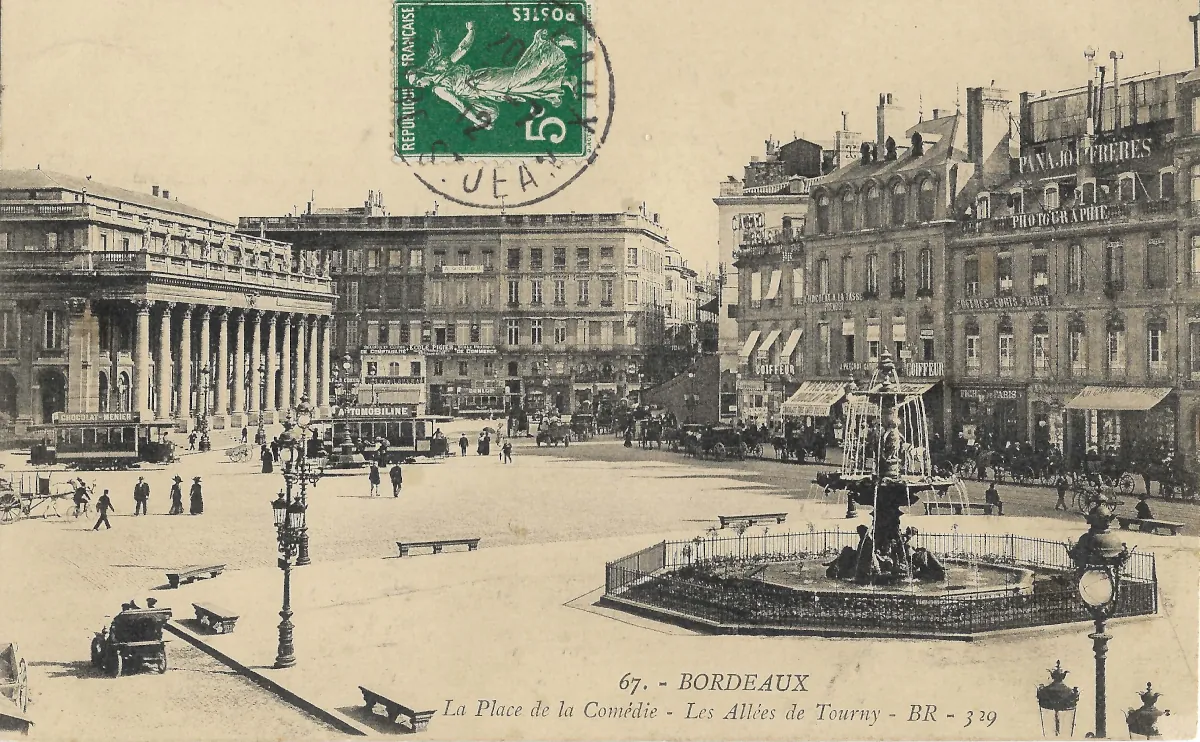
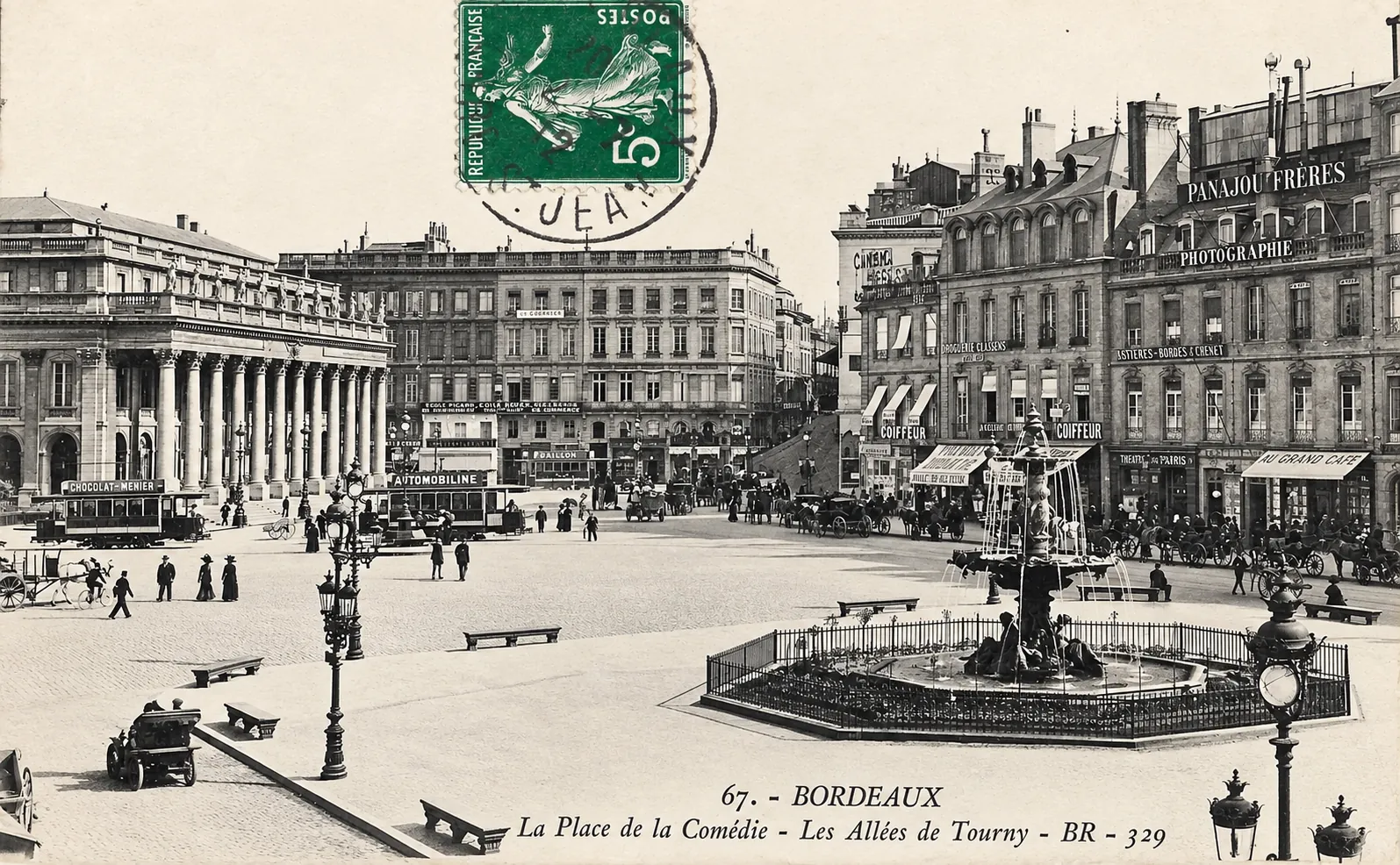
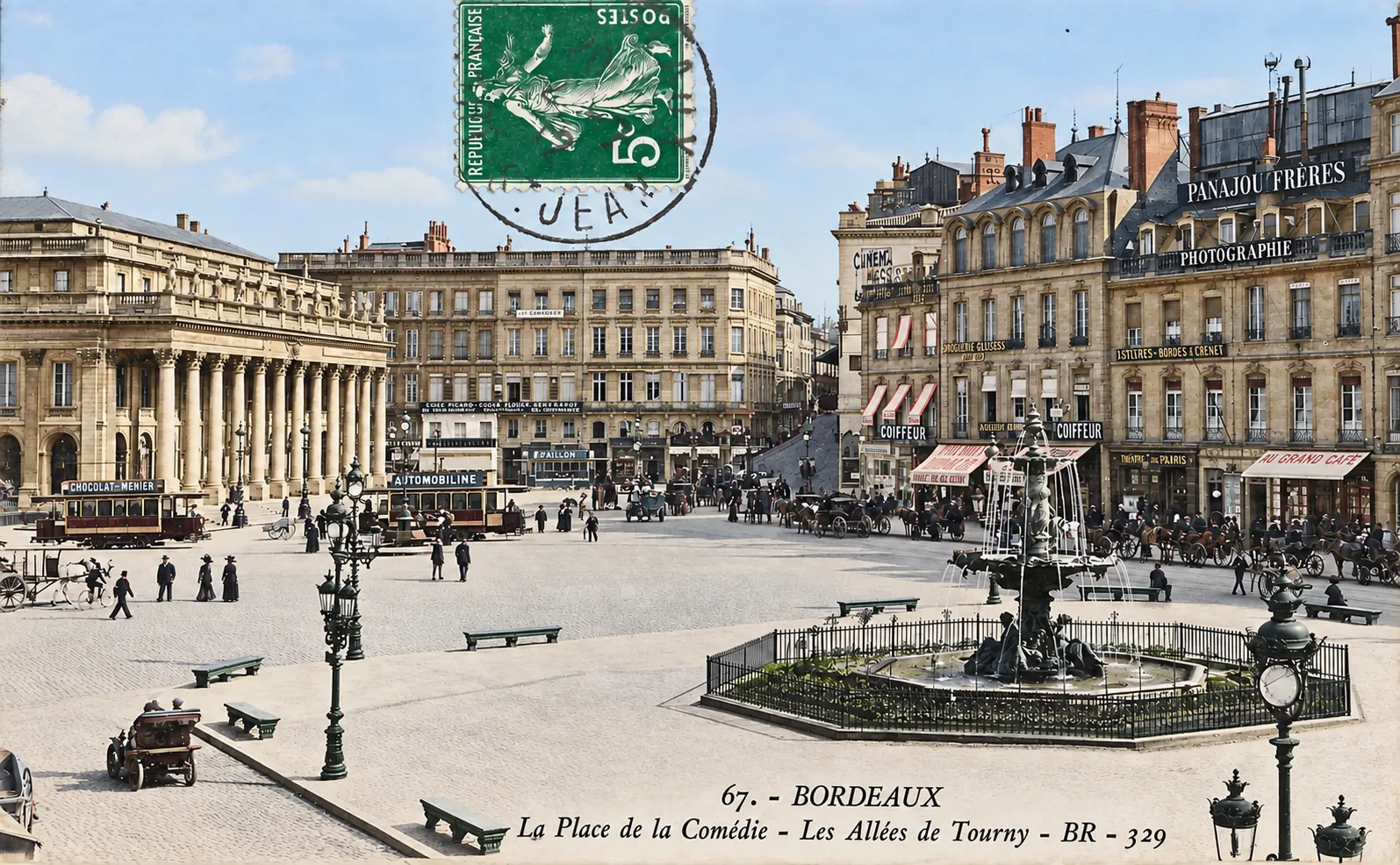
Place de la Comédie in Bordeaux is shown here in a remarkably lively view looking towards the Allées de Tourny, in the historic centre of the city. The printed caption at the bottom of the postcard clearly identifies the scene as “BORDEAUX – La Place de la Comédie – Les Allées de Tourny”. Today, the area remains part of Bordeaux’s central district, close to the Place des Quinconces and the Garonne riverfront. The Allées de Tourny link Place de la Comédie with Place Tourny and remain one of the city’s major ceremonial avenues.
On the left stands the unmistakable Grand Théâtre de Bordeaux, with its monumental Neoclassical façade and imposing colonnade. Designed by architect Victor Louis, construction began in 1773 and the theatre officially opened on 7 April 1780. The building was listed as a French Historic Monument in 1899 and has retained much of its original architectural appearance.
The postcard also gives an excellent impression of the square’s former role as a major transport junction. Two tramcars can be seen close to the theatre, while several horse-drawn vehicles occupy the right-hand side and background. Pedestrians cross the broad open space between them. Traffic appears considerably less regulated than in a modern city centre, with people, public transport and horse-drawn vehicles sharing the same urban environment.
Period street furniture adds considerable interest to the scene. Ornamental lamp posts rise above the square, benches are positioned across the open area and iron railings surround several landscaped features. The overall impression is of a spacious urban square that served simultaneously as a transport hub, promenade and prestigious civic setting.
The most striking feature in the right foreground is one of the former Tourny fountains. Two monumental fountains of this type were installed at opposite ends of the Allées de Tourny in 1857. Cast in iron and based on a design associated with sculptor Mathurin Moreau, they were produced by the renowned Val d’Osne art foundry. Both remained in Bordeaux until 1960, when they were removed during major redevelopment work, including construction connected with underground parking.
The fountain seen on this postcard therefore no longer stands in Bordeaux. One of the two former Tourny fountains was subsequently installed at Soulac-sur-Mer. The other changed ownership several times before being acquired and restored in the early twenty-first century and presented to the city of Quebec, where it now stands prominently in front of the Quebec Parliament Building.
To the right, a continuous row of stone façades forms the eastern side of the urban space. Their ground floors are occupied by numerous shops and businesses. Several signs referring to hairdressers can be distinguished, while a large Chocolat Menier advertisement appears on one of the tramcars. The word “AUTOMOBILINE” is also prominently displayed on another advertising panel, reflecting the growing visibility of motoring-related products in early twentieth-century commercial culture.
The postcard consequently records both continuity and change. The monumental framework formed by the Grand Théâtre and Bordeaux’s eighteenth- and nineteenth-century stone architecture remains recognisable, but the fountain, early trams, horse-drawn traffic and much of the street furniture belong to a cityscape that has disappeared.
Historical description
The postcard most probably dates from the opening years of the twentieth century, with the late 1900s or early 1910s providing the most plausible general timeframe. Several clues support this estimate, although none allows the photograph itself to be dated to a precise year.
One particularly useful clue is the green 5-centime Semeuse camée postage stamp attached to the picture side. The French Postal Museum’s documentation records the Semeuse camée issues of 1907, including the 5-centime denomination. Its presence therefore places the postal use of this particular card within or after that general period. The cancellation visible over the stamp is unfortunately too indistinct to provide a secure date.
A second clue is the printed reference “BR – 329” at the bottom of the postcard. Research into Bordeaux postcard publishing identifies the initials B.R. with Bloc Frères, a Bordeaux-based postcard publisher. A study drawing on municipal archives and local trade directories states that the Bloc brothers established their publishing company in 1909 and officially registered the B.R. trademark on 27 October of that year.
This information should nevertheless be treated with some chronological caution. Surviving copies of BR-329 have occasionally been catalogued with very early postal dates, suggesting either that the initials may have been used before formal trademark registration or that some catalogue dates require further verification. For this reason, assigning the postcard to a single exact year would be unjustified. A working range of approximately 1907-1912 is more appropriate for the scene and the early circulation of this design.
The forms of transport shown in the photograph are fully consistent with that period. Electric tramways had become a major component of urban transport, while horse-drawn carriages and carts remained common. Their coexistence is one of the most characteristic visual features of European cities during the years immediately before the First World War.
The fountain provides a broader chronological landmark. Bordeaux’s two Tourny fountains had stood on the avenue since 1857 and remained there until 1960, so the fountain alone cannot precisely date the photograph. Its presence is nevertheless valuable because it records the nineteenth-century ornamental layout of the Allées de Tourny before the major alterations of the twentieth century.
The Grand Théâtre was already more than a century old when the photograph was taken. Since its inauguration in 1780, it had become one of Bordeaux’s principal architectural and cultural landmarks. Place de la Comédie and the neighbouring Allées de Tourny developed into a prestigious central district combining theatres, hotels, cafés, shops and urban promenades.
The historical value of this postcard therefore lies not simply in its view of a famous monument, but in the everyday urban details surrounding it. Trams, horse-drawn vehicles, pedestrians, advertisements, shopfronts, decorative lamps and the Tourny fountain together preserve the atmosphere of central Bordeaux during the Belle Époque. The buildings provide continuity with the modern city, while the street scene reveals how profoundly the use of the square has changed since the early twentieth century.