Roebling Wire Mills in Trenton, c. 1906–1910
Geographic description
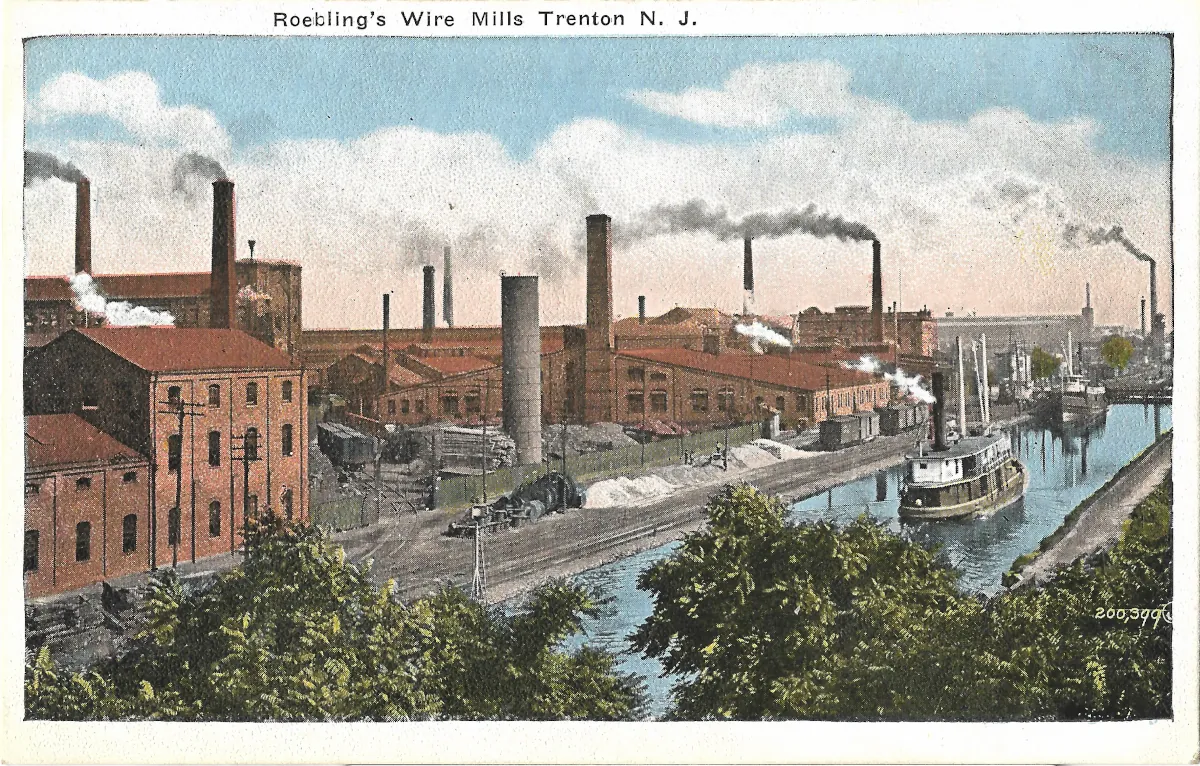
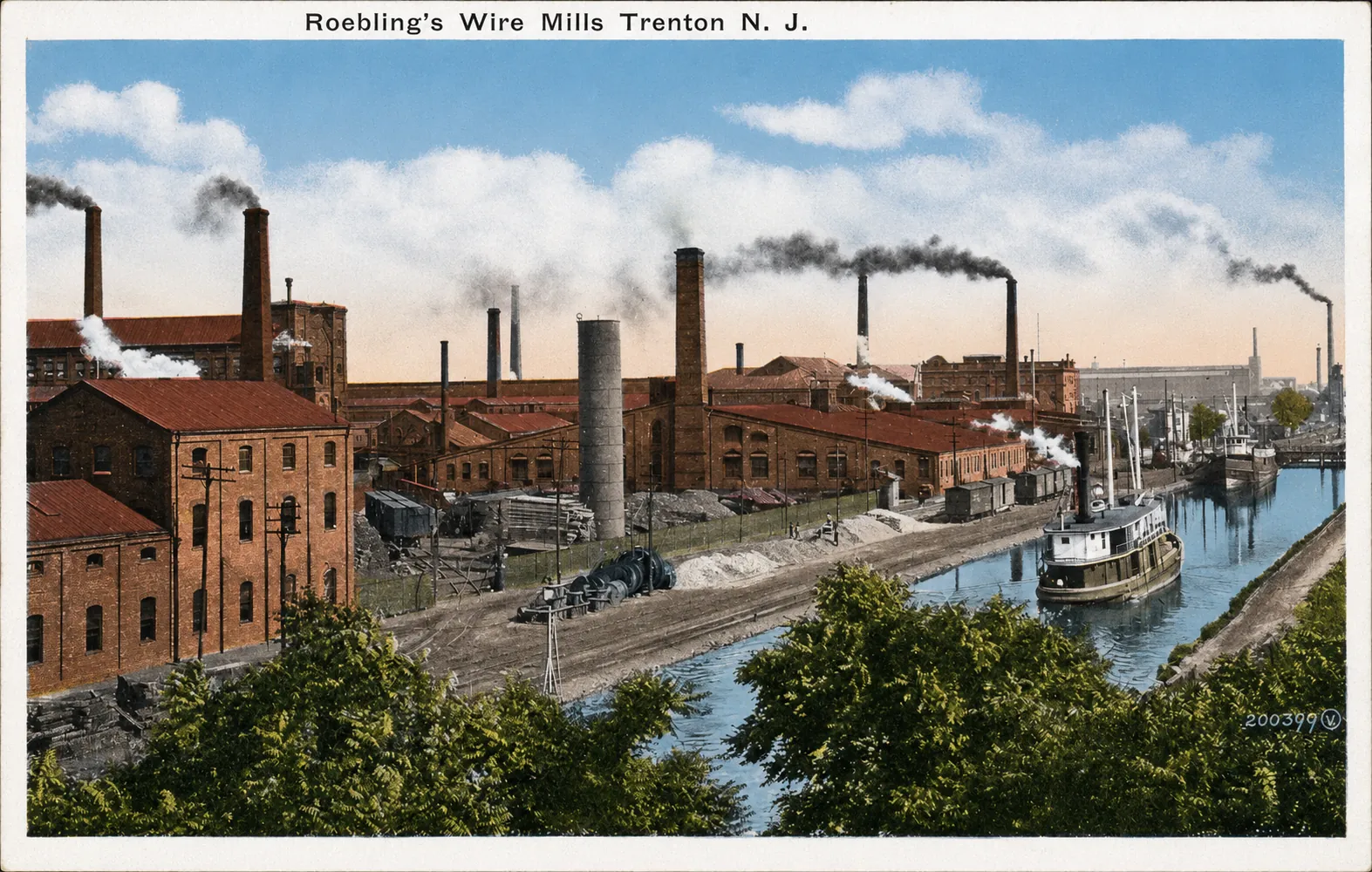
Roebling Wire Mills Trenton is shown here as a sprawling industrial landscape beside the Delaware & Raritan Canal in the southern part of Trenton, New Jersey. The printed caption at the top of the postcard, “Roebling’s Wire Mills Trenton N. J.,” identifies the location directly. Historical documentation confirms that John A. Roebling’s industrial works occupied a site in the Chambersburg section of Trenton, alongside the canal and extending through an area associated with South Broad, Clark, Elmer, Mott and Hudson Streets.
The postcard provides an unusually informative view of the physical arrangement of an early twentieth-century American industrial complex. The canal dominates the right side of the scene, running almost straight toward the distant background. A small steam-powered vessel can be seen on the water, equipped with a tall smokestack and central cabin. Its exact function cannot be established from the postcard alone, but its presence demonstrates that the waterway remained part of the active industrial landscape when the photograph was made.
Between the canal and the factory buildings are several railroad tracks, together with a number of freight cars. Water transport, rail transportation and manufacturing facilities therefore appear side by side within a very narrow corridor. This combination was one of the practical advantages of the Roebling location. The Historic American Engineering Record confirms that John A. Roebling deliberately acquired property along the Delaware & Raritan Canal when establishing his Trenton wire-rope works.
Across the left and central portions of the postcard stands a dense collection of red-brick workshops and manufacturing buildings. Most are relatively low structures with long pitched roofs. This appearance is consistent with the older portions of the Roebling complex. City documentation notes that buildings erected there before 1915 typically employed masonry load-bearing walls and gable roofs, sometimes incorporating roof structures designed to admit additional daylight into the workshops.
The dominant visual feature, however, is the remarkable number of smokestacks. Tall brick and metal chimneys rise above almost every part of the complex, several of them releasing substantial clouds of dark or pale smoke. Rather than hiding these emissions, the postcard artist or colorist preserved and emphasized them. In the visual culture of the industrial era, busy smokestacks could suggest employment, production and economic vitality, making the functioning factory itself an appropriate subject for a souvenir postcard.
Rail cars can also be distinguished along the industrial waterfront, while piles of what appear to be bulk materials occupy open areas between the tracks and the workshops. Their precise contents cannot be identified confidently from this image. Trees fill much of the foreground, creating an unexpected contrast between the greenery and the intensely developed industrial area immediately beyond it.
The photograph appears to have been taken from an elevated position overlooking the canal and the works. The exact camera location remains uncertain because no unmistakable viewpoint landmark survives within the postcard itself.
The area has changed dramatically since this view was produced. The canal is no longer visible in this form through the former industrial district; part of its historic right-of-way was subsequently used for New Jersey Route 129. Important portions of the Roebling industrial heritage have nevertheless survived, and former factory buildings have been preserved, adapted or included in redevelopment projects. The City of Trenton continues to pursue rehabilitation work within the historic Roebling Wire Works area.
Historical description
The history behind Roebling Wire Mills Trenton reaches back to 1848, when engineer John Augustus Roebling acquired approximately twenty-five acres beside the Delaware & Raritan Canal in Chambersburg, now part of Trenton. Here he expanded the manufacture of iron and steel wire rope based on techniques he had developed for engineering and suspension structures. Roebling designed both industrial machinery and parts of the factory itself. After his death in 1869, control passed to his sons Washington, Ferdinand and Charles, who greatly expanded the company.
Roebling wire rope became closely associated with the rapid development of suspension bridges, but the company’s output went far beyond bridge construction. Historical Engineering Record documentation lists applications including shipping, mining, elevators, cable cars, street railways, electrical transmission, construction equipment and numerous other industrial uses. By World War I, the Trenton operation had become the world’s largest wire-rope plant, reflecting the extraordinary expansion of American infrastructure during the late nineteenth and early twentieth centuries.
An important distinction is necessary when identifying this postcard. The scene is not the later Roebling steel works located farther south along the Delaware River. As the original Trenton plant expanded, limitations of space and the company’s dependence on outside steel suppliers encouraged the Roebling family to create a much larger integrated steel and wire facility at Kinkora beginning in 1904. The settlement eventually became known as Roebling, New Jersey. The postcard caption specifically states “Trenton N. J.,” so the image represents the older Trenton works along the canal rather than the Kinkora/Roebling plant.
A particularly useful clue for dating the postcard appears in the lower-right corner, where the number 200,390 is printed. Valentine & Sons used numbers in the 200,000 range for its United States postcard series. The number therefore strongly suggests that this view was issued by Valentine & Sons Publishing Co., although the attribution should remain classified as probable unless a publisher’s imprint on the reverse confirms it.
The history of the publisher helps narrow the date considerably. Valentine & Sons extended its operations into the United States in 1906, establishing a separate publishing company and a New York office. Contemporary company history records that its American postcard business initially flourished but was curtailed by tariff changes around 1910, after which the American branch was closed.
Taken together, the visible series number, printing style and documented publishing history make approximately 1906-1910 a reasonable dating range for this postcard. This remains an informed estimate rather than an exact date.
The postcard therefore captures the Trenton works at a particularly significant moment. The original industrial complex was still operating at high intensity, while the Roebling company was simultaneously developing its newer integrated steel operation farther south. The smoking chimneys, railway freight cars, canal traffic and closely packed brick workshops visually express the scale of industrial production that made the Roebling name internationally important.
Today the image has acquired an additional documentary value. What was once presented as a modern scene of industrial progress has become evidence of a largely vanished industrial environment. It records not only one famous company but also an era when canals, railroads, steam power and heavy manufacturing were physically concentrated within the same urban landscape, making the postcard an especially valuable record of Trenton’s industrial history.