Antique Postcard Trenton NJ: Calhoun Street Bridge
Geographic description:
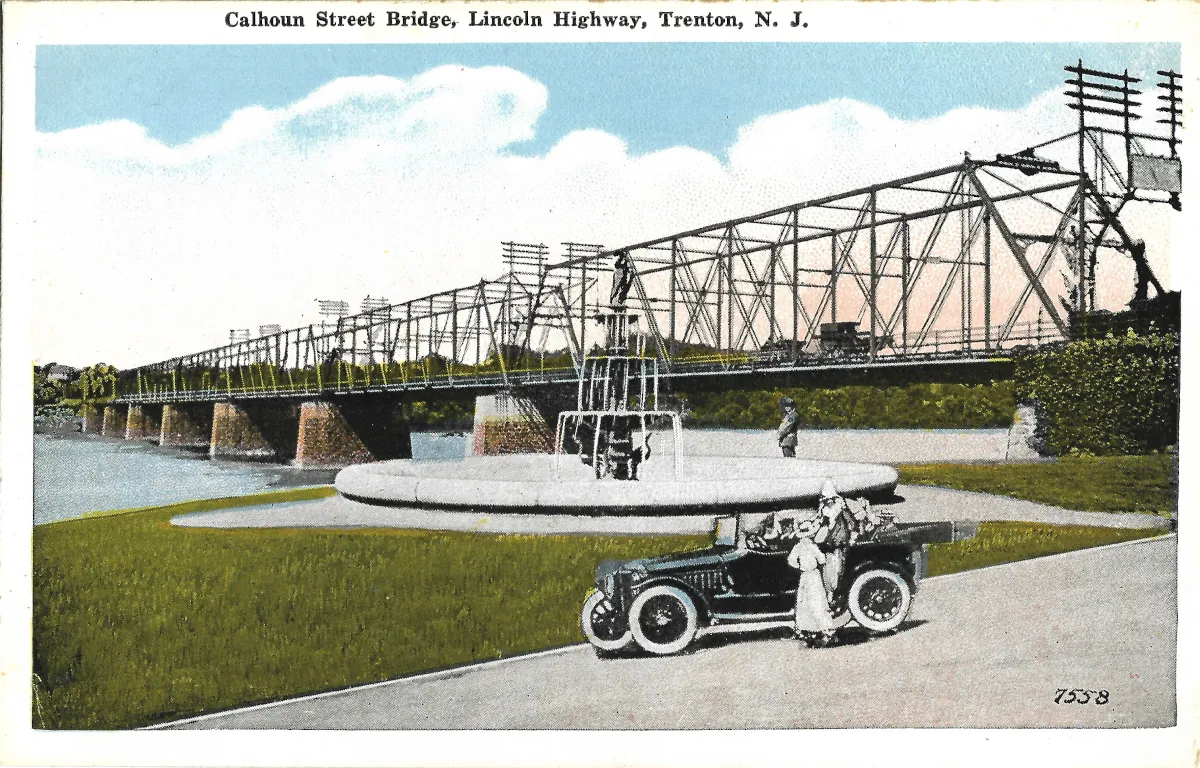
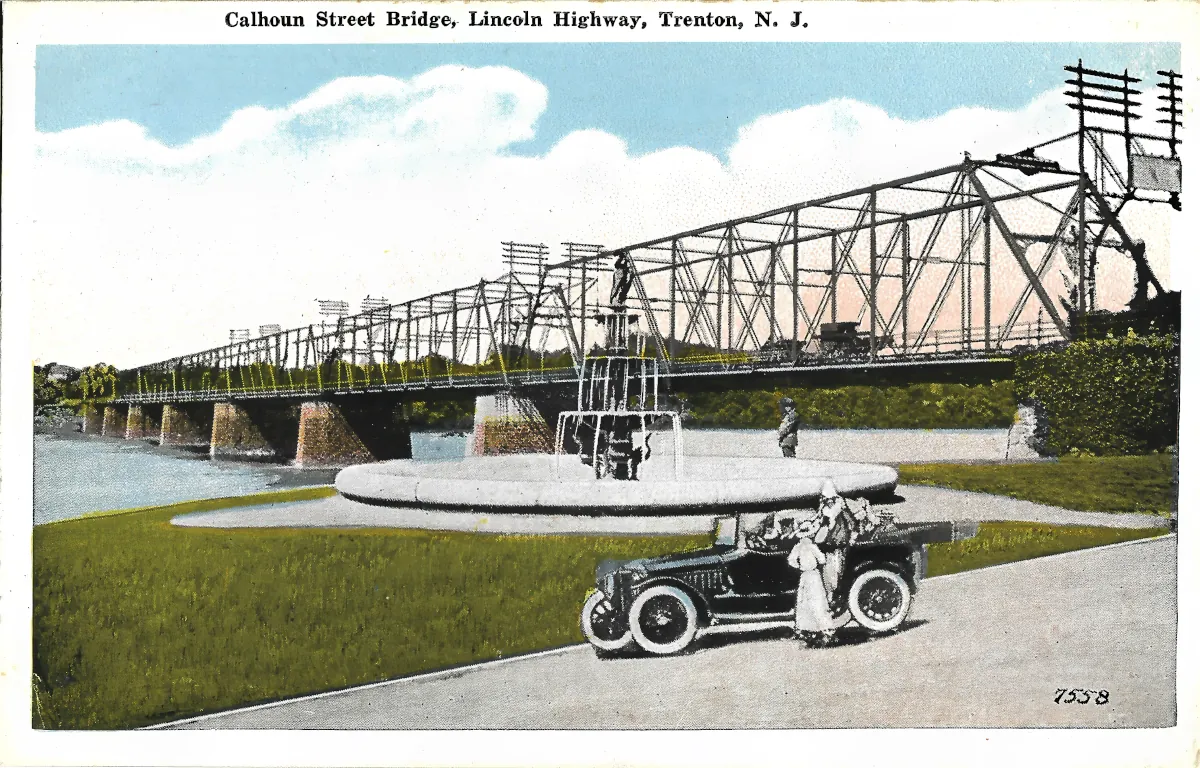
This antique postcard Trenton NJ depicts the Calhoun Street Bridge spanning the Delaware River, an iron truss structure identified by the printed caption at the top of the card: “Calhoun Street Bridge, Lincoln Highway, Trenton, N. J.” The bridge, shown running the full width of the image, consists of a long series of riveted metal truss spans resting on masonry piers that reach down to the waterline; its slender, repetitive structure, typical of American steel road bridges from the late nineteenth and early twentieth centuries, crosses the river toward Morrisville, Pennsylvania, on the opposite bank. At the right end of the bridge, on the Pennsylvania side, a cluster of utility poles and what appear to be electrical or telephone pylons rises above the roadway, suggesting the presence of a trolley line or an electrical installation linked to traffic crossing the span.
In the foreground, the card shows a landscaped riverside park, with a manicured lawn and a paved walkway. An ornamental fountain occupies the center of the composition: it consists of a raised circular basin and a set of tiered upper basins topped by a statue, whose details are difficult to identify with certainty given the small scale of the element within the overall image. This fountain appears consistent with the kind of riverside square or public garden that was in fact developed along the Delaware waterfront in Trenton in the early twentieth century, though it cannot be confirmed with certainty that this is the same space, in the absence of any direct point of comparison on the card itself.
In the middle distance, an open touring automobile is parked along the walkway, with several passengers dressed for travel: the women wear long coats and hats characteristic of early-1920s motoring fashion, while a pedestrian stands near the fountain basin. The combination of the automobile, the bridge, and the landscaped setting places the scene within the kind of urban promenade commonly depicted on American tourist postcards of this period.
Historical description:
Several clues support a reasoned dating of this antique postcard Trenton NJ. The white border surrounding the image, combined with the hand-tinted color applied over what was originally a black-and-white photograph, corresponds to the so-called “White Border” era of American postcard publishing, broadly dated between 1915 and roughly 1930. The edition number “7558” visible in the lower right corner of the card is a publisher’s catalog reference, but the publisher’s identity itself remains undetermined: no company name appears on the front of the card, and confirming it would require examining the reverse side, which is not available here.
The caption, which explicitly links the Calhoun Street Bridge to the Lincoln Highway, provides an additional and significant dating clue. The Lincoln Highway, the first transcontinental road route in the United States, was formally dedicated on October 31, 1913. The Calhoun Street Bridge itself, built in 1884 by the Phoenix Bridge Company, carried the Lincoln Highway route from its inception until around 1919-1920, when the official alignment was shifted to the toll-free Lower Trenton Bridge farther south. The explicit reference to the Lincoln Highway on this card therefore suggests a printing date prior to that change of route, narrowing the plausible dating window to approximately 1913-1920, consistent with the white-border printing style noted above.
The touring car shown in the foreground, an open automobile with wire-spoke wheels and white-sidewall tires, along with the passengers’ clothing, is consistent with this chronological range, though these details alone cannot narrow the dating further: this general body style was produced by several American manufacturers throughout the 1910s and into the early 1920s.
The absence of a visible reverse side for this card is a significant methodological limitation: it removes any direct postal dating evidence, such as a cancellation postmark, an affixed stamp, or a handwritten message, that could have confirmed or refined the proposed period. As it stands, the dating suggested here — roughly 1913 to 1920, and more likely toward the later part of that range given the printing style — remains a hypothesis based on the convergence of visual and documentary evidence, not an established certainty. Further verification through Trenton municipal archives or postcard-collecting databases specializing in early twentieth-century American publishing could help confirm the publisher’s identity and refine the exact date of this printing.