A Bourbonnais Farm Woman in a Rural Farmyard
Geographic description
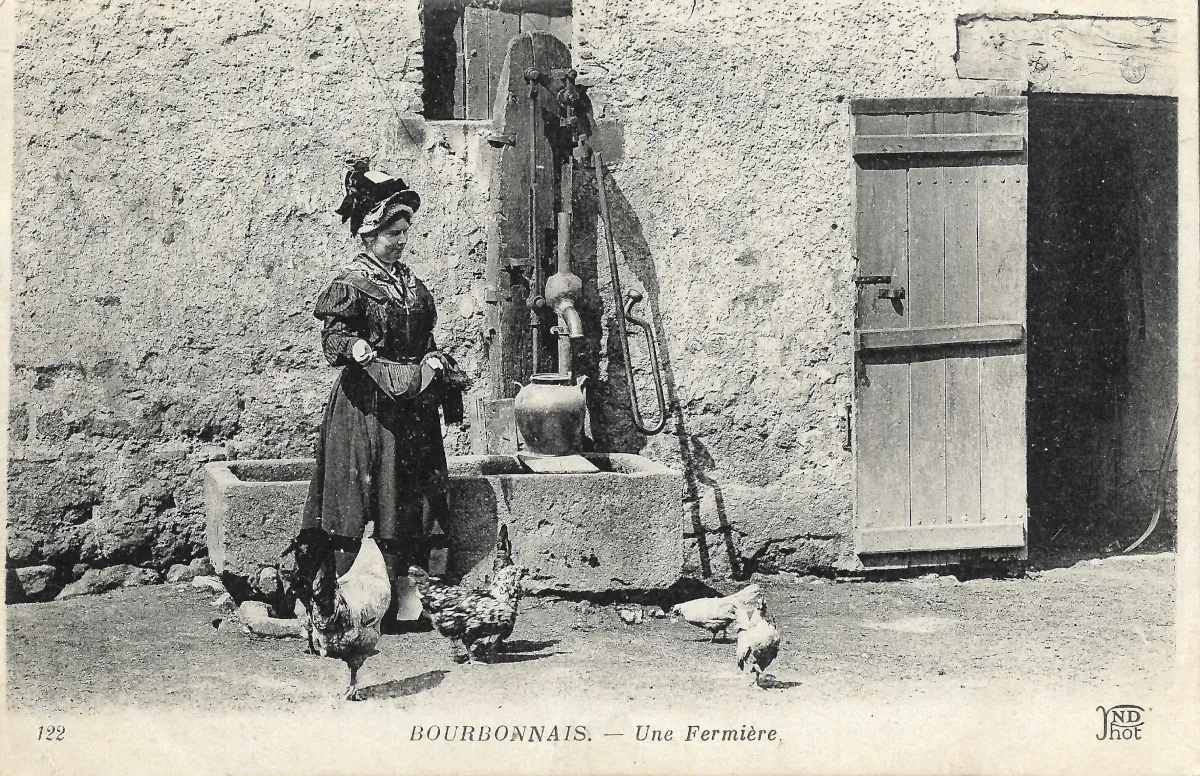
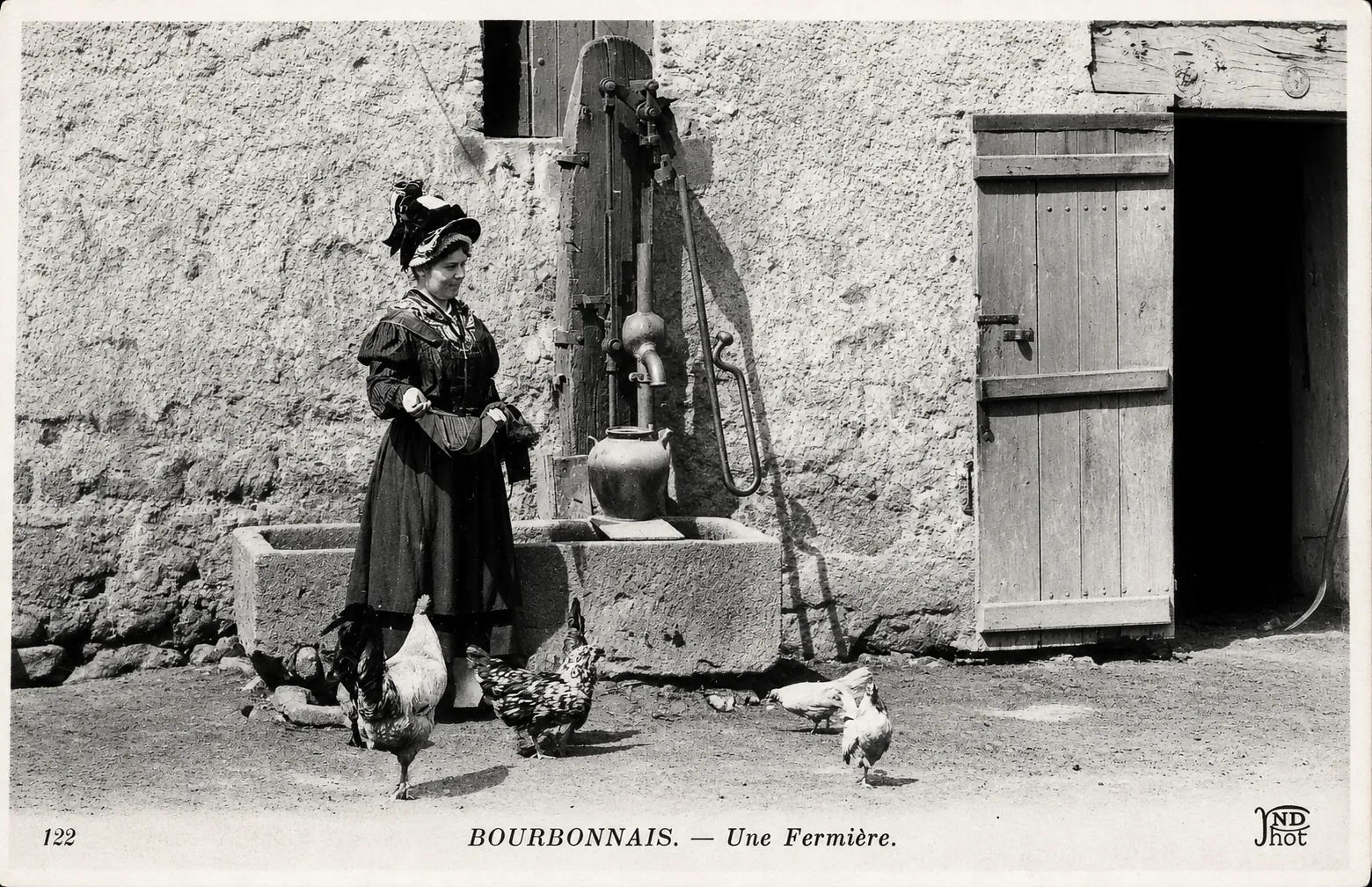
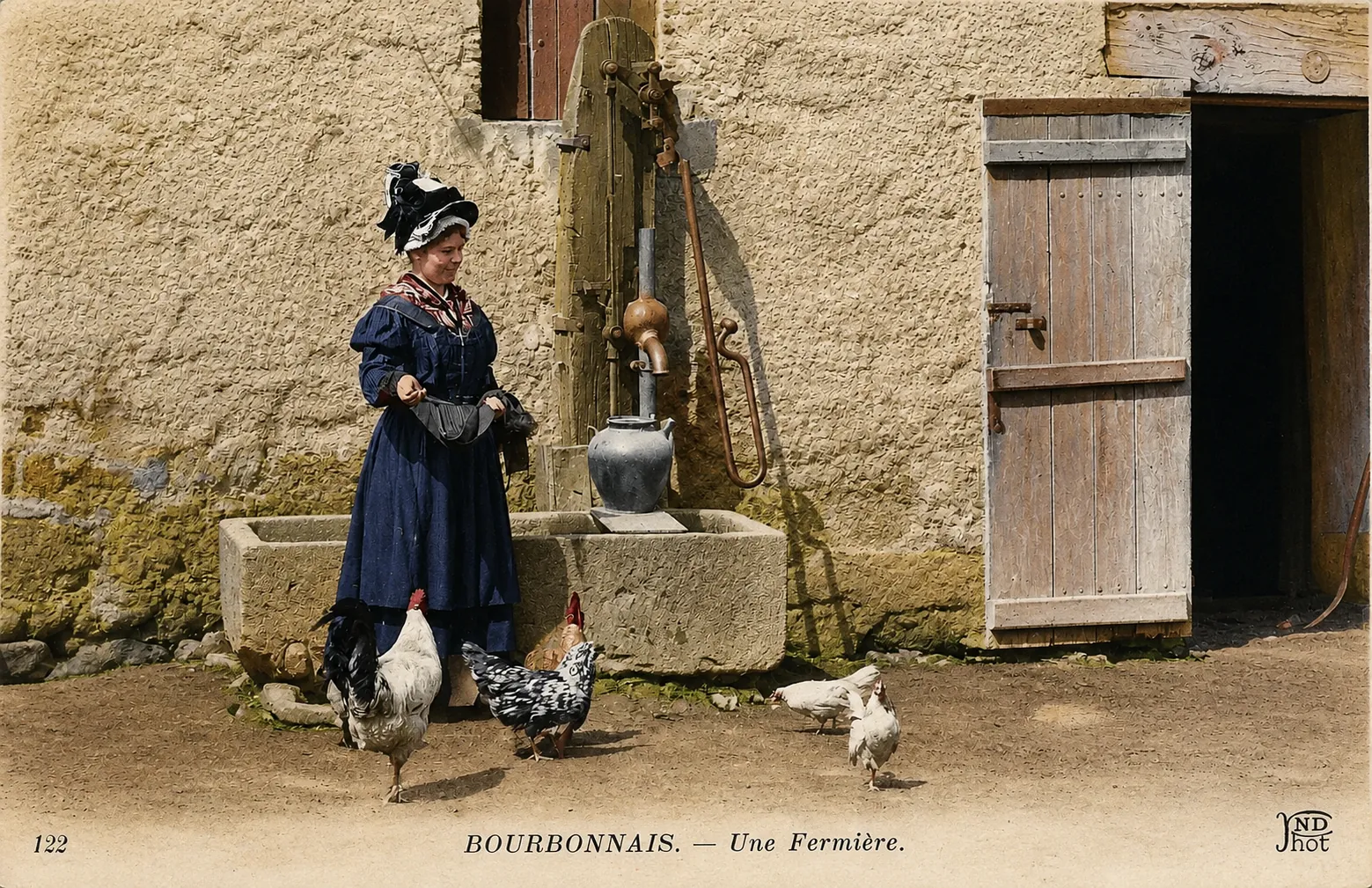
This Bourbonnais farm woman is photographed in a rural courtyard somewhere in the historic Bourbonnais region of central France. The printed caption at the bottom of the postcard reads “BOURBONNAIS. — Une Fermière” (“Bourbonnais — A Farm Woman”). This provides a reliable regional identification, but no town, village or farm is named. The exact location therefore remains unknown and should not be attributed to a particular commune without additional evidence.
Historic Bourbonnais corresponds broadly to the modern French département of Allier. According to the Allier departmental authorities, when France’s departments were created in 1790, the former province of Bourbonnais became the département of Allier with relatively few changes to its boundaries. The postcard should consequently be understood as a regional portrayal of rural Bourbonnais rather than as a precisely identifiable village view.
The composition centres on a manual water pump fixed against the wall of a farmhouse or agricultural outbuilding. A large earthenware or stoneware vessel has been placed beneath the pump spout, beside what appears to be a rectangular stone trough or basin. Such equipment was an important feature of domestic life in rural communities before piped water became widely available inside farmhouses.
The building itself is very plain. Its wall has a coarse, irregular rendered surface, with areas of masonry visible near ground level. A small shuttered opening can be seen above the pump. To the right is a substantial wooden door made from vertical boards reinforced by horizontal braces. Beside it is a dark open doorway, possibly leading into the dwelling or an agricultural outbuilding, although the photograph does not provide enough evidence to determine its precise function.
Several chickens and a rooster wander freely through the courtyard. Their presence immediately establishes the agricultural character of the setting. Two wicker baskets are also placed on the ground. Their contents cannot be identified confidently from the image, so it would be unwise to describe them as containing any specific crop or product. Nevertheless, the baskets, poultry and water equipment together evoke the everyday activities of a small family farm.
The woman is clearly intended as the central subject. She wears a long dark dress, an apron and an elaborate head covering or regional-style cap. The full sleeves and carefully arranged clothing give her a particularly traditional appearance. This was typical of early postcard photography devoted to French regional “types,” in which publishers presented rural inhabitants, craftspeople and traditional costumes as representative figures of individual provinces.
It is therefore quite possible that the woman was deliberately dressed and positioned for the photographer. The costume should not automatically be treated as proof that every Bourbonnais farm woman dressed exactly this way in everyday life. What is certain is that the photographer and publisher wanted viewers to recognise her as a characteristic rural woman of Bourbonnais.
Historical description
The postcard most probably belongs to the great expansion of illustrated postcards in the early twentieth century, when publishers produced extensive photographic series devoted not only to monuments and town views but also to regional customs, traditional occupations and rural communities.
An important clue appears in the lower-right corner: the distinctive “ND Phot” mark. This was one of the signatures used by Neurdein Frères, the major Paris photographic and publishing firm run by Étienne and Louis-Antonin Neurdein. The Bibliothèque nationale de France records the use of the “ND” mark from 1885 and identifies “ND phot.” as one of the firm’s names. The Musée d’Orsay likewise lists “ND Phot” as an alternative name used by Neurdein Frères.
This identification provides a useful chronological framework without supplying an exact date. The numbered caption 122, the typographic presentation, the photographic style and the subject matter are consistent with a postcard probably issued around 1900-1914. A more precise date cannot responsibly be established from the front alone, particularly in the absence of a dated postmark or other information from the reverse.
The photograph belongs to an important category of postcard imagery often devoted to regional characters and rural scenes. At the height of the postcard collecting craze, publishers created series showing fishermen, shepherds, farmers, market women, craftspeople and inhabitants wearing traditional clothing. These images were purchased by travellers but were also collected and exchanged by people interested in the variety of France’s regional cultures.
The composition of this image appears too orderly to be entirely accidental. The woman stands almost motionless beside the pump, while the photographer includes the chickens, baskets, water vessel and rustic wall within the same carefully framed scene. This makes a partially staged photograph quite probable. The setting itself, however, appears genuinely agricultural. The most reasonable interpretation is therefore that an authentic farm environment was used to create a deliberately picturesque portrait of rural life.
Such images need to be approached with some caution. They preserve genuine details of material culture, but they also reflect how publishers wished the French provinces to be presented to postcard buyers. The traditional clothing, poultry and weathered farm building form a visual shorthand for a rural Bourbonnais perceived as traditional and rooted in long-established customs.
For today’s viewer, this Bourbonnais farm woman offers more than a picturesque portrait. The hand-operated pump recalls the daily labour involved in obtaining water; the poultry illustrates the importance of the farmyard economy; the wicker baskets and simple architecture reveal aspects of domestic material life; and the woman’s clothing records the visual identity associated with the region at the time.
The postcard is therefore both a document of rural life and an example of early twentieth-century regional imagery. It preserves the appearance of a modest Bourbonnais farmyard while also illustrating the way one of France’s leading postcard publishers transformed ordinary rural environments into images intended for a national market.