Antique Postcard Trenton NJ: Cadwalader Park Monument
Geographic description:
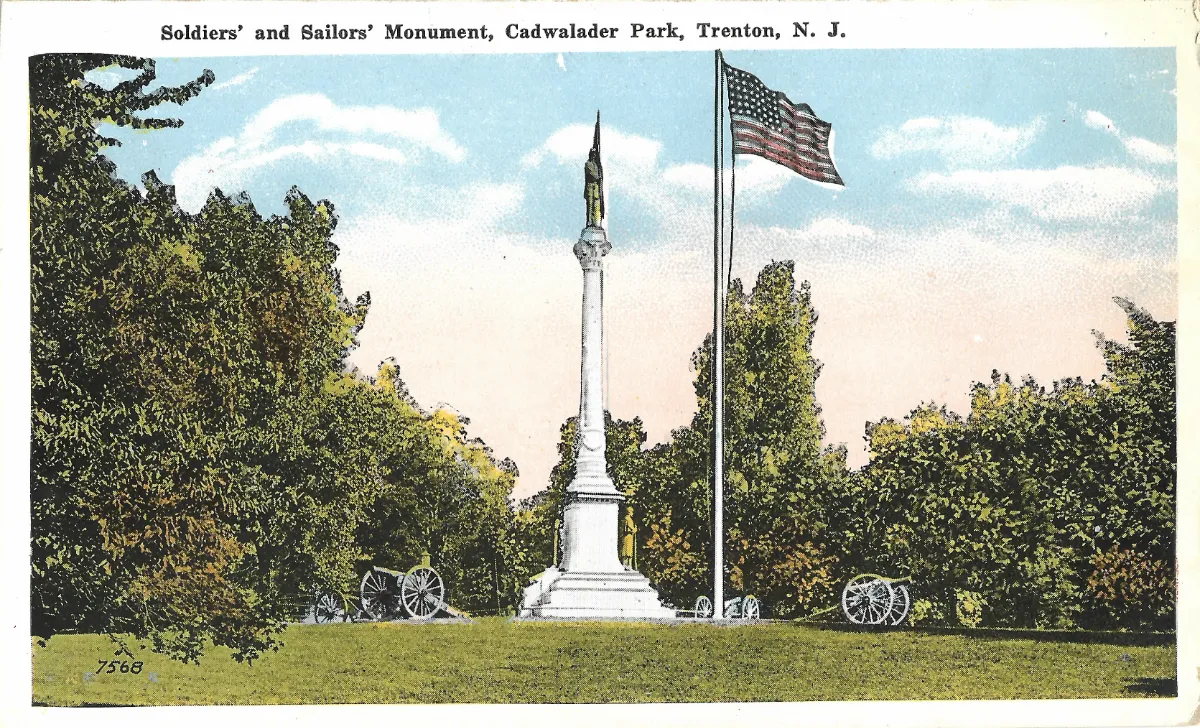
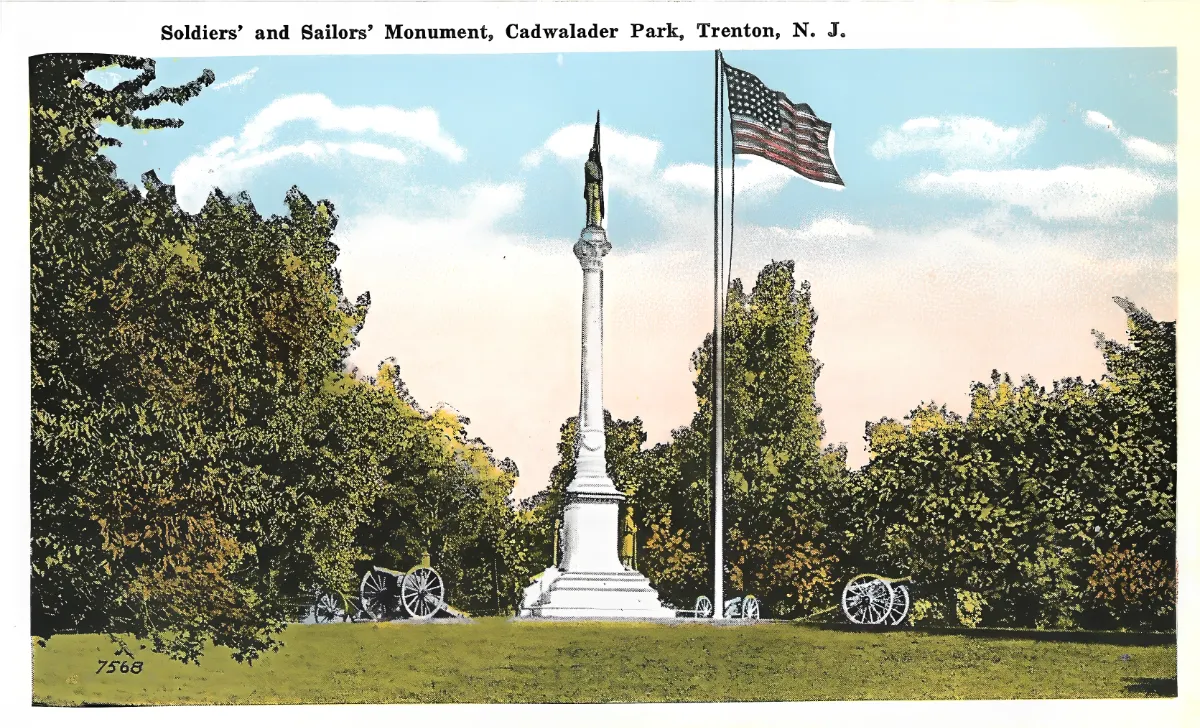
This antique postcard Trenton NJ depicts the Soldiers’ and Sailors’ Monument, standing at the entrance to Cadwalader Park in New Jersey. The printed caption at the top of the card, set in a classic serif typeface, states plainly: “Soldiers’ and Sailors’ Monument, Cadwalader Park, Trenton, N. J.” This caption is the single most reliable geographic clue on the card, since it names the monument, the park, the city, and the state without ambiguity.
The monument itself dominates the center of the composition: a tall, tapering white column, likely carved from stone or light-colored marble, rising from a stepped, multi-tiered pedestal. The shaft narrows to a slender, needle-like point near the top, a form common to many American Civil War commemorative columns erected around the turn of the twentieth century. At the distance from which this view was taken, it is not possible to confirm whether bronze figures typically associated with monuments of this kind are present at the base; their presence therefore remains indeterminate on this particular image.
To the right of the column stands a tall flagpole flying an American flag, its stripes and star field clearly visible and rippling in the wind, though the exact number of stars cannot be counted with confidence at this resolution. At ground level, on either side of the monument’s base, two artillery pieces mounted on wheeled carriages are visible — a type of nineteenth-century field cannon commonly preserved as commemorative fixtures in American public parks.
The scene is framed by dense stands of deciduous trees occupying the left and right thirds of the card, drawing the eye toward the central monument. The foreground consists of a well-maintained lawn, consistent with the deliberate landscaping of an urban public park. The sky is rendered in soft pastel blue and pink tones with stylized clouds, a coloring technique typical of halftone-printed postcards that were subsequently hand- or press-tinted, a widely used method in early twentieth-century American postcard publishing.
In the lower left corner of the image appears a plate number, “7568,” most likely a publisher’s series or catalog number. No publisher’s name is legible near this number, so its attribution remains indeterminate; only external verification, for instance through specialized postcard archives, could confirm the identity of the publishing house with certainty.
Historical description:
Cadwalader Park is, according to external documentary verification, Trenton’s oldest public park. The city authorized its development in 1888 on roughly one hundred acres, and the design was entrusted to the renowned landscape architect Frederick Law Olmsted, also known for designing Central Park in New York. This is an established historical fact, separate from anything directly observable on the postcard, since nothing on the image itself dates the park’s original design.
The monument shown, the Soldiers’ and Sailors’ Monument, honors Mercer County residents who served in the United States Army and Navy during the Civil War (1861-1866). According to external documentary sources, the column was erected in 1903 and formally dedicated on June 19, 1909. This dating does not come from the image itself, but it usefully constrains the postcard’s likely production window, since the card must have been published after this dedication date.
On purely visual grounds, several clues on the card itself allow a reasonable dating range for the printing of this particular postcard: the typeset caption at the top, the white border framing the image, and the pastel color palette applied over a halftone base are all characteristics associated with the so-called “White Border” era, which dominated American postcard production from roughly 1915 to 1930. Combining this stylistic clue with the monument’s known dedication date of 1909, it is reasonable to hypothesize that this postcard was printed sometime between 1915 and 1930, though greater precision is not possible from the front of the card alone.
The two cannons flanking the monument reflect a common practice in American parks of this era, in which retired Civil War artillery pieces were installed as commemorative fixtures around war memorials. External sources confirm that the park did host several artillery pieces at various points in its history, which supports, without conclusively proving for this specific card, the consistency between the observed image and the documented development of the site.
The absence of a visible reverse side for this card prevents any analysis of a postal cancellation, stamp, or handwritten message, any of which might have supplied a precise mailing date or clues about sender and recipient. As it stands, the proposed dating remains a reasoned hypothesis based on the convergence of printing style and documented monument history, rather than an established certainty.