Antique Postcard Orleans France: Joan of Arc Statue
Geographic description:
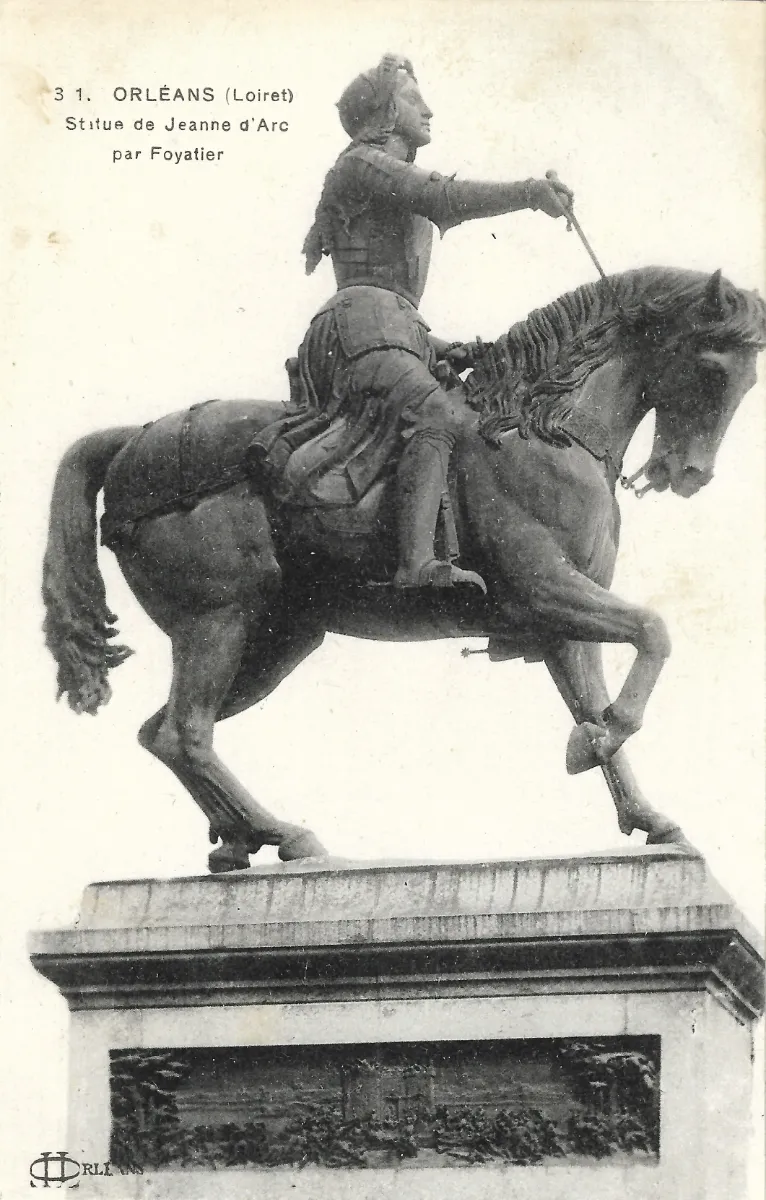
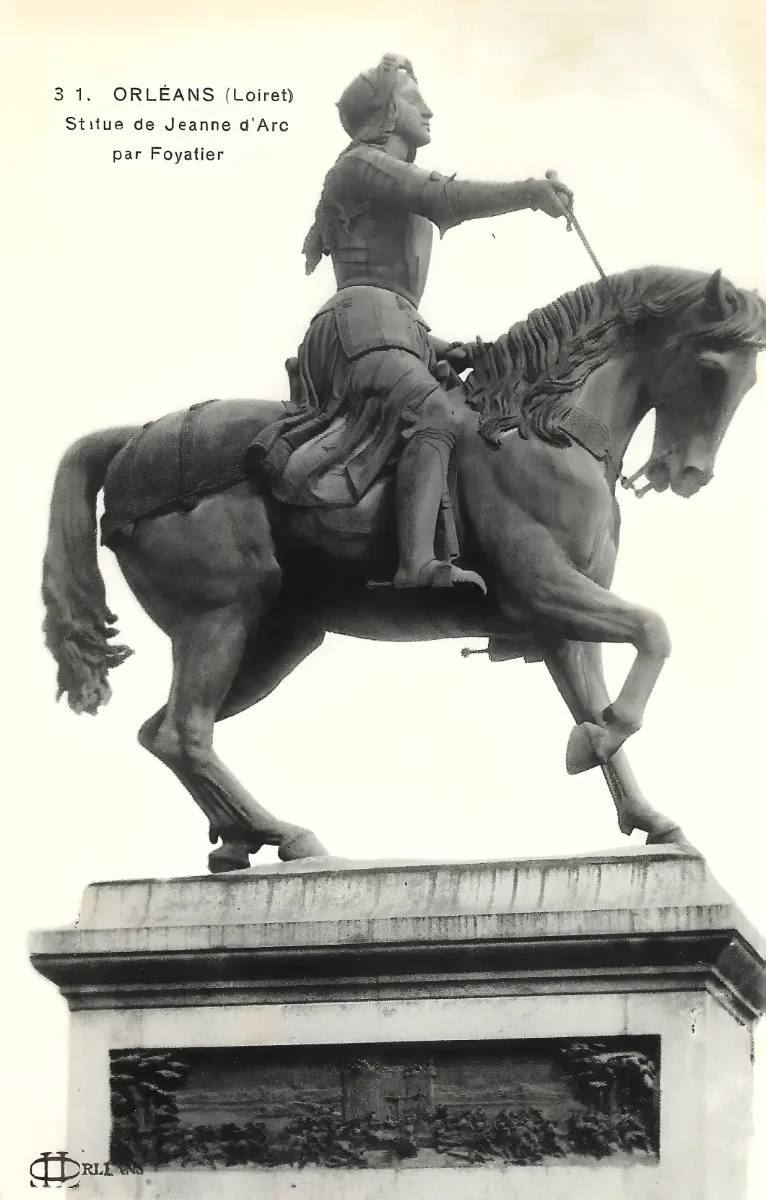
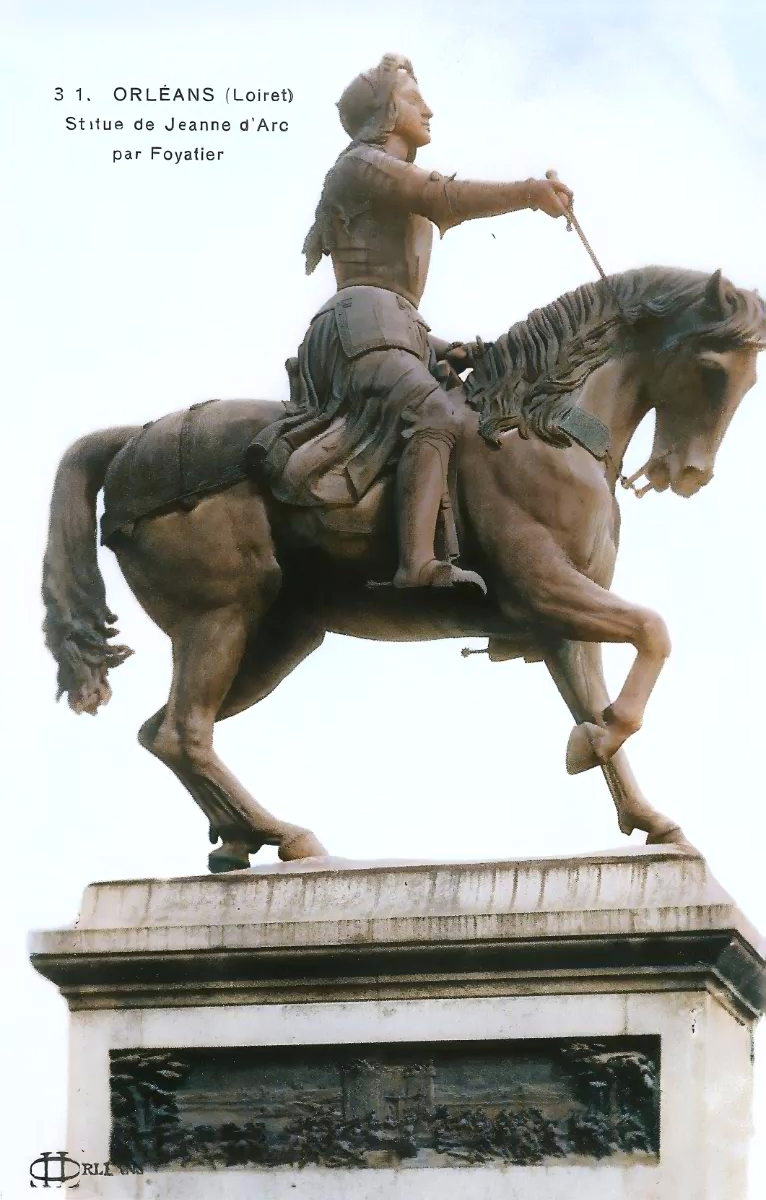
This antique postcard Orleans France view offers a close-up of the equestrian statue of Joan of Arc, the work of sculptor Denis Foyatier, which stands at the center of Place du Martroi in the historic heart of Orléans, in the Loiret department of central France. The photographer’s tight framing keeps the focus entirely on the monument itself rather than on its surroundings: no building façades, traffic, or passers-by are visible around the square. Joan of Arc is shown in armor, wearing a plumed helmet, mounted on a walking horse, her arm extended forward with a raised sword. The blade points upward rather than horizontally, a detail that matches Foyatier’s original intent: rather than depicting the heroine charging into battle, he chose to show her giving thanks to God after the lifting of the siege of Orléans in 1429.
The lower portion of the image includes part of the monument’s pedestal, with a fragment of a sculpted bas-relief visible on its front face. Though too small to read in detail at this resolution, this scene is consistent with the series of bas-reliefs added to the base by sculptor Vital-Dubray several years after the statue’s own unveiling. In the upper left corner, a printed caption reads “3 1. ORLÉANS (Loiret) / Statue de Jeanne d’Arc / par Foyatier,” which unambiguously confirms both the location and the subject. The number “3 1” most likely corresponds to a series or catalogue number used by the card’s publisher, a common practice for thematic sets covering the monuments of a single city. In the lower left corner of the front, a circular monogram or seal bearing the partially legible letters “…RLEANS” appears to be the publisher’s or printer’s mark, though its precise identity cannot be established with certainty from this visual clue alone.
The absence of a white border around the image, the fine photographic grain, and the grayscale rendering, with no trace of sepia toning or hand coloring, are features commonly found on so-called “full-bleed” or real-photo type postcards produced in the early twentieth century. Taken alone, these clues do not allow for a precise date; they will be cross-referenced with additional stylistic evidence in the historical description below.
Historical description:
The equestrian statue of Joan of Arc shown on this antique postcard Orleans France view is a well-documented historical monument, which allows the depicted subject itself to be dated with precision, independently of when the postcard was actually printed. The work was created by sculptor Denis Foyatier and unveiled on May 8, 1855, during the Johannic festivities commemorating the liberation of Orléans by Joan of Arc in 1429. Standing 4.40 meters tall, the bronze statue was reportedly cast using metal recovered from several cannons taken from the enemy, a metal-recovery practice frequently used for commemorative statuary in the nineteenth century. It replaced an earlier standing statue on the same site at Place du Martroi, created by sculptor Gois in 1804 and considered by that time too modest for the stature of the historical figure it honored. The bas-reliefs decorating the pedestal, a fragment of which is visible at the bottom of this postcard, were added a few years after the statue itself was unveiled, the work of sculptor Vital-Dubray, and chronologically depict the major episodes of Joan of Arc’s life.
Regarding the postcard itself, since no reverse side was available for this analysis, no postmark, stamp, or handwritten annotation could be examined: dating the print itself therefore remains a hypothesis based solely on stylistic clues from the front. The typography used in the caption, the series number in the upper left corner, the absence of a white border, and the grayscale photographic rendering all point toward a probable production date within the first two decades of the twentieth century, roughly 1900-1920, a period during which illustrated postcards experienced massive growth in France and urban monuments, statues, and public squares were a favored subject for publishers specializing in city views. This range remains a reasonable hypothesis rather than a certainty; a more precise dating would require examining the reverse of the card for a postmark, stamp, or postage indication, or comparing it with similar examples already catalogued and dated by collectors or archival services.
In terms of social and editorial context, Place du Martroi and its equestrian statue were already, at the probable time this card was published, among the most photographed sites in Orléans, alongside Sainte-Croix Cathedral. The circulation of such cards met a dual demand: from local residents wishing to send an image of their city, and from travelers and Johannic pilgrims visiting sites connected to the story of Joan of Arc, whose commemoration saw a particularly strong revival of interest in France during this period. Anyone seeking a more precise identification of this antique postcard Orleans France publisher, based on the monogram visible at the bottom of the image, would benefit from checking the municipal archives of Orléans or specialized deltiology databases.