Riverside Drive Playgrounds Beneath the Manhattan Trees
American postcard series “N.Y. 228”, estimated dating circa 1910–1925
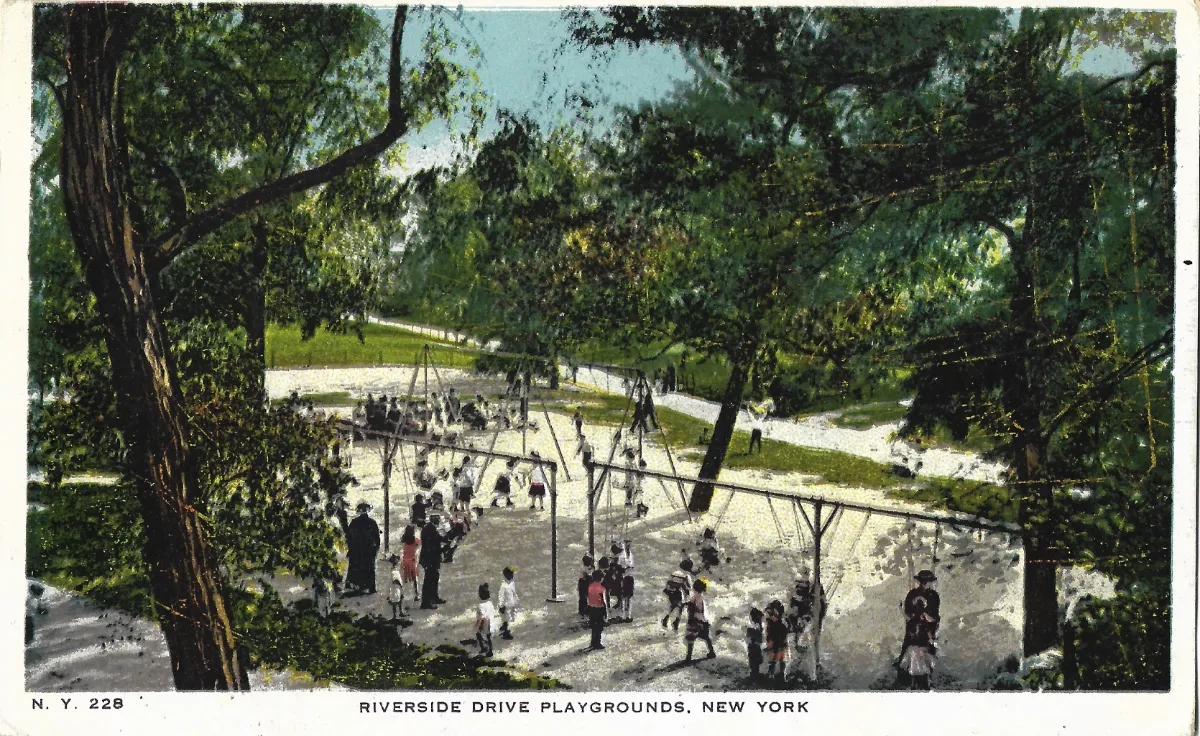
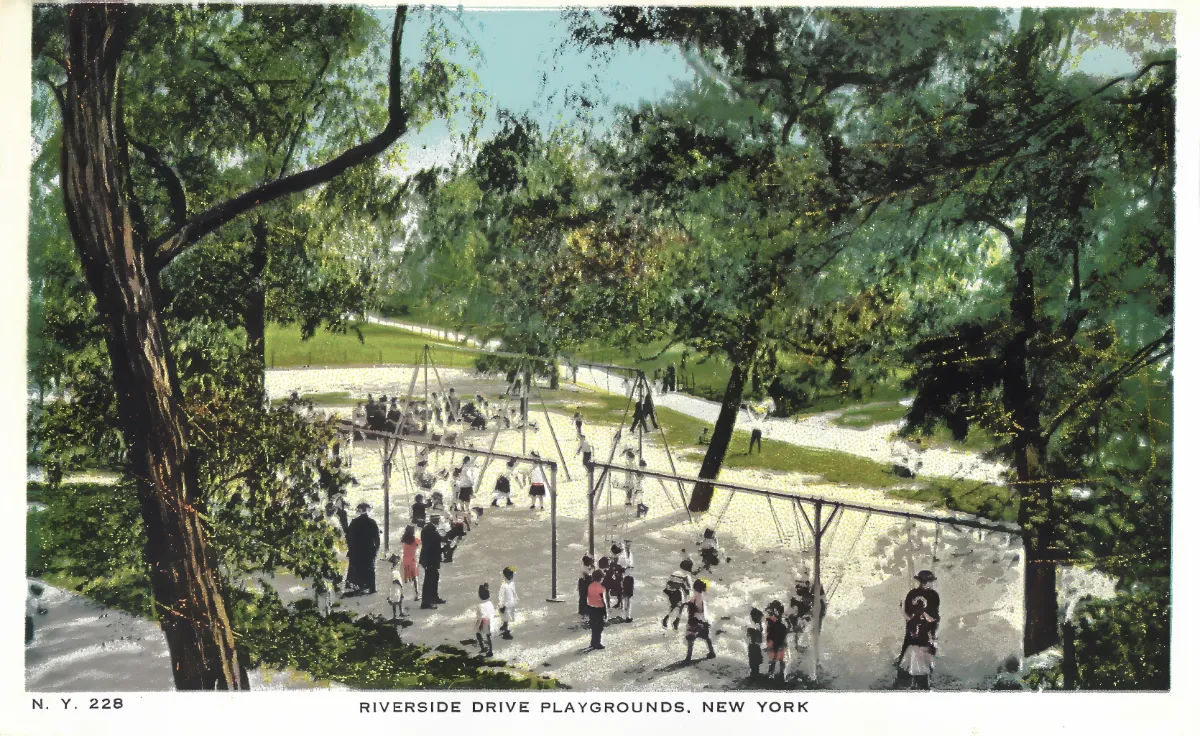
Riverside Drive Playgrounds unfolds across this postcard in a shaded clearing of Riverside Park in Manhattan, where tall trees frame a lively scene of swings, seesaws, and children in full motion. The composition, captured from a slightly elevated vantage point within the park, reveals a winding path and a green lawn in the distance, while in the foreground, gnarled tree trunks and dense foliage create an almost theatrical natural frame around the play area. Roughly thirty figures populate the scene: children in light-colored dresses or short trousers, girls wearing wide ribbons in their hair, and a handful of adults in dark clothing — likely mothers or governesses — watching over the activity from the sandy edge of the ground. The metal swing frames, arranged in parallel rows, dominate the center of the image and reflect an already fairly structured playground layout for its era.
This postcard belongs to a very specific historical movement: the American “playground movement” of the early twentieth century, a progressive-era effort to establish supervised play areas within urban parks, in response to rapid urbanization and the lack of safe spaces for children in large cities. New York was among the pioneering municipalities in this regard, driven by reform associations and the newly founded Playground Association of America, established in 1906. Riverside Park, originally laid out by Frederick Law Olmsted in the 1870s along the Hudson River, had its facilities gradually enriched over the following decades, well before the sweeping redesign carried out under Robert Moses in the 1930s. The playgrounds shown here therefore belong to this earlier generation — more modest in their infrastructure, yet already emblematic of the growing attention paid to urban childhood.
Technically, the card displays the characteristics of a halftone print enhanced with applied color, a widely used process in American postcard publishing during the 1910s and 1920s. The original photograph, likely taken outdoors on a clear day, was subsequently hand-colored in flat tones — the deep green of the foliage, the pale blue of the sky, the bright touches of the children’s clothing — using a technique similar to that employed by publishers such as Curt Teich or Detroit Publishing for their series of American city views. The series number “N.Y. 228,” printed in the lower left corner, suggests this view was part of a broader collection dedicated to New York landmarks, likely sold to tourists and residents alike as a souvenir or a card meant to be mailed. Unfortunately, the publisher cannot be clearly identified from this reproduction; should you have access to the reverse side of the card, examining it — the postage stamp, postmark, printer’s imprint, or return address — would considerably sharpen both the dating and the editorial attribution.
Beyond its documentary value, this postcard carries a quiet, endearing quality: it captures a slice of everyday New York life that has remained remarkably stable across time. As several chroniclers of the city’s urban history have noted, children’s play photographed in Riverside Park over a century ago does not differ fundamentally from the scenes still visible today in the same shaded lanes, among swings and sandboxes. It is this persistence of childhood’s simple gestures, carrying through decades of urban upheaval, that gives this postcard its nostalgic charge and lasting documentary charm.