Antique Postcard Prospect Park, Brooklyn, New York
Geographic description:
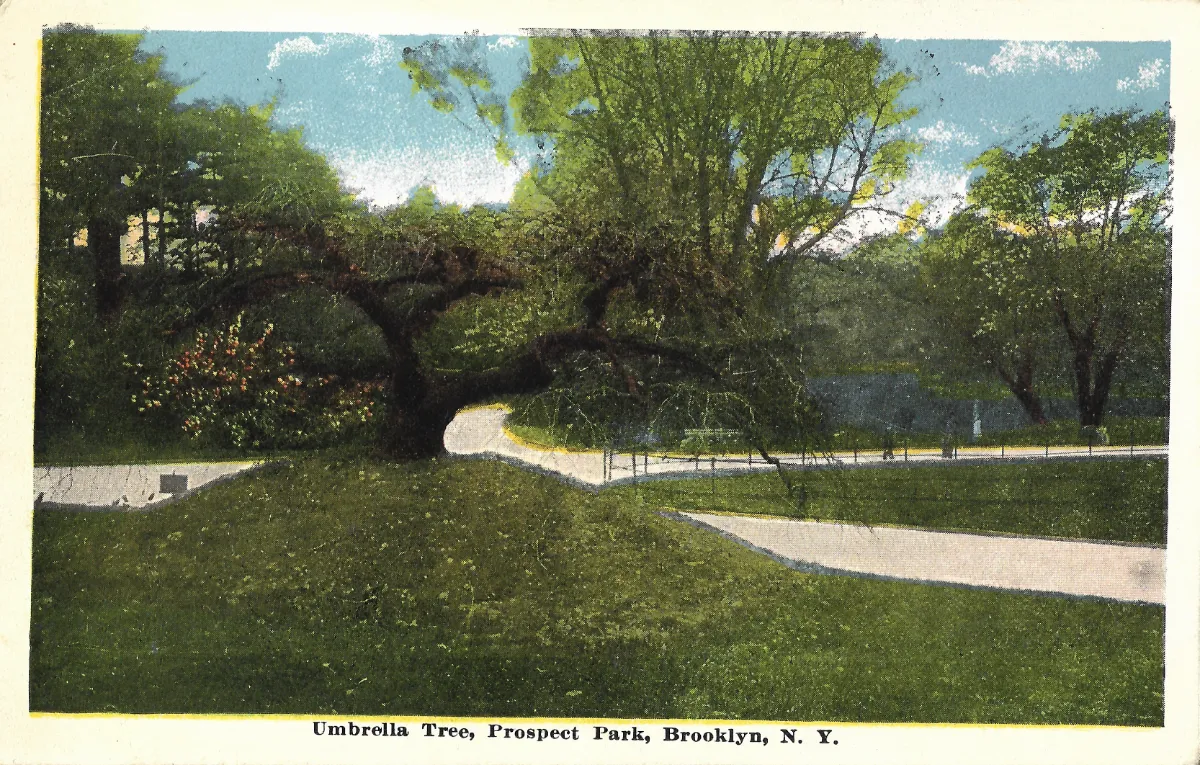
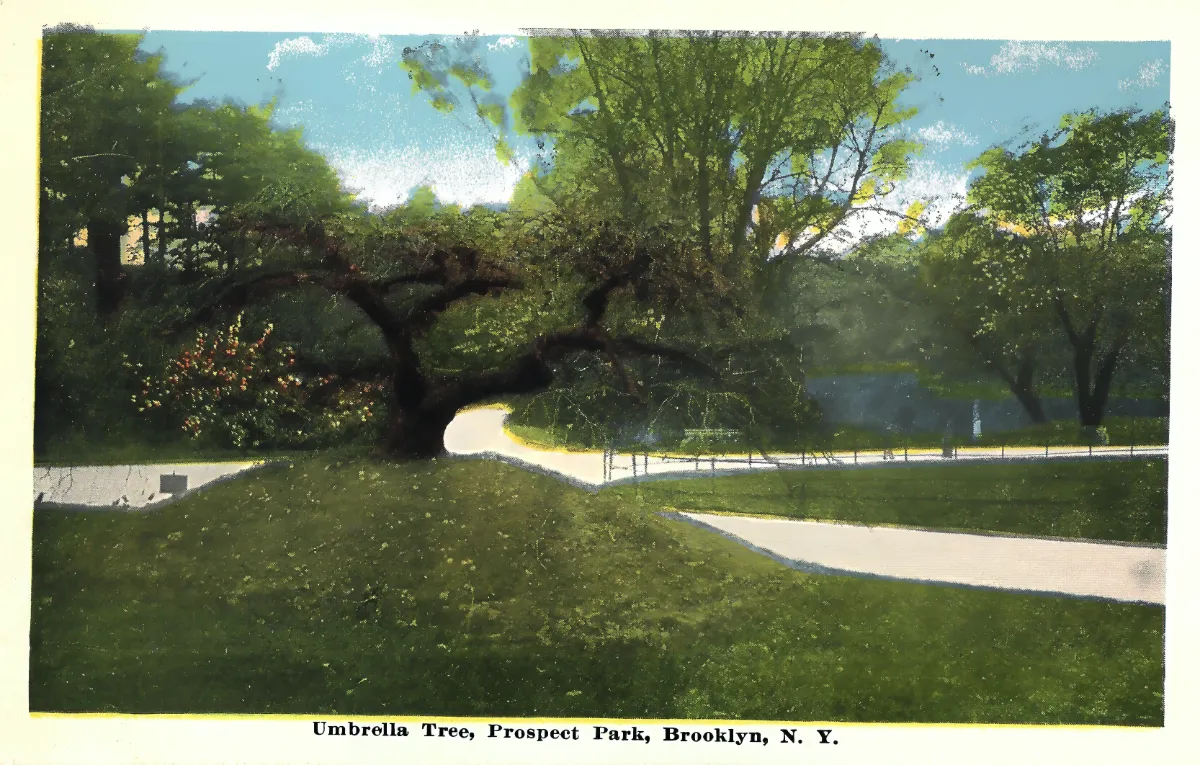
This antique postcard Prospect Park view depicts a specific and identifiable site, confirmed directly by the caption printed at the bottom of the card: “Umbrella Tree, Prospect Park, Brooklyn, N. Y.” The central subject is a single tree standing on a low grassy mound, its silhouette immediately distinctive: a gnarled, twisting trunk that splits low into wide, near-horizontal branches, forming a dense, umbrella-like canopy — hence the name given to this specimen on the card itself. This unusual growth habit, radically different from an ordinary elm’s upright form, allows for a reasonably reliable external identification beyond the printed caption alone, discussed further below.
Around the tree, the park’s main paved path curves sharply, wrapping around the base of the mound before continuing into the background, where a low wire fence strung between posts is visible — a landscaping detail typical of large American urban parks of the late nineteenth and early twentieth centuries. A second, wider and straighter path crosses the foreground from right to left, suggesting a pedestrian junction within the park grounds. In the background, a dense mass of trees closes the horizon; no clearly identifiable building appears, though a light-colored structure, possibly a park shelter or pavilion, is faintly visible at mid-distance on the right side of the image. Two small human figures, too distant to describe in detail, walk along the right-hand path, giving the scene a sense of scale and confirming its recreational, pedestrian use.
The printed caption placing the scene at Prospect Park, in Brooklyn, New York, is not a hypothesis but information directly legible on the document itself. Prospect Park is a major public park created in the second half of the nineteenth century by the same landscape designers responsible for Manhattan’s Central Park; this is external, well-documented background information rather than a deduction from the image, and is mentioned here purely as general geographic context. The precise identity of the path shown, or of the faint structure in the background, remains undetermined given the limited resolution of the available image.
Historical description:
The printing style of this antique postcard Prospect Park — a white border framing the image, half-tone photographic colorization (a visible dot pattern can be seen in the sky and clouds), and a typeset caption placed below the image rather than integrated into the photograph — matches the typical characteristics of the American “White Border” postcard era, broadly dated to roughly 1915 to 1930. This dating remains a hypothesis based on observable publishing conventions rather than on a postmark or handwritten inscription, since the reverse of the card has not been provided: any analysis of a postal cancellation, stamp, or manuscript correspondence is therefore impossible, and this dating cannot be refined without that additional document.
No publisher’s mark, series number, or logo is visible within the supplied image area, so the identity of the printer or publisher of this card remains undetermined. It was, however, common for this type of touristic view card, sold in series at kiosks and souvenir shops in New York’s major parks during this period, to be produced by publishing houses specializing in park and urban landscape views, though this cannot be confirmed here in the absence of a legible imprint.
On the level of documentable historical content, and this is external information, independently verifiable and clearly distinct from a reading of the image itself, the tree depicted very likely corresponds to a well-documented specimen from the literature on Prospect Park: a Camperdown Elm (Ulmus glabra ‘Camperdownii’), a grafted cultivar recognizable by its weeping habit and horizontal branches, given to the park in 1872 by a Brooklyn florist and planted near the boathouse on the Lullwater under the direction of the park’s landscape architects. This tree has remained a celebrated botanical curiosity of the site ever since, sometimes nicknamed the “Umbrella Tree” or “Upside-down Tree” because of its distinctive shape, matching exactly the caption printed on this card. This identification remains a connection between a strong visual clue (the tree’s shape and the caption) and documented external information, not an absolute certainty based on the image alone: in theory, another card could depict a different specimen of the same cultivar, though this seems unlikely given the fame of the Prospect Park tree and the exact coincidence of the caption.
Regarding the social use of this type of document, illustrated postcards of urban parks circulated very widely during the first decades of the twentieth century, serving simultaneously as tourist souvenirs, quick correspondence, and thematic collectibles, a pattern that explains the serial production of similar views of the same site from slightly different angles, as attested by other known cards depicting other paths or features of Prospect Park from the same period.