The Royal Carrière, Suspended in Lorraine’s Sky
No. 162 — Imprimeries Réunies de Nancy — estimated date: 1900–1915
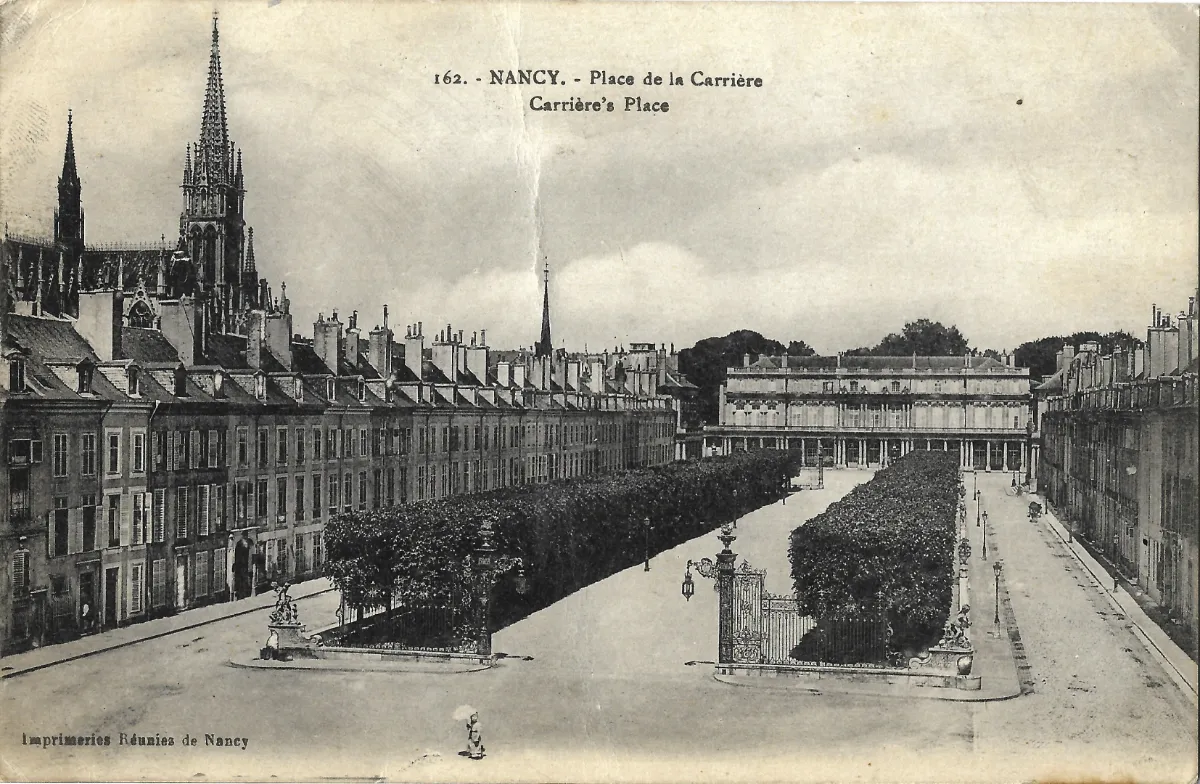
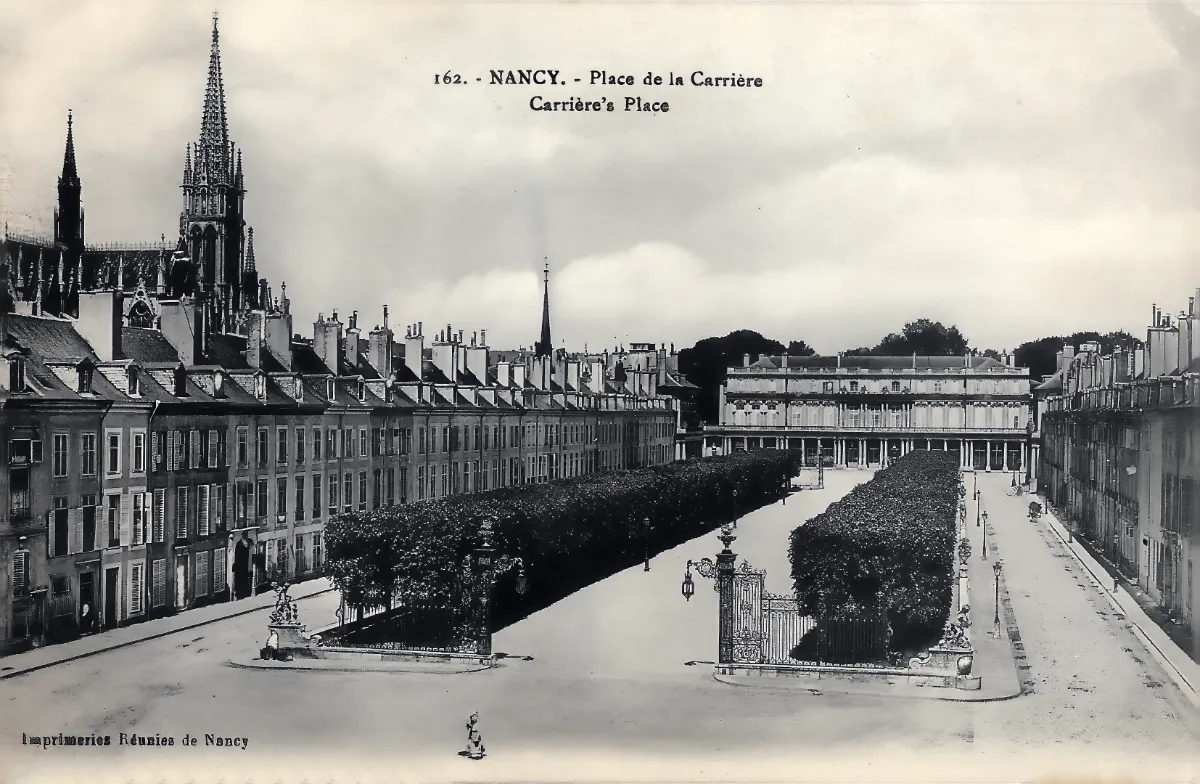
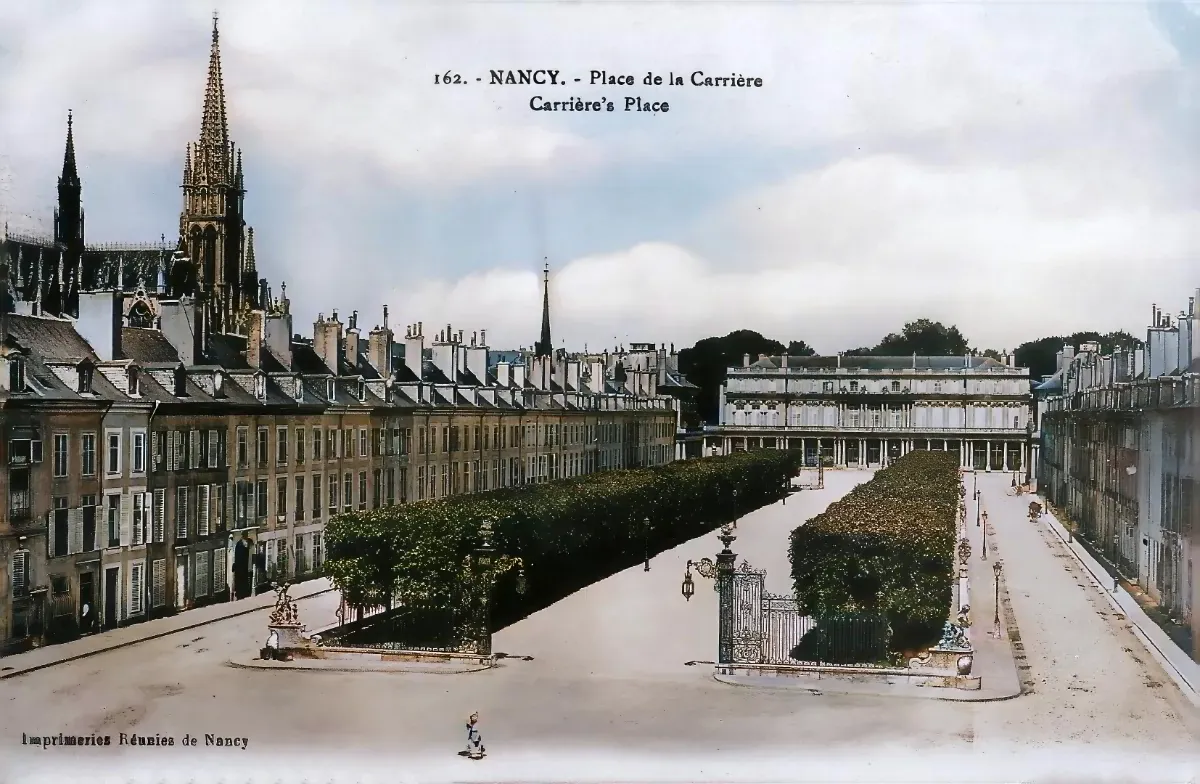
The photographer’s vantage point sits slightly above street level — likely a window or elevated balcony near the Place Stanislas end of the square — lending the composition its sweeping, commanding perspective. The Place de la Carrière stretches away in full length before the lens, flanked on both sides by two long parallel masses of clipped hornbeam hedging, the kind of rigidly trimmed formal planting that defines French classical garden design. The central carriage path, wide and empty, draws the eye deep into the frame toward the Palais du Gouvernement, whose Ionic colonnade closes the far end of the square with composed, neoclassical authority.
Along the left side, the orderly facades of eighteenth-century private mansions (hôtels particuliers) present their rows of shuttered windows in the restrained, well-proportioned style characteristic of Emmanuel Héré, the architect who reshaped Nancy under Duke Stanislas Leszczyński. In the foreground, the ornate ironwork gates that mark the passage from the Place Stanislas catch the eye: finely wrought lampposts, decorative overthrows, and flanking sculptural groups executed in the tradition of the great Lorraine ironwork workshops. These gates, like those of the adjacent Place Stanislas, are the work of Jean Lamour, whose mastery of decorative metalwork made Nancy one of eighteenth-century Europe’s foremost centres of the art. Rising above the roofline to the left, the slender neo-Gothic spire of the Église Saint-Epvre pierces the cloudy sky, introducing a vertical, Romantic note that contrasts pleasingly with the horizontal discipline of the square below.
The card was published by the Imprimeries Réunies de Nancy, a Lorraine printing firm active from the late nineteenth century, known for both regional views and general commercial printing. The bilingual caption — Place de la Carrière / Carrière’s Place — signals a conscious tourist market at a time when Nancy, with its celebrated Stanislas ensemble already listed as a historic monument, was drawing visitors from across Europe and beyond. The series number 162 points to a broad, systematically catalogued collection consistent with the large panoramic series typical of the Belle Époque postcard trade. Printed in phototypie, the card displays that characteristic velvety grain and soft grey tonal range that mark this photographic printing process, dominant in the French postcard industry from roughly 1880 to 1920.