Beneath Lace-Like Ironwork — Jean Lamour’s Gates Frame Everyday Life in Nancy
Numbered series no. 8 — Publisher: Maison des Magasins Réunis, Nancy — Estimated date: c. 1900–1910
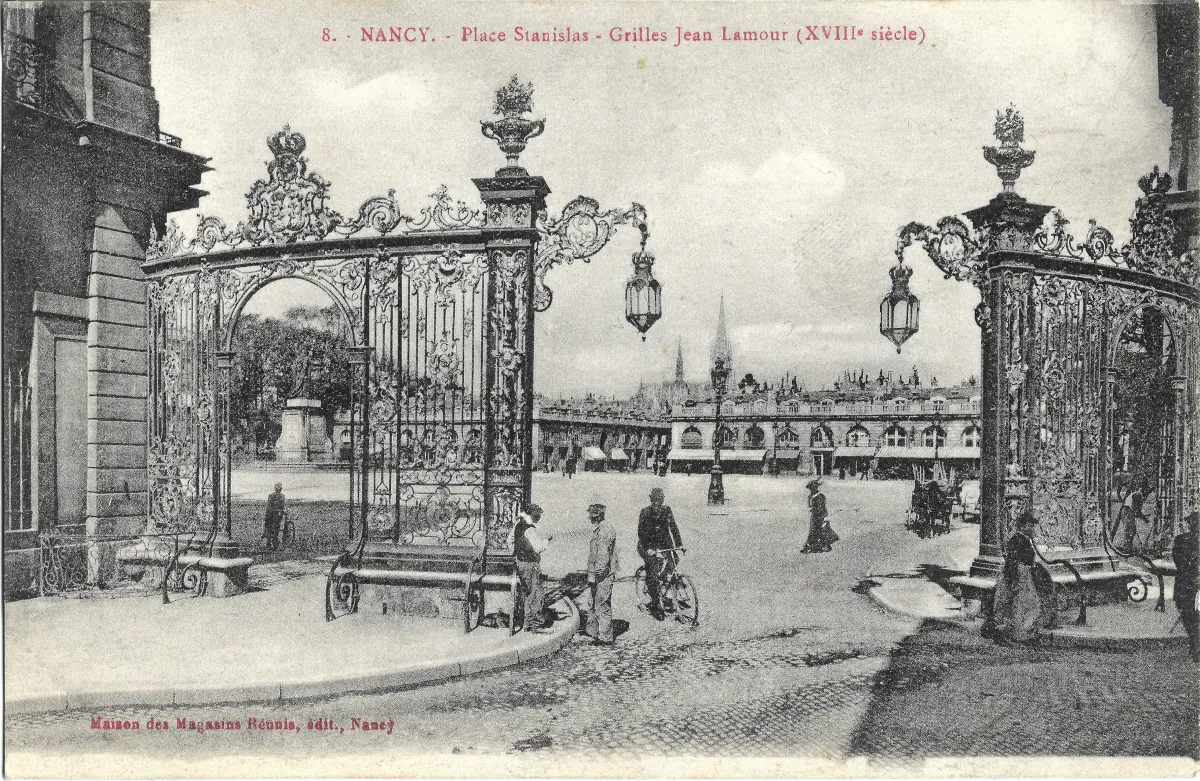
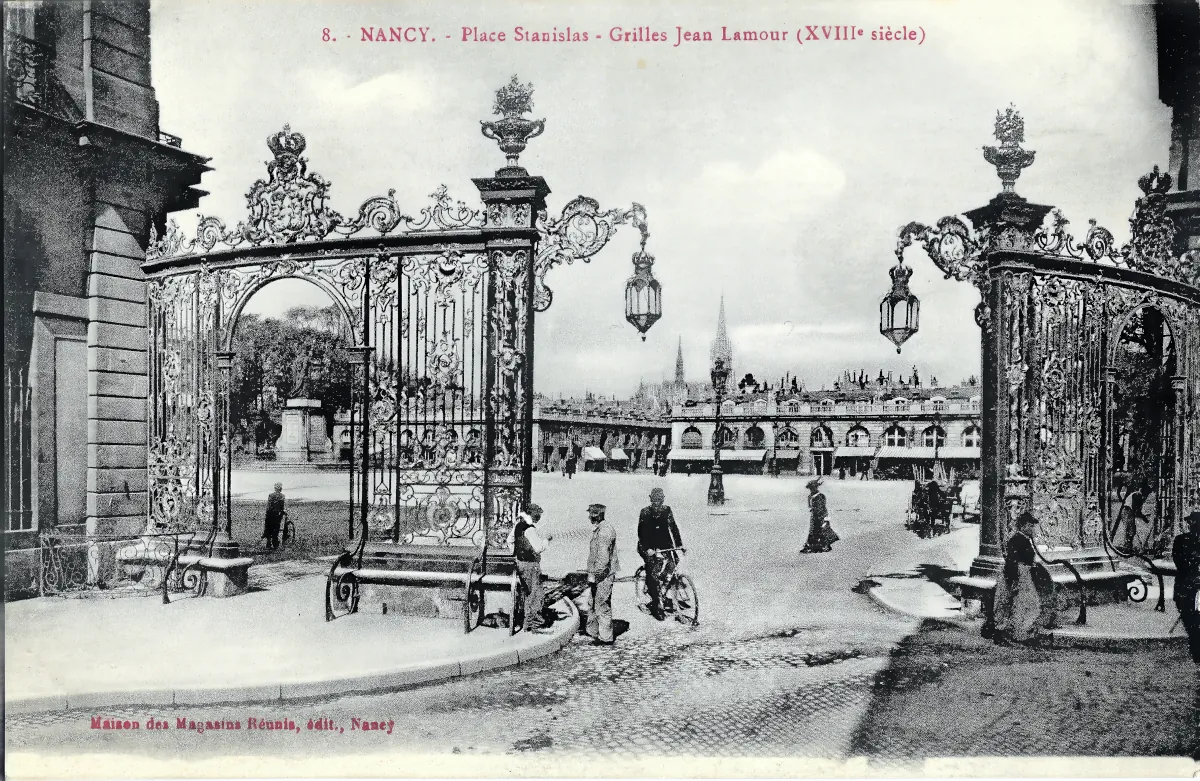
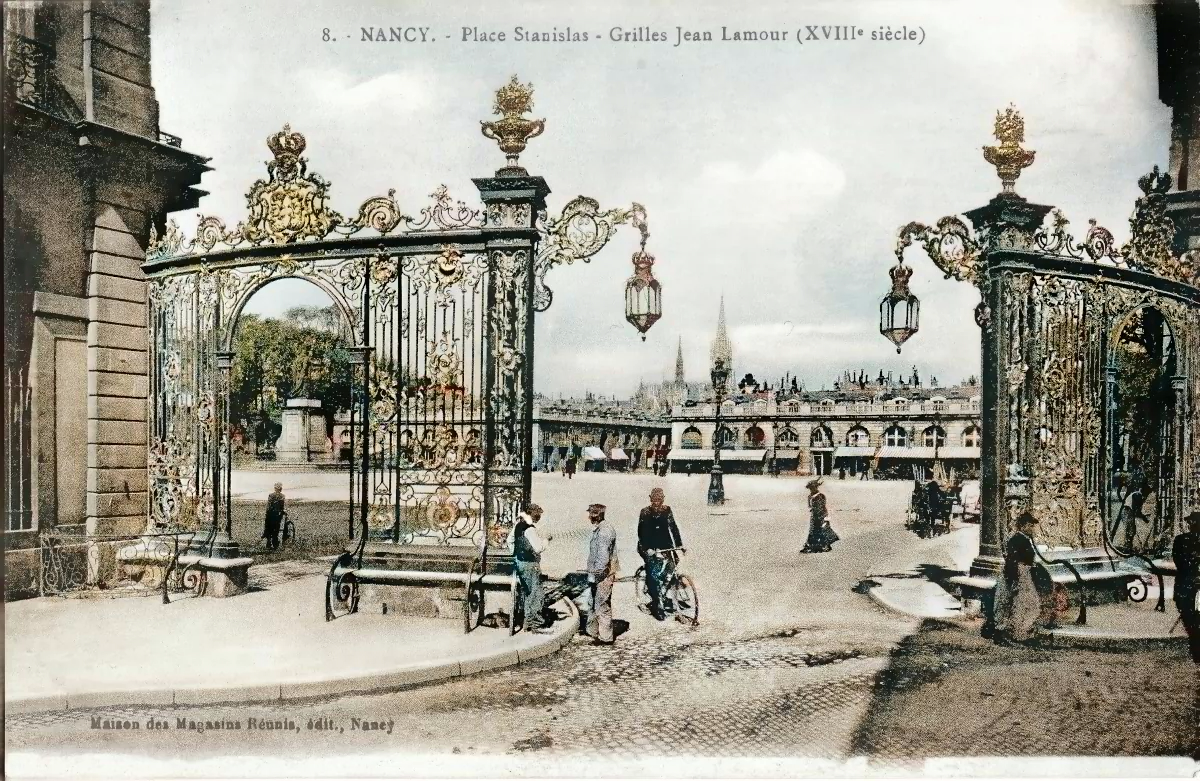
From the south-western corner of the Place Stanislas, the photographer’s lens came to rest where the eye inevitably does: on one of Jean Lamour’s monumental wrought-iron gates, a masterpiece of Rococo metalwork that closes off the square like the lid of a jewellery box. The gaze first lingers over the profusion of scrolls, ducal crowns, gilded flowers and cartouches before passing through the archway to discover, along the central axis, the open perspective of the square itself — the arcades of the Rue Héré, the restless backdrop of the city, and the soaring spires of the church of Saint-Épvre piercing the Lorraine sky.
In the foreground, life has slipped into the frame with that casual ease so typical of street photography from the Belle Époque. Three men — one apparently in military or official uniform — linger beside a bicycle, that emblem of modernity in a France then enthusiastically embracing the two-wheeled machine. A little further across the square, a female figure in a long dark dress crosses the cobblestones, seemingly unaware of the camera. Cast-iron benches, echoing the style of the gates themselves, line the pillars, offering a place to pause. The phototypie print, with its characteristic velvety grain, renders the intricacies of the forged metalwork with remarkable fidelity.
The Maison des Magasins Réunis, the publisher of this card, was a major Nancy department store which, like its Parisian counterparts, had ventured into postcard production as a way of diversifying its activities and promoting the city’s image — a common practice during the golden age of the illustrated postcard, between 1900 and 1914. The number 8 in the series suggests a likely extensive collection devoted to the monuments and landmarks of Nancy, the Lorraine capital whose Place Stanislas — listed as a UNESCO World Heritage Site since 1983 — was then, as now, its most celebrated jewel.