A Morning on Avenue Nationale: The Post Office of Moulins
No. 284 — Published by P. Paquet, Moulins — Estimated date: c. 1910-1914
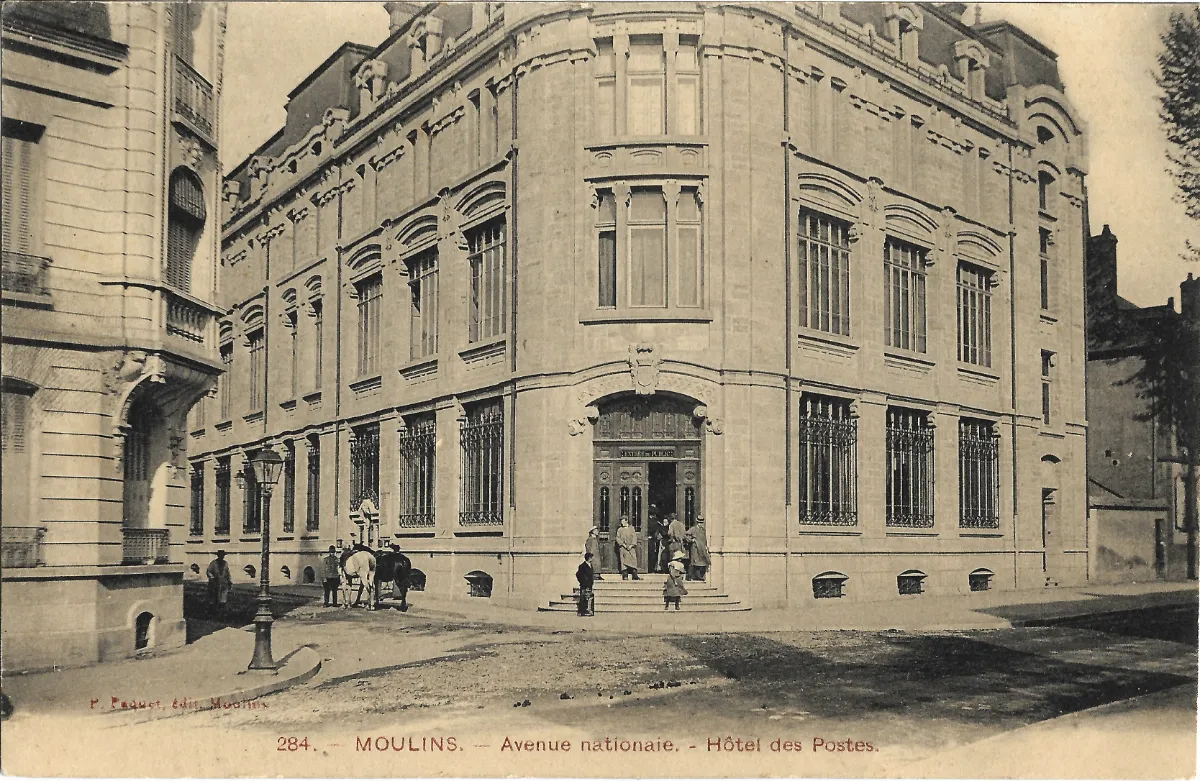
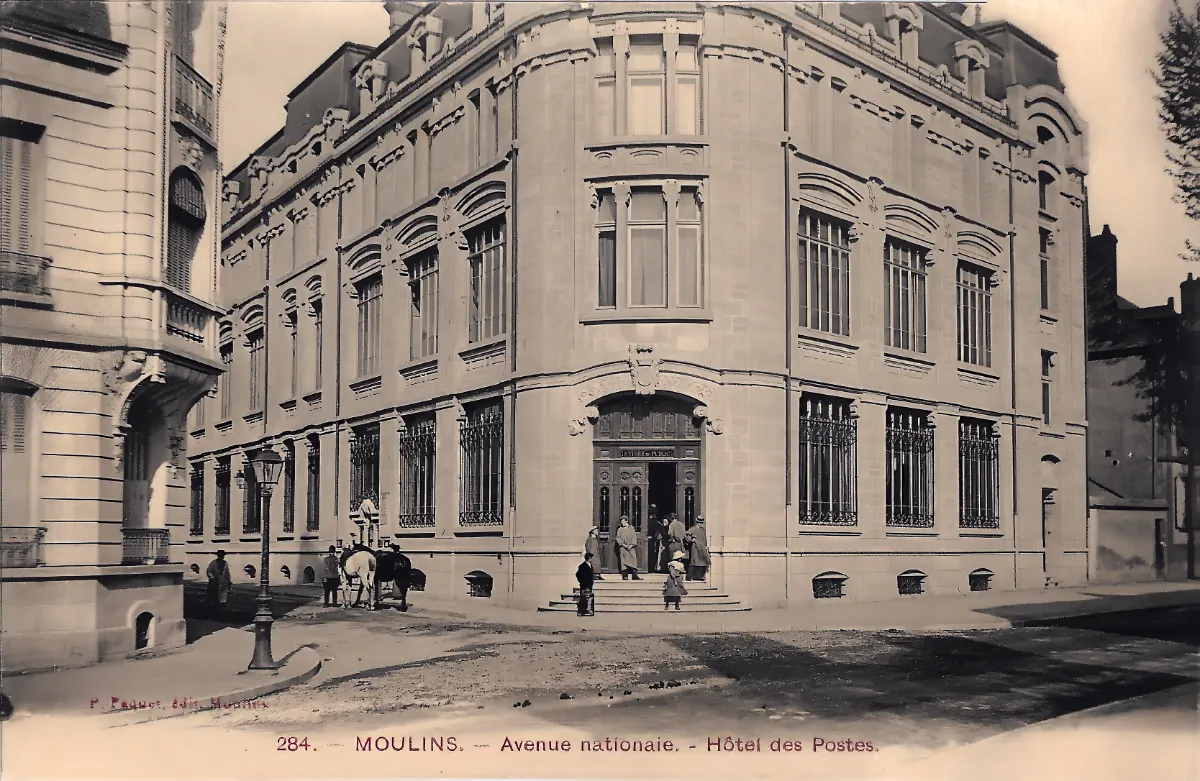
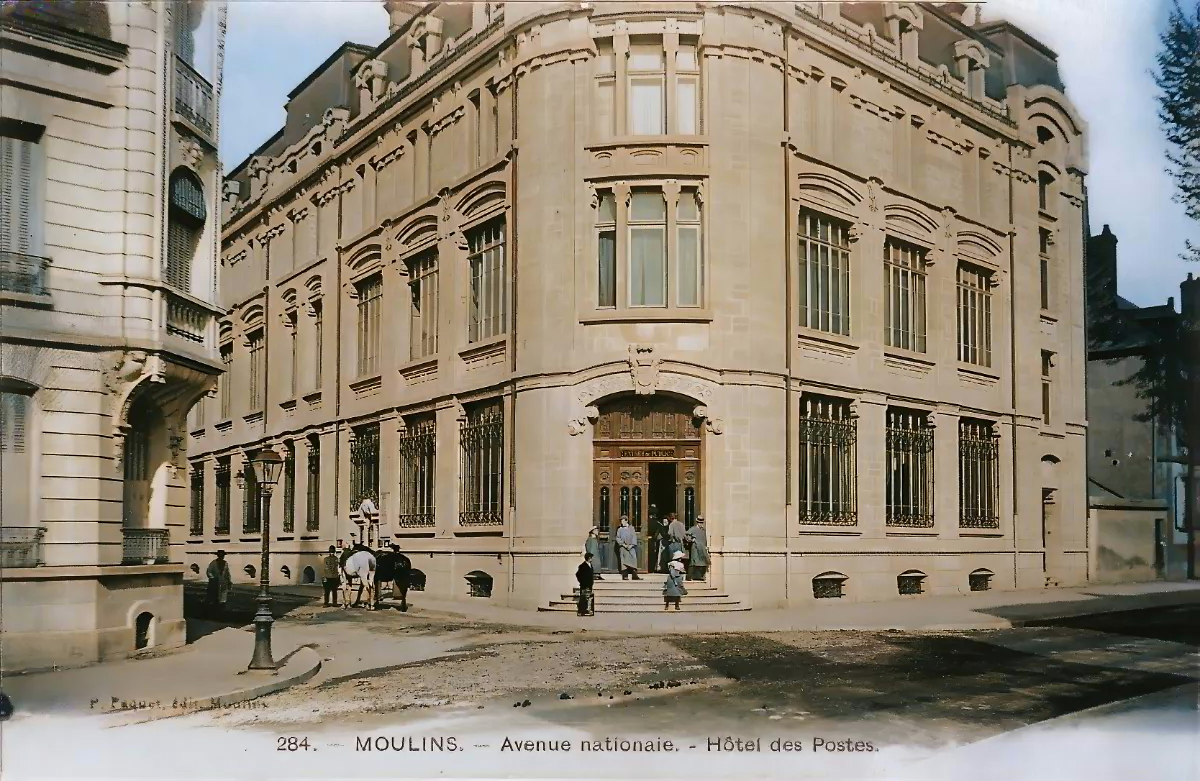
This Moulins post office postcard captures an imposing corner building photographed on a quiet day at the very start of the twentieth century. The structure fills the entire width of the frame: three storeys marked by tall arched windows, sculpted stone aprons beneath the sills, running balconies at the upper floors, and, at street level, heavy wrought-iron grilles protecting the openings — a discreet but telling signature of a public building entrusted with valuables and correspondence. The main entrance, set slightly back, is marked by a double door beneath a carved pediment, reached by a three-flight staircase. On these steps stands a small group: a few men in long dark coats and bowler or boater hats, two children, a woman in a long dress wearing a wide-brimmed hat — an everyday scene, almost posed, as was common practice to bring life into these urban views intended for sale. To the left, a horse-drawn cart stands near a cast-iron lamppost, a detail that firmly places the card in an era before the automobile had taken over the streets of provincial county towns. The print, in the characteristic grey-brown palette of collotype (phototypie), carries at the bottom the printed caption in red ink, “284. — MOULINS. — Avenue nationale. — Hôtel des Postes,” along with the mark of the publisher, P. Paquet, active in Moulins at the turn of the century.
The building shown here is no ordinary administrative block: it is the former Post and Telegraph Office of Moulins, built in 1909 by the architect Gustave Baer fils, who also designed the town’s museum, inaugurated the following year and incorporating the Anne de Beaujeu pavilion, along with hospital buildings on rue de Paris as early as 1895. His father, Baer père, had earlier designed the monument to the poet Théodore de Banville, a native son of Moulins. One construction detail is worth noting: the building rests on wooden piles, since the plot corresponded to the former site of the Bréchimbault pond, filled in and drained to allow this part of Moulins to be developed. Technically, this post office is counted among the last buildings in Moulins to still combine stone and iron before reinforced concrete became the norm the following decade — making it, in hindsight, a witness to an architectural transition as much as a working post office. Its composition, hierarchically organised floor by floor on a triangular plot, expresses with elegant symmetry the administrative function of the place. The building has since been repurposed and now houses the city’s social services under the name “Sésame”; the Avenue Nationale named on the card’s caption has, in all likelihood, been renamed since, following later urban redevelopment of the area, though I cannot confirm this with certainty without a direct source on the old street plan of Moulins — a point that further research into historical cadastral maps could settle.
Editorially, this view belongs to a substantial numbered series produced by P. Paquet, a local publisher whose imprint appears on numerous Moulins postcards of the period — shopping streets, the Lycée Banville, the lycée’s chapel, and views of the surrounding countryside. These provincial publishers, often booksellers or stationers by trade, supplied a rapidly growing market: between 1900 and 1918, illustrated postcards enjoyed a golden age in France, driven by modest postage rates and widespread public enthusiasm for collecting. Photographing newly completed public buildings, such as this freshly finished post office, reflected civic pride as much as commercial calculation: residents were happy to buy views of their own town to send to relatives or keep in an album.