The Town Hall Square Dominated by the Jacquemart Tower
Series no. 33 — Publisher Lévy & Neurdein Réunis (LL imprint) — Phototype — c. 1900–1910
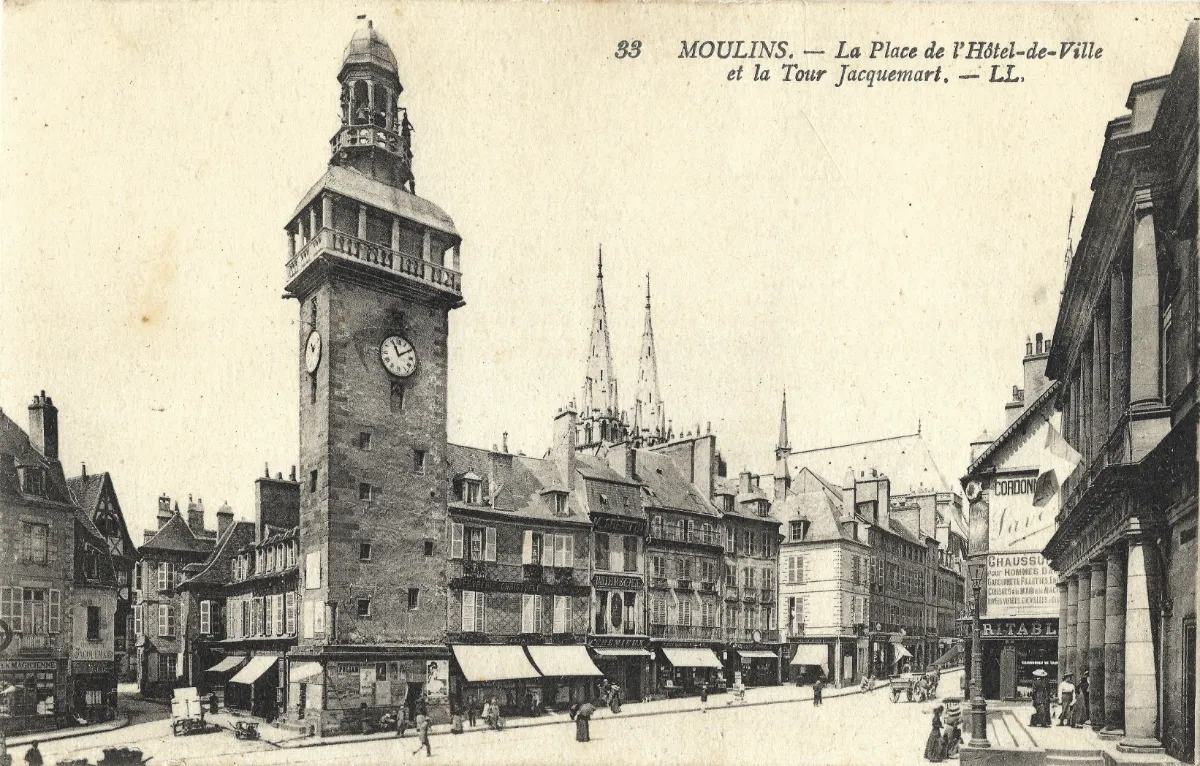
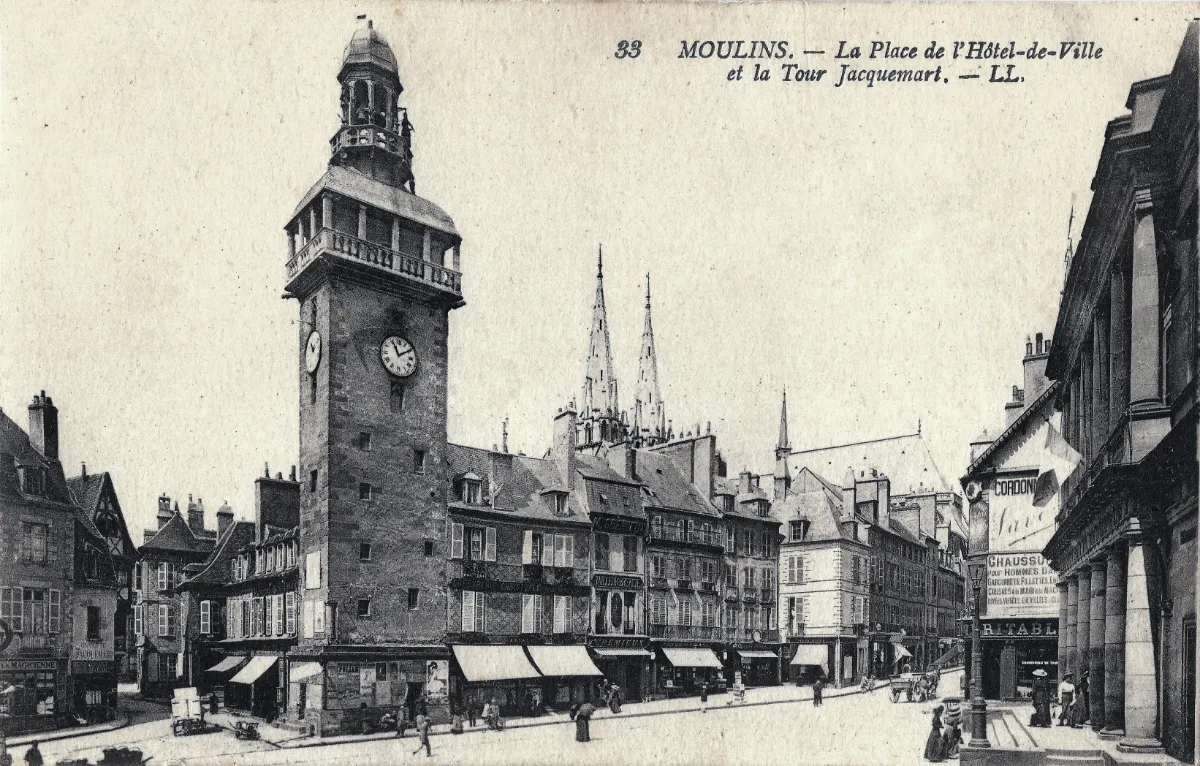
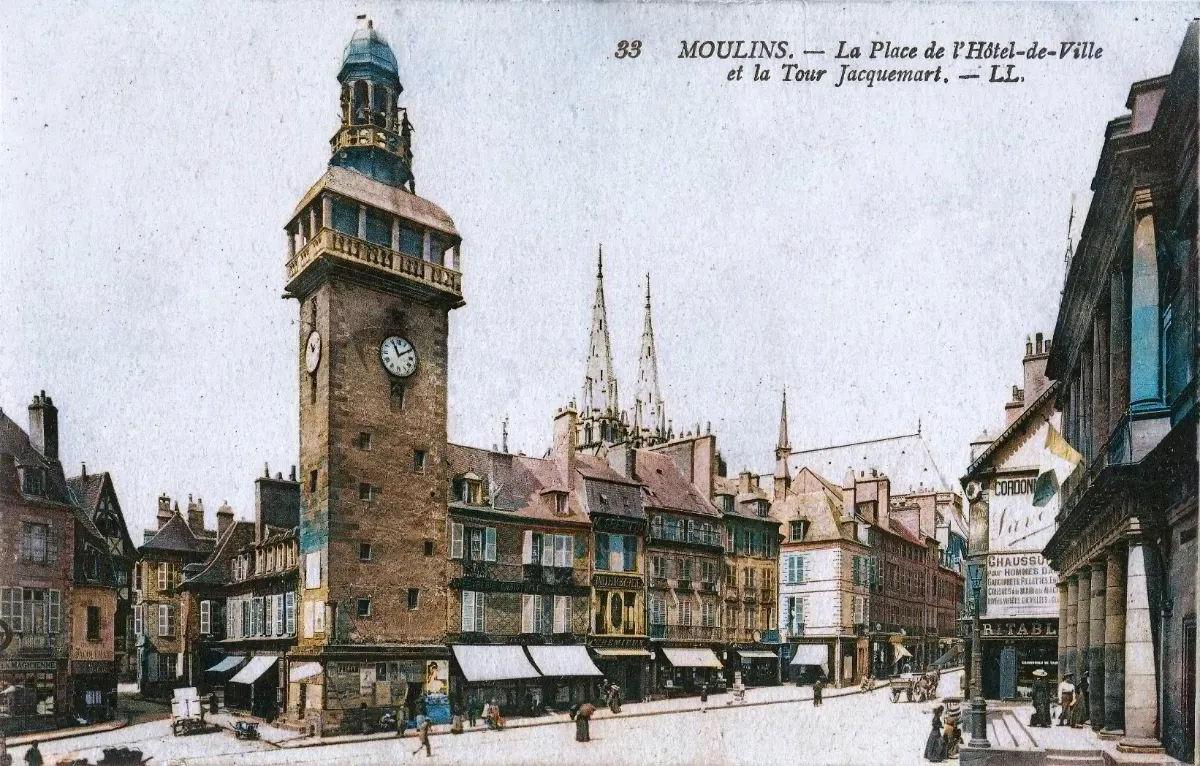
The Jacquemart Tower of Moulins commands the center of this postcard with quiet authority. It is the first thing the eye encounters: a mass of red and yellow sandstone rising some thirty meters, topped by its characteristic octagonal lantern and campanile — the very structure that would be destroyed in the fire of May 12, 1946, accidentally ignited by fireworks set off to celebrate the first anniversary of the Liberation. The tower, built in the mid-fifteenth century, was modified and restored following several fires. In this photograph, it appears in its pre-disaster state, still wearing its original crowning, home to four automaton figures — Jacquemart, his wife Jacquette, and their two children — who, according to tradition, strike the hours, the half-hours, and the quarter-hours respectively.
Below, the Place de l’Hôtel-de-Ville buzzes with the provincial market life typical of the Belle Époque. Silhouetted figures cross the open square; shops with dark awnings line the bourgeois façades. To the right, partially legible advertising posters for shoes and soap testify to the early days of urban billboard advertising. In the background, the slender Gothic spires of Moulins Cathedral pierce the sky, adding yet another vertical dimension to this already history-laden composition.
The card was published by Lévy & Neurdein Réunis, identified by the LL initials printed in the caption — one of the major Parisian postcard publishers, active from the 1890s onward and responsible for thousands of views across France and Algeria. The phototype printing, with its finely grained tonal rendering, is characteristic of their premium production. The number 33 places this card within a series dedicated to Moulins, making it a prized item for cartophiles specializing in the Allier department. The typographic style of the caption and the likely undivided back format suggest a date of around 1900–1910.