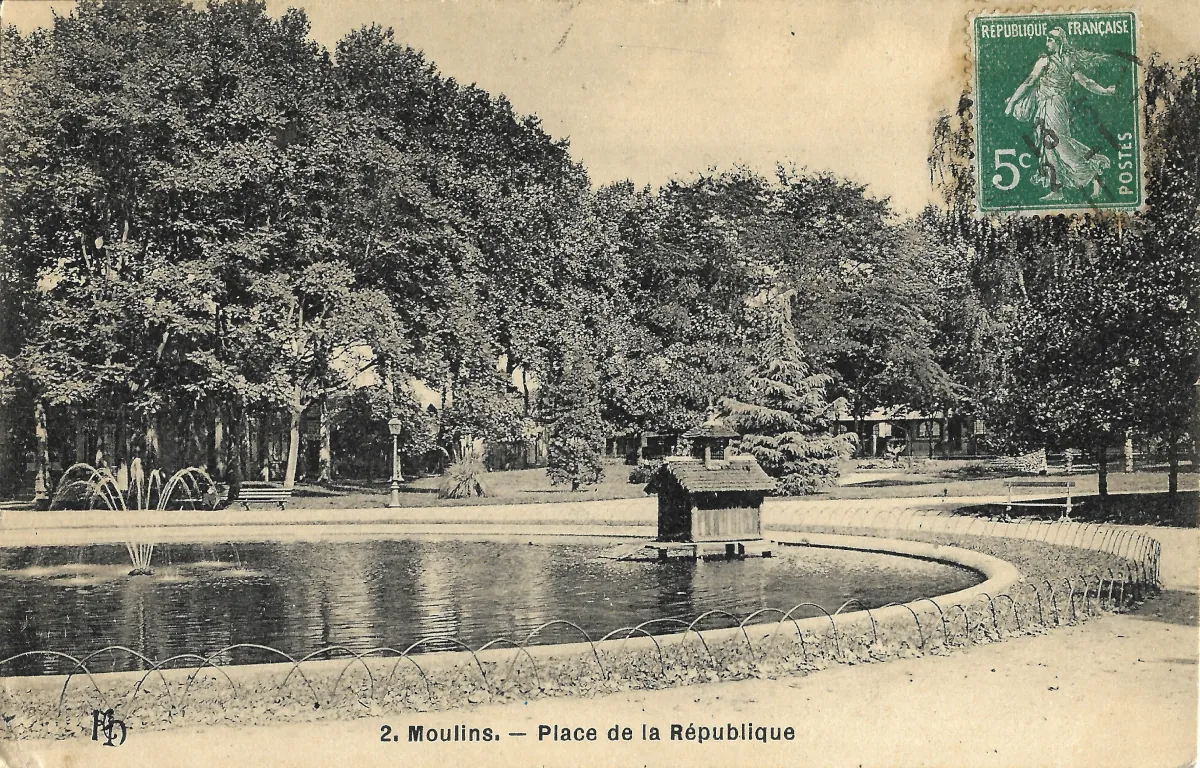
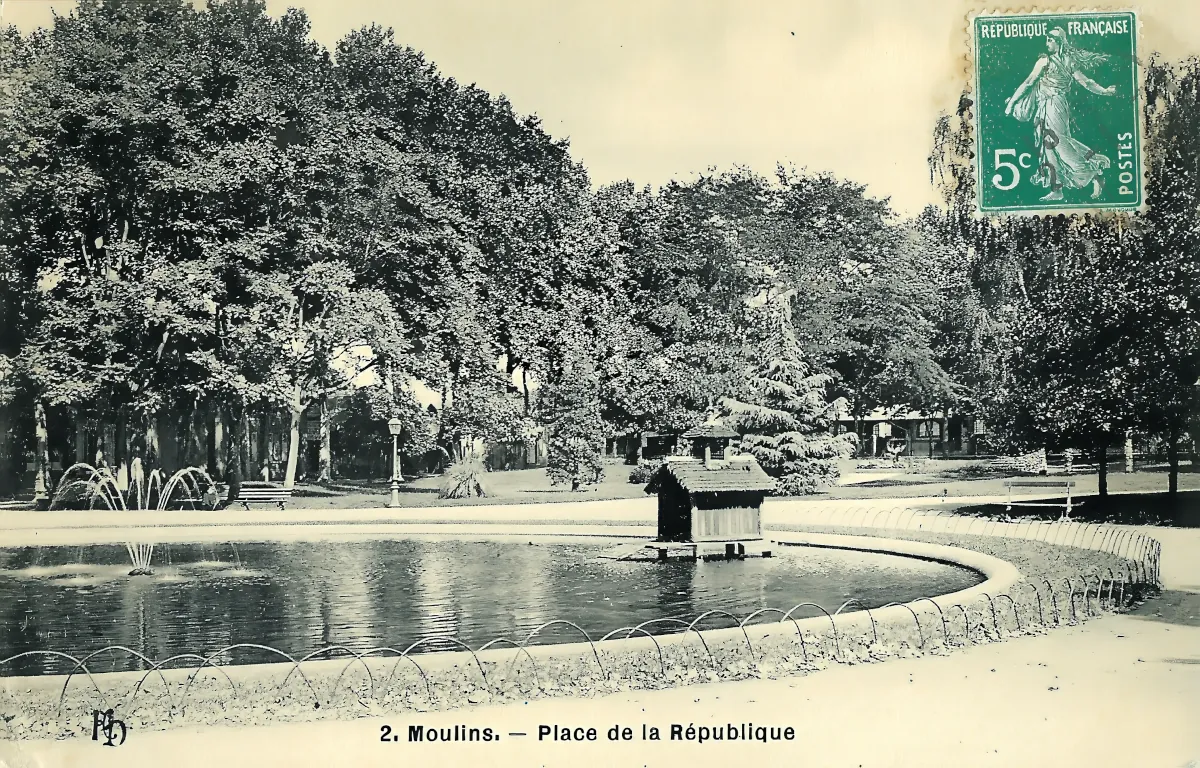
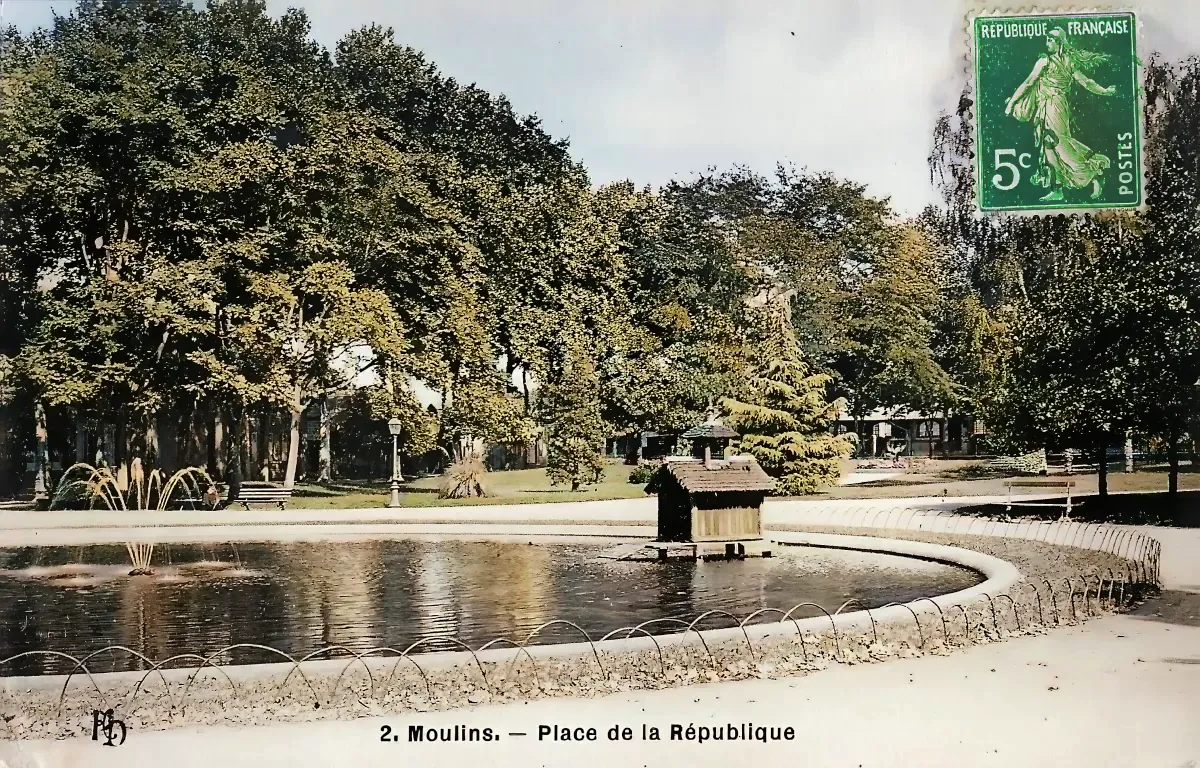
The duck pond on Place de la République, beneath Moulins’ great trees
Publisher series “PD” (likely a regional editor or photographer), card no. 2 — Estimated date: 1905–1915, based on the green 5-centime Semeuse stamp and card format
At the heart of Moulins — the préfecture of Allier and former capital of the Duchy of Bourbon — the Place de la République offered early twentieth-century strollers a cool and leafy retreat, captured here with quiet elegance. The photographer positioned himself slightly above the central pond, whose pale stone rim curves gracefully across the foreground. A charming detail catches the eye: a row of small metal arches runs the entire length of the coping, a practical device to protect the pond’s edge — and perhaps to keep overly curious children or Sunday-afternoon dogs at a safe distance.
At the centre of the pond sits a small artificial island topped by a wooden shelter with a lean-to roof, typical of the duck houses and bird refuges that were fashionable features of French municipal squares during the Belle Époque. This kind of amenity, widely popular in late nineteenth-century public gardens, reflects the care that town councils took to provide their citizens with well-appointed green spaces, somewhere between the English landscape garden and the formal French park. To the left, a multi-jet fountain ripples the water’s surface, while wooden benches — one visible on the left — invite visitors to sit and linger. In the background, a light pavilion or kiosk peeks through the foliage, possibly a gardener’s shelter or a small reading room.
The outdoor shot, taken on a day of full summer foliage, lends the scene a serene and luminous quality despite the black-and-white phototype process. The print displays that soft, slightly warm contrast characteristic of Edwardian-era photography. The stamp affixed to the front — a green Semeuse at 5 centimes, in use from 1903 to 1924 — confirms the card was posted, even if the postmark is not visible here. As for the initials PD in the lower left corner, they most likely identify the local publisher or photographer: a discreet but valuable mark for collectors piecing together the series devoted to Moulins in this period.