Antique Postcard Lake Charles: St. Patrick’s Sanitarium
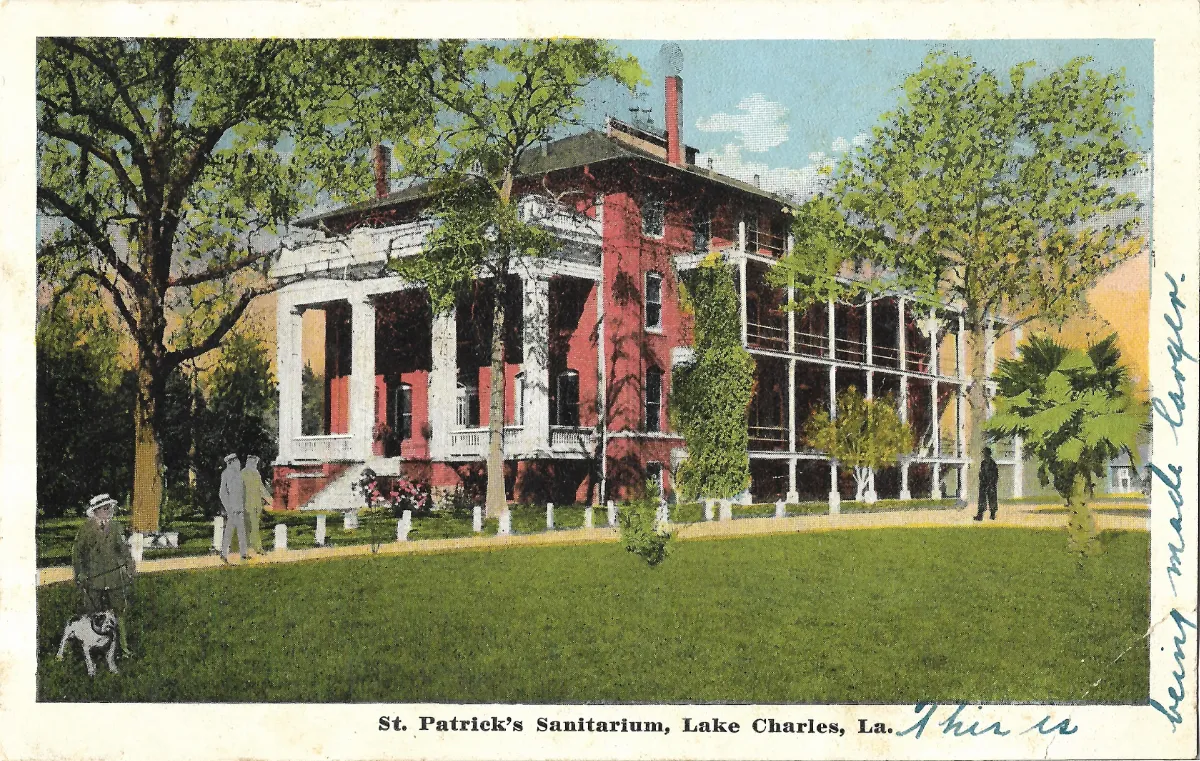
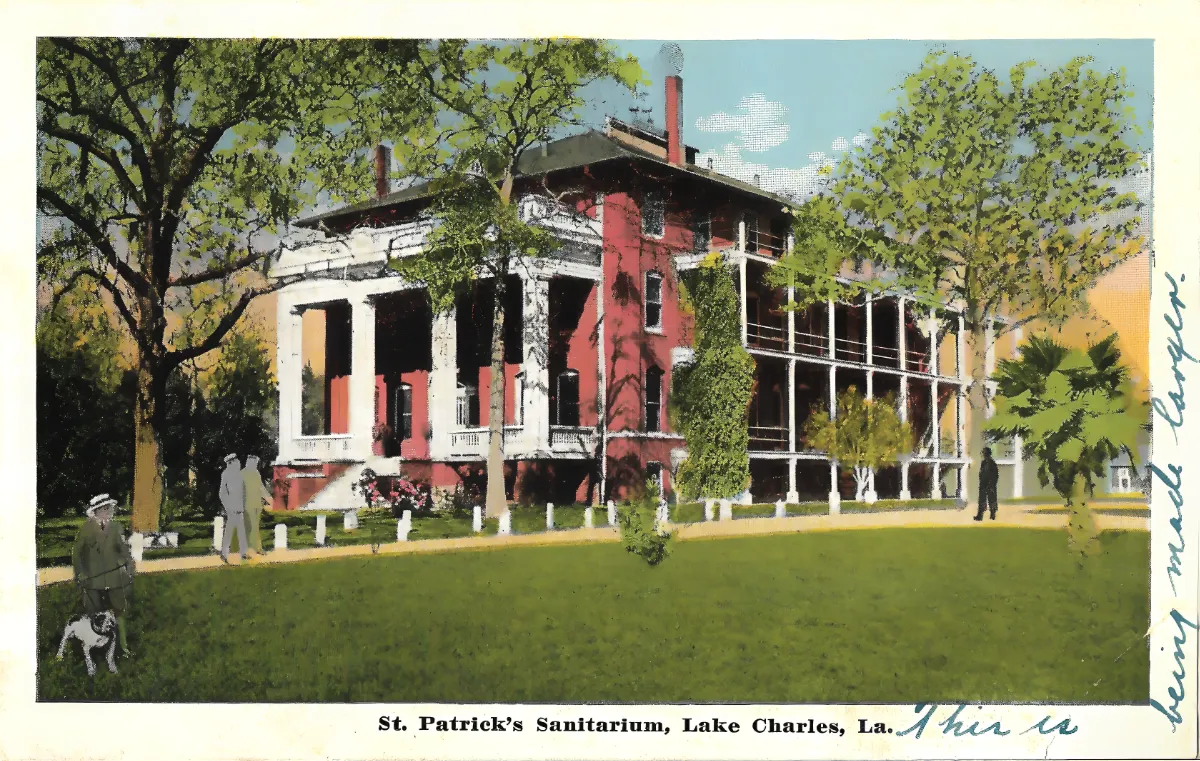
Geographic description: This antique postcard Lake Charles shows an exterior view of St. Patrick’s Sanitarium, an imposing brick building tinted in a reddish-orange hue, located in the city of Lake Charles, Louisiana, near the Gulf of Mexico. The building is captured from the lawn facing it, an open, well-kept expanse bordered by a low white edging (likely stone or painted wood) marking out a walking path. The structure rises three stories and follows an L-shaped plan, with a main wing facing the viewer and a secondary wing extending toward the right of the image. The front façade is organized around a broad two-tier white colonnade: a ground-floor portico supported by neoclassical columns, topped by a covered gallery on the first floor, an architectural feature widely used across the American South to provide shade and encourage natural ventilation of the rooms. The side wing, to the right, repeats this stacked-gallery principle across three levels, culminating in an open gallery tucked beneath the roof cornice, which suggests the structure was expanded beyond its original footprint rather than built as a single unified design. An unidentified climbing vine, possibly wisteria, colonizes the right corner of the building up to the roofline. Two chimneys rise from the shallow-pitched roof, which appears covered in dark tiles or shingles. The grounds are planted with large deciduous trees, likely live oaks, an emblematic species of southern Louisiana, framing the view, along with one or two palm trees visible to the right of the building, a detail consistent with the subtropical climate of the Gulf Coast. Several figures animate the scene: a man in dark clothing stands near the right-hand corner of the path, two figures in light-colored clothing walk side by side toward the building at the center of the image, and, in the foreground on the left, a man wearing a straw boater hat and a light-colored suit stands near a young tree, accompanied by a black-and-white dog, likely a pointer or setter breed. The ground is covered by a manicured lawn, with a flowering shrub bed at the center of the grounds. The name of the institution, “St. Patrick’s Sanitarium, Lake Charles, La.”, is printed in full at the bottom of the card, allowing a certain identification of the location without ambiguity.
Historical description: Dating this antique postcard Lake Charles relies mainly on an analysis of its printing style, since no verso is available for this item: no postmark, stamp, or dated handwritten note can therefore be examined, which limits the conclusions to reasoning from visual clues alone. The white border surrounding the image corresponds to the so-called White Border format, widely used in American postcard publishing between roughly 1915 and 1930; this is the most reliable indicator available for an approximate date range. The building shown corresponds to the former St. Patrick’s Sanitarium of Lake Charles, Louisiana: available research indicates that the institution was dedicated on St. Patrick’s Day in 1908, with fifty beds, an operating room, and a sterilizing room, making it the first hospital in the city. This is externally verified information, distinct from what can be deduced from the image alone. The architectural development visible on the card, the secondary wing with stacked galleries across three levels, considerably larger than a simple original pavilion, suggests an expansion of the institution sometime after its 1908 founding, a hypothesis reinforced by the handwritten cursive note in blue ink visible in the right margin and near the printed caption, which appears to read: “This is being made larger.” This annotation, added by hand by the sender or a previous owner of the card, is a contemporaneous clue to when it was written and strengthens the hypothesis of a date in the 1910s-1920s, a period during which the institution underwent several expansion phases to meet growing demand for care in the southwest Louisiana region. Socially, the presence of strolling figures in day clothing, a boater hat, a light suit, a dog on a leash, reflects a use of the sanitarium’s outdoor grounds as a walking area, for staff, visitors, and convalescing patients alike, a common practice at care institutions of this period, which placed particular emphasis on fresh air, natural light, and outdoor exercise as beneficial to recovery. The institution later became CHRISTUS St. Patrick Hospital, and subsequently CHRISTUS Ochsner St. Patrick Hospital, but nothing on the card itself allows this later renaming to be dated, as it falls outside the period depicted here. Without a verso, it is impossible to confirm whether the card was actually mailed, or to identify the exact publisher of this chromolithographed print; these points would need to be verified through specialized American postcard archives or local collections from Calcasieu Parish.