Antique Postcard Holyrood Abbey: The Ruined Nave, Edinburgh
Geographic description:
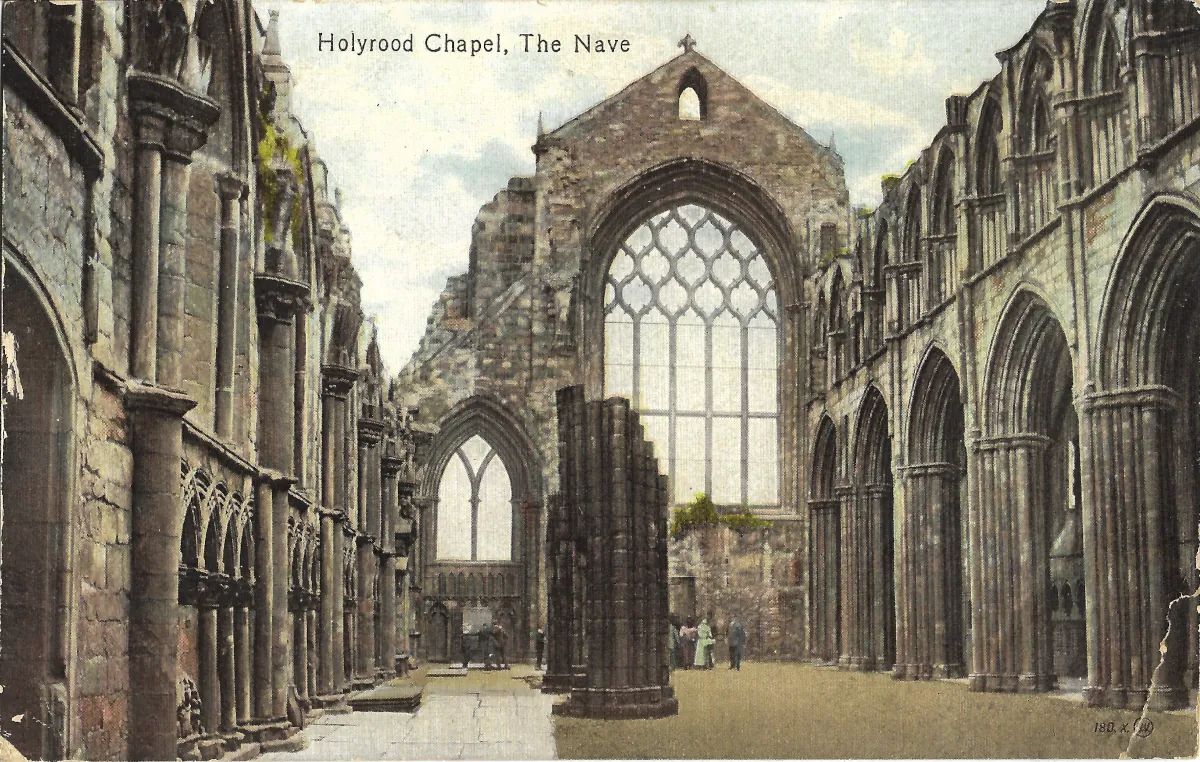
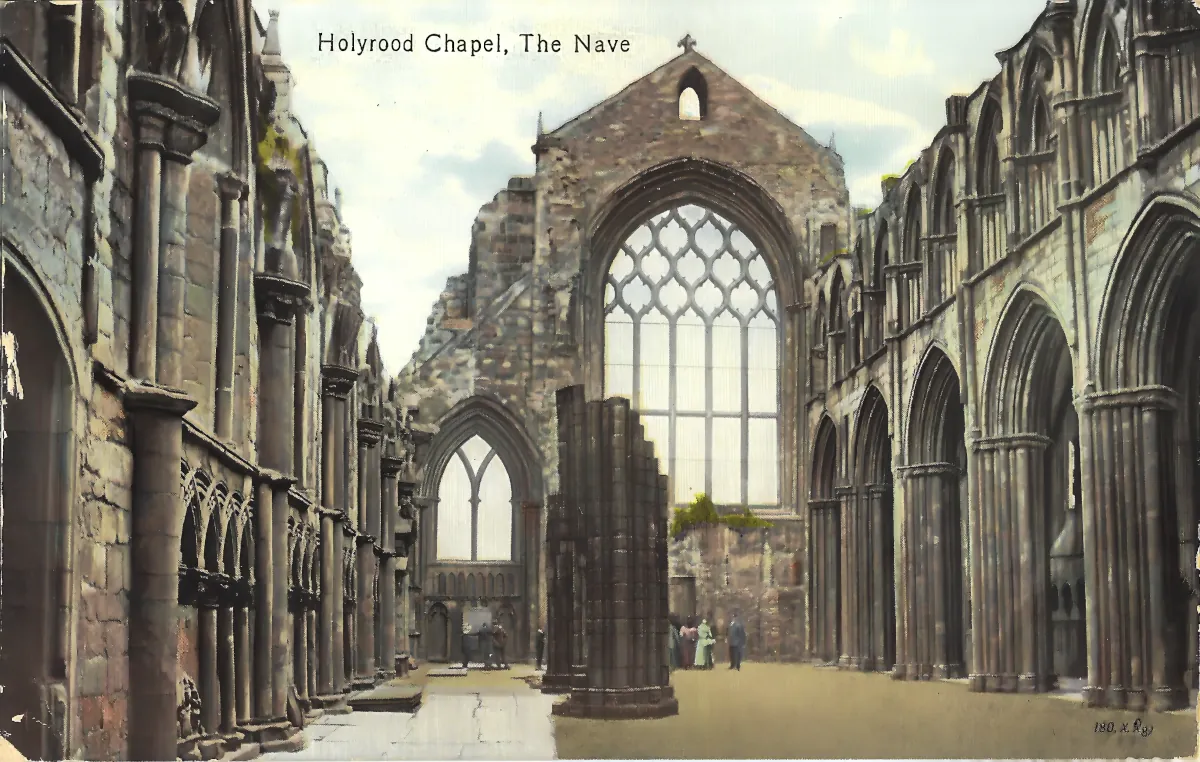
This antique postcard Holyrood Abbey view shows the interior of the nave of Holyrood Abbey, in Edinburgh, Scotland. The caption printed at the top of the image, “Holyrood Chapel, The Nave,” confirms both the location and the framing chosen by the photographer: this is a documented fact rather than a hypothesis, since it is supplied directly by the card’s publisher. The word “Chapel” used here reflects the historical and touristic name commonly applied to this same building during the Edwardian period, whereas present-day heritage literature more consistently refers to it as “Holyrood Abbey.”
The photograph is taken along the axis of the nave from the western entrance, showing in perspective the two rows of Gothic arcades that once flanked the central vessel. These arcades, with their clustered piers typical of thirteenth-century Gothic architecture, are now entirely open to the sky: no trace of vaulting or roof timber survives, and open air alone occupies the space once covered by the building’s roof. At the far end of the perspective stands an imposing stone gable pierced by a large window with flamboyant Gothic tracery, its pattern of lozenges and quatrefoils clearly visible. This is very probably the surviving opening at one end of the ruined nave; its exact orientation (east or west) cannot be established with certainty from the framing of the postcard alone, and therefore remains a reasonable assumption rather than a verified fact.
Several figures in period dress, men in jackets and hats, women in long gowns, stand at the human scale of the building near the centre of the composition, which helps convey the considerable height of the piers and the great window. In the lower right corner of the image, a partially legible printed inscription (in the form “180. X.” followed by a hard-to-distinguish digit) most likely corresponds to a series or negative number assigned by the card’s publisher or printer; the precise identification of that publisher remains undetermined based on the image alone.
Historical description:
Holyrood Abbey was founded in 1128 by King David I of Scotland, immediately adjacent to what would become the Palace of Holyroodhouse, at the eastern end of Edinburgh’s Royal Mile. The building reconstructed between 1195 and 1230 included an eight-bay aisled nave flanked by twin towers at its west front — a layout still discernible in the structure shown on this antique postcard Holyrood Abbey view, despite its ruined state. The abbey hosted several Scottish royal coronations and weddings, including those of James II in 1437 and Charles I in 1633, before entering a gradual decline following the Reformation.
The roofless, open-air state of ruin visible on the postcard results from a precisely dated and well-documented event: a new stone roof, installed in 1758 after several earlier reconstructions, collapsed in two stages during a storm on 2 December 1768. The nave has remained without a roof ever since, gradually becoming a picturesque site visited by nineteenth-century travellers and artists, including the painter Louis Daguerre and the composer Felix Mendelssohn, who found inspiration for his Scottish Symphony there following his 1829 visit. Several restoration proposals, put forward in 1835 and again in 1906, were never carried out, which explains why the building appears today, as on this postcard, essentially in the state left by the 1768 collapse.
The precise printing date of the postcard itself remains, by contrast, a hypothesis based on stylistic clues rather than direct proof, since no postmark or reverse side was available for this analysis. The dark, formal clothing worn by the visitors depicted, along with the absence of a white border around the image (unlike postcards from the later “White Border Era” after 1915), points toward a probable dating within the British “Divided Back” period of postcard production, roughly 1905 to 1915. This range remains a deduction rather than an absolute certainty. The coloring technique applied over a black-and-white photomechanical print is consistent with the semi-artisanal tinting methods widely used by British publishers of tourist views during this period.