Antique Postcard Chablis: The Railway Station, 1904
Geographic description:
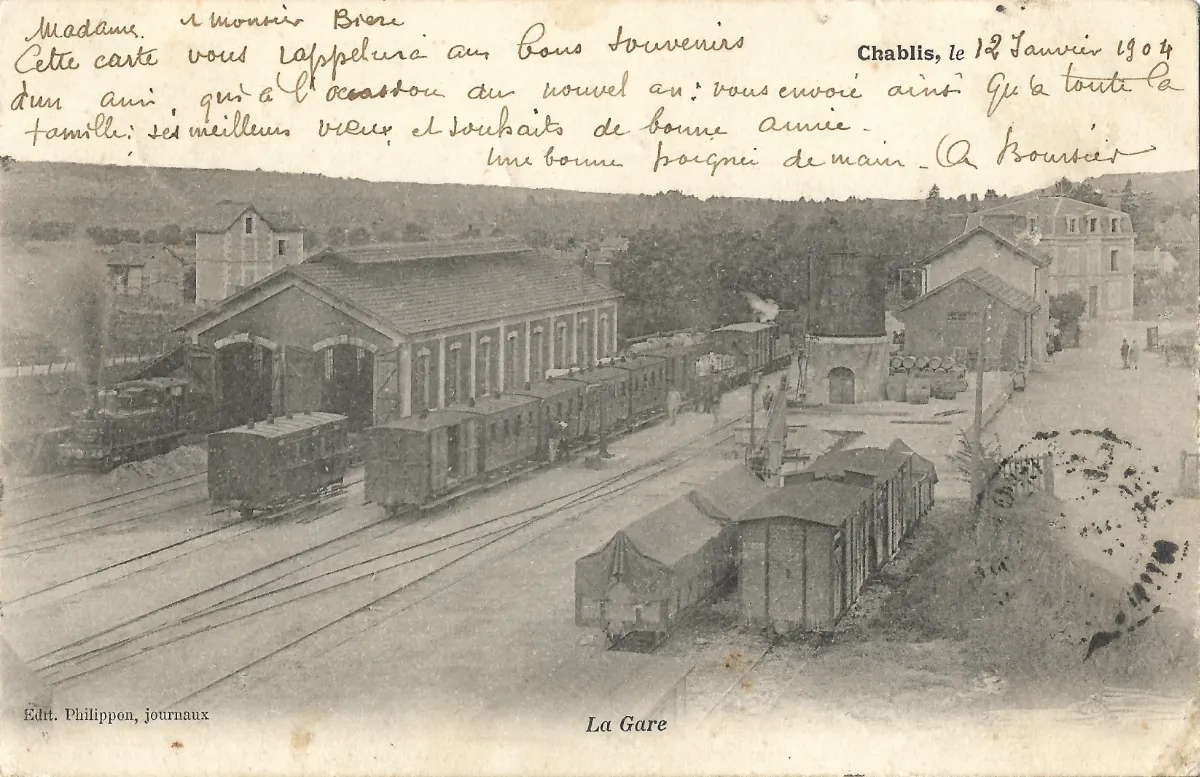
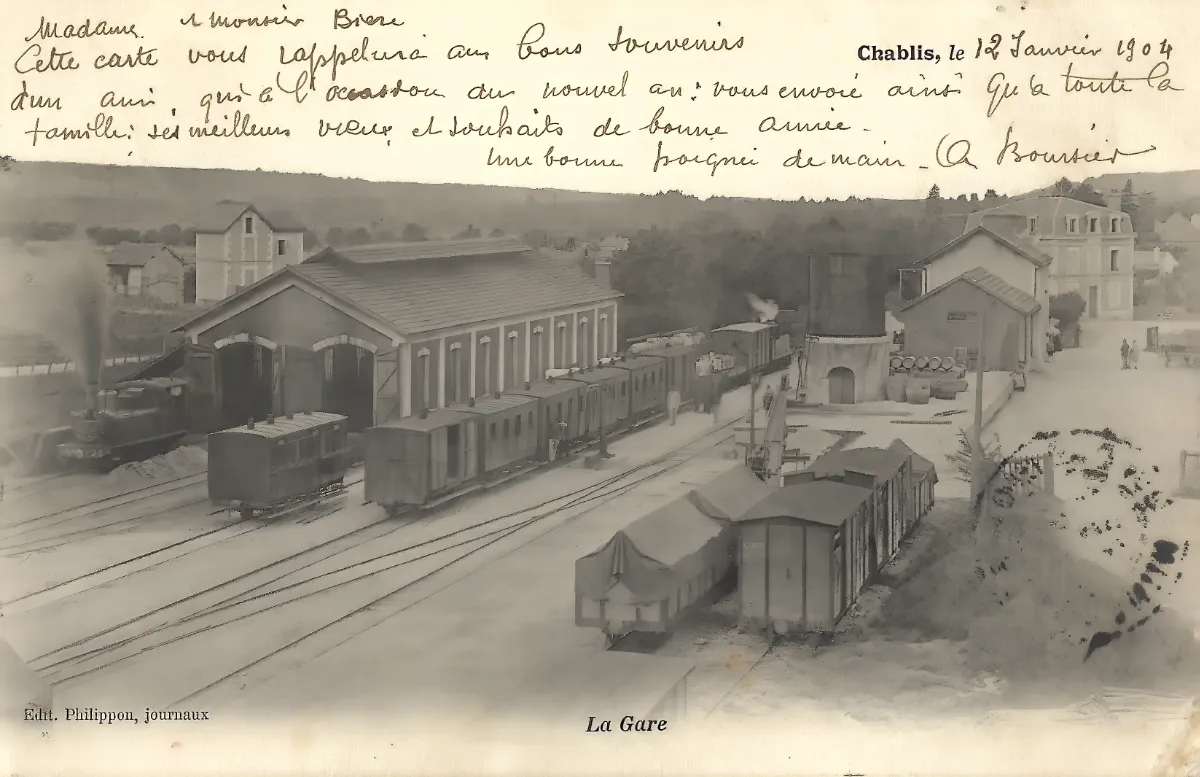
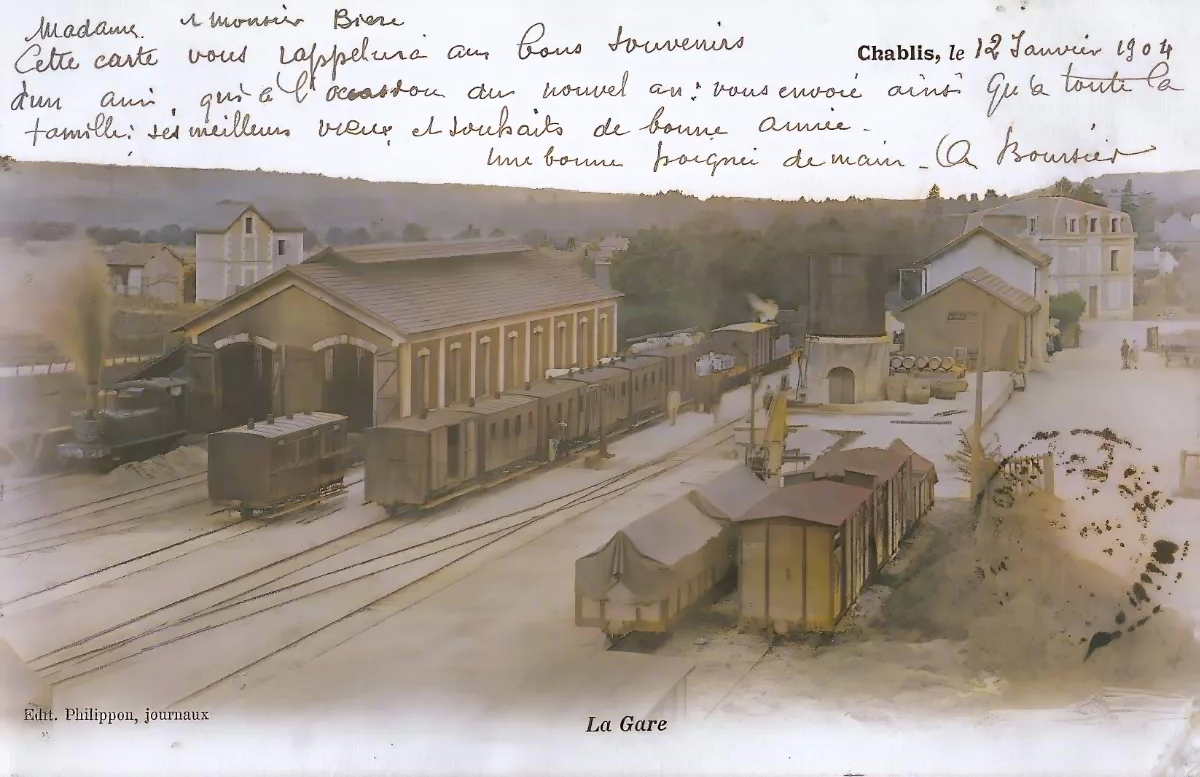
This antique postcard Chablis shows the town’s railway station, photographed from a raised vantage point that takes in the full sweep of tracks and railway buildings. In the left foreground, a steam locomotive coupled to its tender stands on one of the tracks, a thin plume of smoke rising above the main building. It is hauling a train made up of a bogie luggage van, several end-platform passenger carriages, and covered goods wagons, some of them wrapped in tarpaulin sheeting, all typical rolling stock for French secondary lines at the turn of the twentieth century.
The most prominent structure in the scene is the engine shed, recognisable by its steep double-pitched roof and the round-arched openings facing the tracks, which sheltered locomotives for servicing and storage. To its right stands a raised cylindrical structure, most likely a water tower built to supply steam locomotives, a standard fixture of railway infrastructure at the time. Several wine barrels are stacked near this structure, a detail consistent with Chablis’s long-standing reputation for white wine production, already well established by the early 1900s: this suggests the station also handled freight tied to the local wine trade, though that remains an inference drawn from a single visual clue and would benefit from further confirmation.
In the background, several buildings can be made out: to the left, a house with a pointed roof and a dormer window; further along, more modest structures; and, on the right side of the image, a multi-storey bourgeois house with a slate roof and wrought-iron detailing, possibly the stationmaster’s residence or a private home connected to the railway’s operation. The wooded hills visible along the horizon match the rolling landscape typical of the Chablis vineyards, which line the valley of the Serein river.
Telegraph or telephone poles run alongside the main track on the right of the scene, and a cart along with a few human figures can be made out at the far right of the photograph, likely staff or travellers, which brings the composition to life and confirms the station’s everyday use. The sandy ground and the number of parallel tracks point to a crossing or marshalling point rather than a simple halt, suggesting that Chablis station held a certain importance along the local rail line, quite possibly a secondary line serving the wider Yonne département network. This last point would still need confirming through regional railway archives, since the photograph alone does not allow the exact route to be identified with certainty.
Historical description:
No postmark is visible on this recto face of the card, but the handwritten message across the top of the image provides a precise and directly legible date: the sender places and dates the card themselves as “Chablis, le 12 janvier 1904” (Chablis, 12 January 1904). This New Year’s greeting, addressed to a “Monsieur Brère” (the exact spelling of this surname remains uncertain given the cursive handwriting), closes with a warm handshake and a signature that most likely reads “A. Boursier,” though that reading, too, carries some uncertainty.
The fact that this message was written directly across the illustrated side of the card, rather than on the back, is itself a dating clue that reinforces the handwritten date. Until 1904, French postal regulations reserved the back of postcards for the recipient’s address alone, forcing senders to write their message over the picture itself — a format known as an “undivided back” card. The reform allowing the back to be split between address and correspondence only came into effect that same year, 1904, which places this antique postcard Chablis almost exactly at the hinge point between the two conventions, making it a small but telling record of that transition.
The card’s publisher is identifiable in the lower left corner of the image, under the caption “Édit. Philippon, journaux,” indicating a local newsagent named Philippon. He most likely supplemented his press business by publishing postcards depicting local landmarks and infrastructure, a common practice among provincial shopkeepers at the turn of the century, who in doing so helped circulate images of their own towns.
On the physical evidence, the presence of a steam locomotive, the complete absence of any motor vehicle, and the architectural style of both the engine shed and the surrounding houses are all fully consistent with a dating in the very early 1900s and do not contradict the handwritten January 1904 date in any way; this represents a high level of certainty, since the date was explicitly recorded by the sender. The scene captures an ordinary moment in the railway life of Chablis, at a time when the railway likely played a significant economic role in moving wine and other local goods toward major regional trade routes. Checking the municipal archives of Chablis, or local railway history societies, would help confirm the exact line served by this station and its precise period of operation, both of which remain, on the evidence of the image alone, reasoned hypotheses rather than established facts.