Antique Postcard Auvergne: Traditional Regional Costumes
Geographic description:
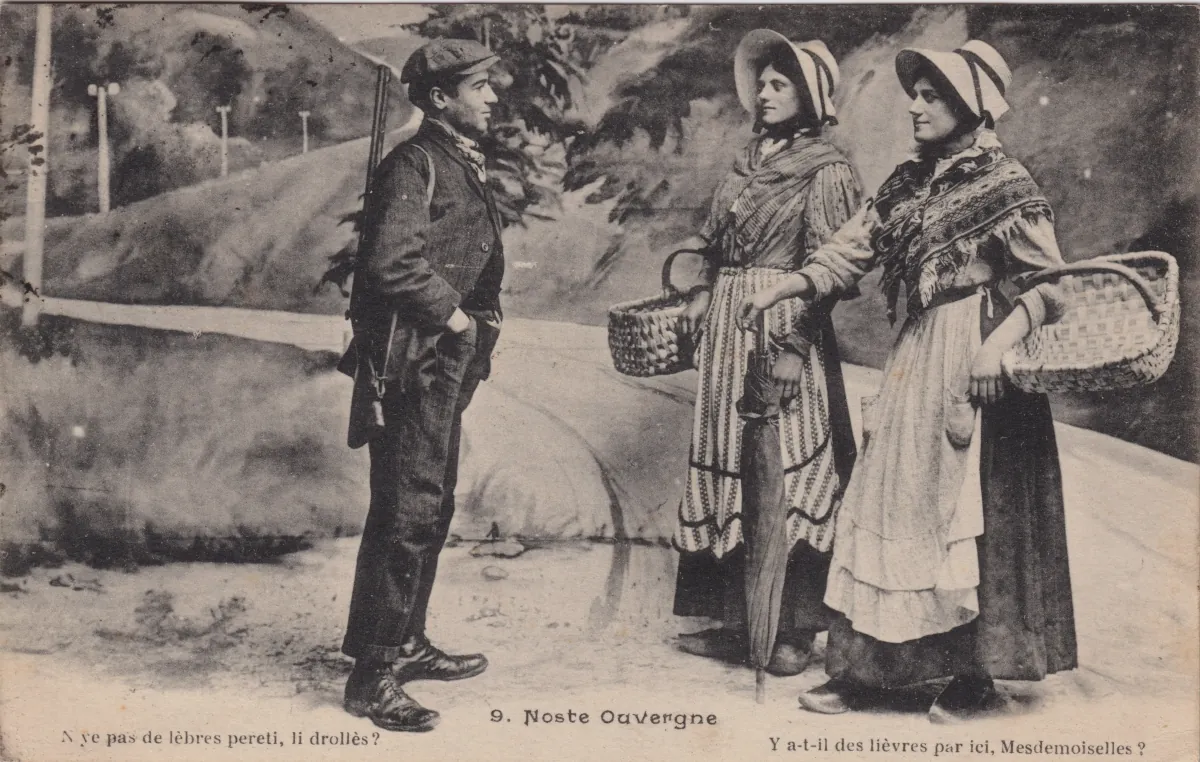
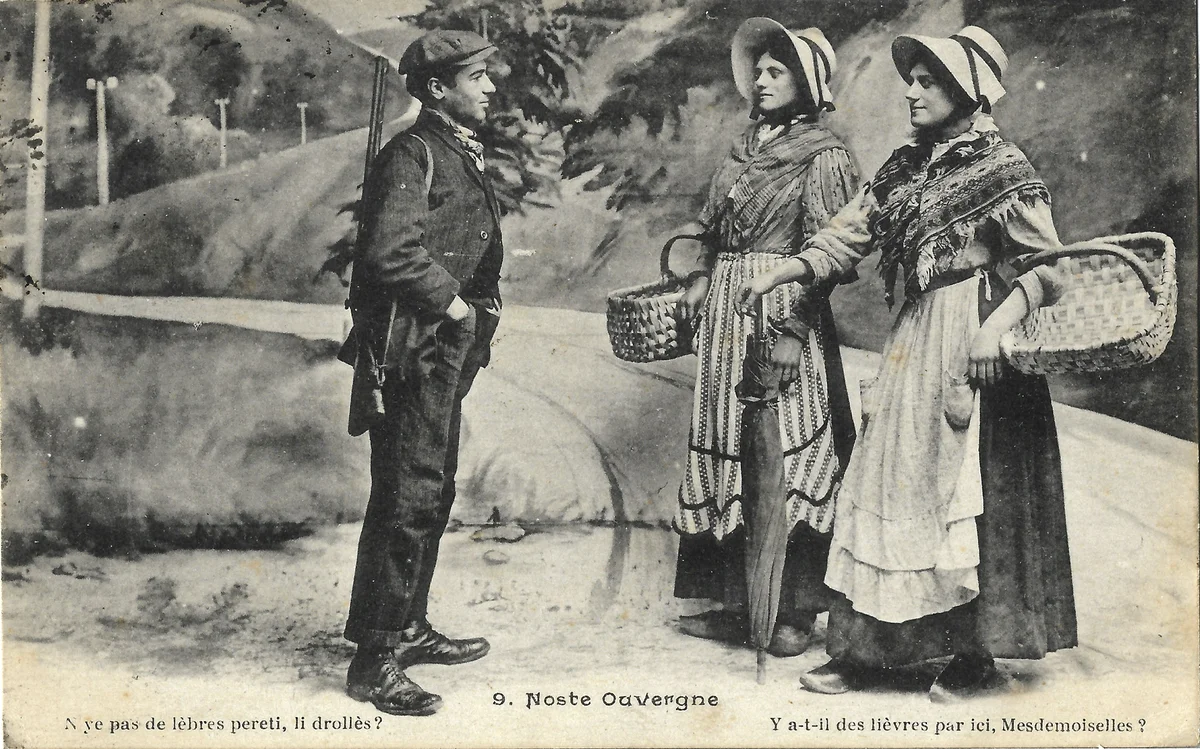
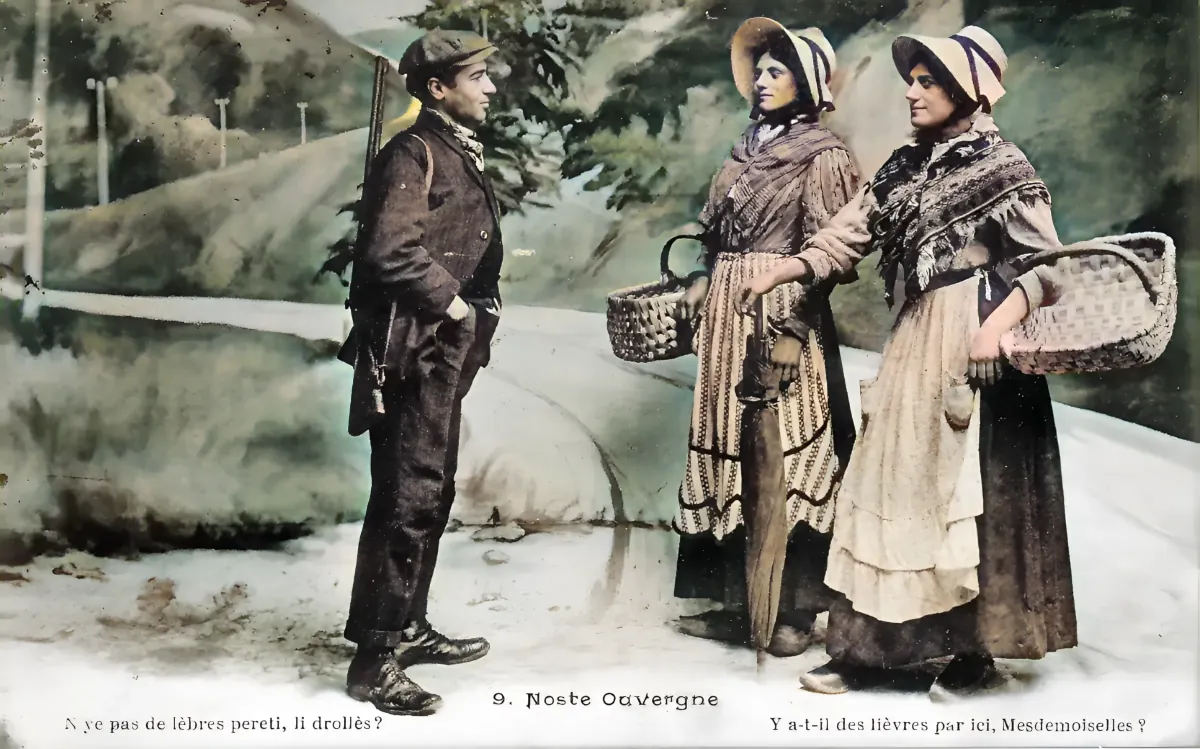
This antique postcard Auvergne stages, against a painted studio backdrop rather than a real topographic view, a genre scene depicting regional Auvergnat “types”: a hunter and two young women in traditional costume. The visible setting — a curving path, a grassy bank, wooden telegraph poles and a few fir trees — is a painted canvas meant to evoke a mid-mountain landscape, probably the Massif Central, without any element allowing a precise locality to be identified. This is therefore not a real urban or village view but a studio composition typical of the “types and costumes” postcard series widely produced in France in the early twentieth century to illustrate regional traditional dress.
The printed title at the bottom of the card, “Noste Ouvergne”, is an Occitan Auvergnat spelling meaning “Our Auvergne”, confirming the ethnographic and regionalist intent of the publisher rather than a documentary intent tied to a specific place. The number “9” visible under the title indicates that this card belongs to a numbered series, presumably devoted to different regional scenes of Auvergne, though the absence of a legible publisher’s name on the front prevents the printing house from being identified with certainty.
The male figure on the left carries a hunting rifle slung over his shoulder, wears a flat cap, a buttoned waistcoat over a shirt, a scarf knotted around his neck and lace-up boots, an outfit typical of the rural hunter or peasant of the early twentieth century in a mountainous area. The two women on the right wear white ribboned bonnets characteristic of traditional Auvergnat women’s costume, fringed shawls crossed over the chest, long aprons and wicker baskets carried on the arm, one of them also holding a closed parasol or umbrella-cane. This combination of garments corresponds to clothing worn at markets or during farm work in the Auvergnat countryside before the First World War, though it remains impossible to pinpoint a specific canton or valley from the visible elements alone.
Historical description:
The photographic style — a static studio pose set against a painted backdrop, frontal framing and the grain typical of early silver-based prints — together with the typography of the printed caption at the bottom of the card, point to a probable dating between 1905 and 1912, a period of heavy production of illustrated postcards in France, before white-bordered postcards became the norm after 1914. No postmark, stamp or handwritten note is visible on this front side, which makes it impossible to confirm a precise mailing date; only an examination of the back, if it carries a stamp or postal cancellation mark, could narrow this chronological range further.
The printed text at the bottom of the card forms a humorous bilingual exchange: the caption on the left, written in Auvergnat Occitan, “N’ye pas de lèbres pereti, li drollès?”, is rendered on the right in standard French, “Y a-t-il des lièvres par ici, Mesdemoiselles?”, meaning “Are there any hares around here, young ladies?” This bilingual Occitan-French structure is characteristic of regionalist postcards published at the turn of the twentieth century, at a time when the Auvergnat dialect remained widely spoken in the countryside while coexisting with French-language schooling imposed under the Third Republic.
The scene belongs to the register of the flirtatious or humorous postcard: the hunter’s question to the two young women, framed as an inquiry about game, the hares, carries a thinly veiled allusion to a chance encounter between a man and two young women on an isolated country path, a comic device widely used in the popular imagery of the period. This type of card had no strict documentary purpose: it was a commercial product aimed at tourists, holidaymakers or Auvergnat expatriates wishing to send relatives a picturesque image of their home region, at a time when rural exodus toward Paris and other major French cities was already substantial.
It can therefore be stated with a high degree of confidence that this card belongs to a commercial series of regional “types”, and with a lower degree of confidence that it dates precisely from 1905 to 1912, this range resting solely on indirect stylistic clues rather than on any explicit date appearing on the document.