Antique Postcard Trenton State Prison Entrance Gate
Geographic description:
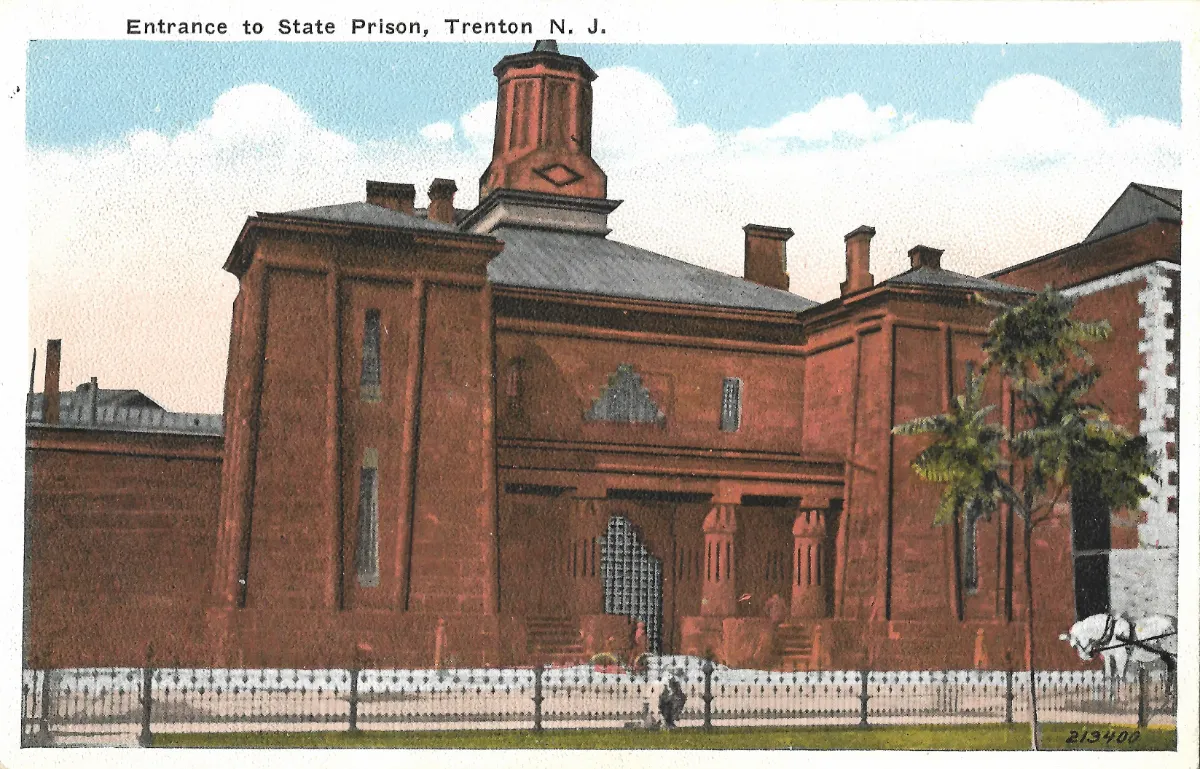
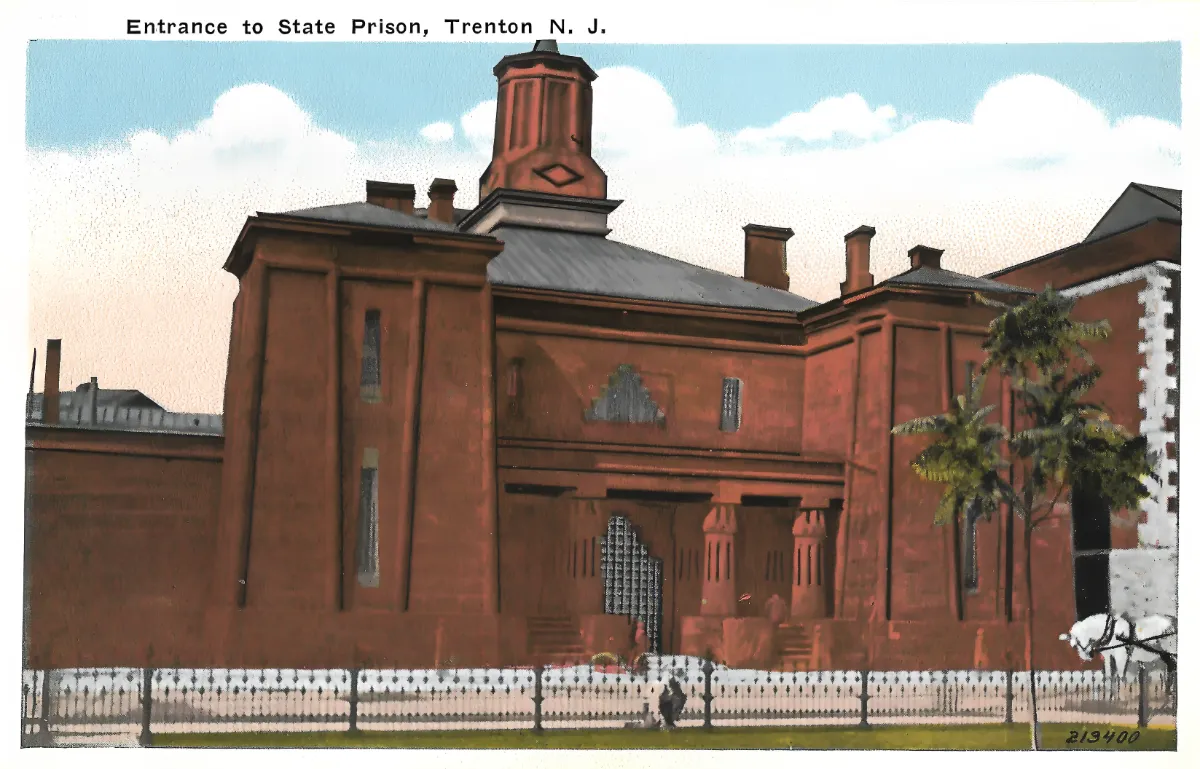
This antique postcard Trenton State Prison view shows the main entrance of the New Jersey State Prison, as confirmed by the printed caption at the top of the card: “Entrance to State Prison, Trenton N. J.” The building itself, photographed and then hand-tinted according to the standard colorization process used for early twentieth-century postcards, displays a massive castellated architecture typical of large American penitentiaries built during the nineteenth century. The facade, rendered in a deep reddish-brown stone or brick tone, is structured by heavy vertical buttresses that give the whole composition a fortress-like appearance. At the center rises a crenellated tower topped with a diamond-shaped ornament, an unusual decorative detail that distinguishes this otherwise austere institutional facade. On either side of the tower, several squat chimneys emerge from a slate or grey metal roof, suggesting a substantial internal heating system consistent with the building’s institutional function.
The entrance itself is marked by a raised portico, reached by a short flight of steps, and closed off by a dense metal gate resembling a portcullis or a security grille. This gate, combined with the thickness of the walls and the near-total absence of ground-floor windows, visually reinforces the security function of the site. In the foreground, an ornamental cast-iron fence with a repeating pattern marks the boundary between the public street and the prison grounds; this type of fencing was typical of institutional street furniture of the period, intended both for security and for a degree of aesthetic presentation of an official public building. A well-developed tree occupies the right side of the composition, adding a touch of vegetation against the otherwise mineral tone of the scene. Also on the right, part of a horse and cart is visible at the edge of the frame; no automobile appears anywhere in the image, which is a relevant dating clue, though not conclusive on its own. In the lower right corner, a printed number, “213400,” is visible, most likely a negative or print reference used by the printer; no publisher’s name is legible on the front of the card, which prevents any firm attribution to a specific publishing house.
Historical description:
The printing style of this postcard, with its white border framing the image and its plain typographic caption at the top, corresponds to the production style that collectors commonly refer to as the “White Border Era,” a period running roughly from 1915 to 1930 in the United States. This dating remains a hypothesis based on the print format rather than direct postal evidence, since the back of the card has not been supplied: no postmark, stamp, or handwritten message can therefore be examined to confirm or narrow this chronological range. In particular, the absence of a verso limits any conclusion about the sender, the recipient, or the exact date the card was mailed.
The presence of a horse-drawn vehicle rather than an automobile in the visible field is an additional, though cautious, clue: animal-drawn vehicles continued to circulate, including near official buildings, well after automobiles became widespread during the 1910s and 1920s, particularly for utilitarian purposes such as delivery or maintenance work. This element alone therefore cannot narrow the dating beyond the range already suggested by the printing style; at most it serves as a converging indicator rather than firm proof.
In general historical terms, American state penitentiaries built during the nineteenth century frequently adopted an architectural vocabulary drawn from Gothic Revival or Romanesque Revival styles, considered appropriate for visually expressing the authority and punitive function of the institution; crenellated towers, thick walls, and reduced window openings answered both a security requirement and a symbolic intention. It is likely, though not something the image alone can document with certainty, that the building shown here corresponds to a construction phase considerably earlier than the postcard’s own publication, since photographic postcard views of a building were typically issued decades after the structure’s completion. In any case, the document’s function remains that of a scenic view card intended for the tourist or local documentary trade, a very common use for notable institutional buildings of the period, whether prisons, courthouses, or town halls. Further verification through Trenton municipal archives or databases dedicated to New Jersey’s penitentiary history would help refine the dating and, potentially, identify the card’s publisher from the “213400” reference number visible on the front.