Antique Postcard Trenton: The Junior High School, NJ
Geographic description:
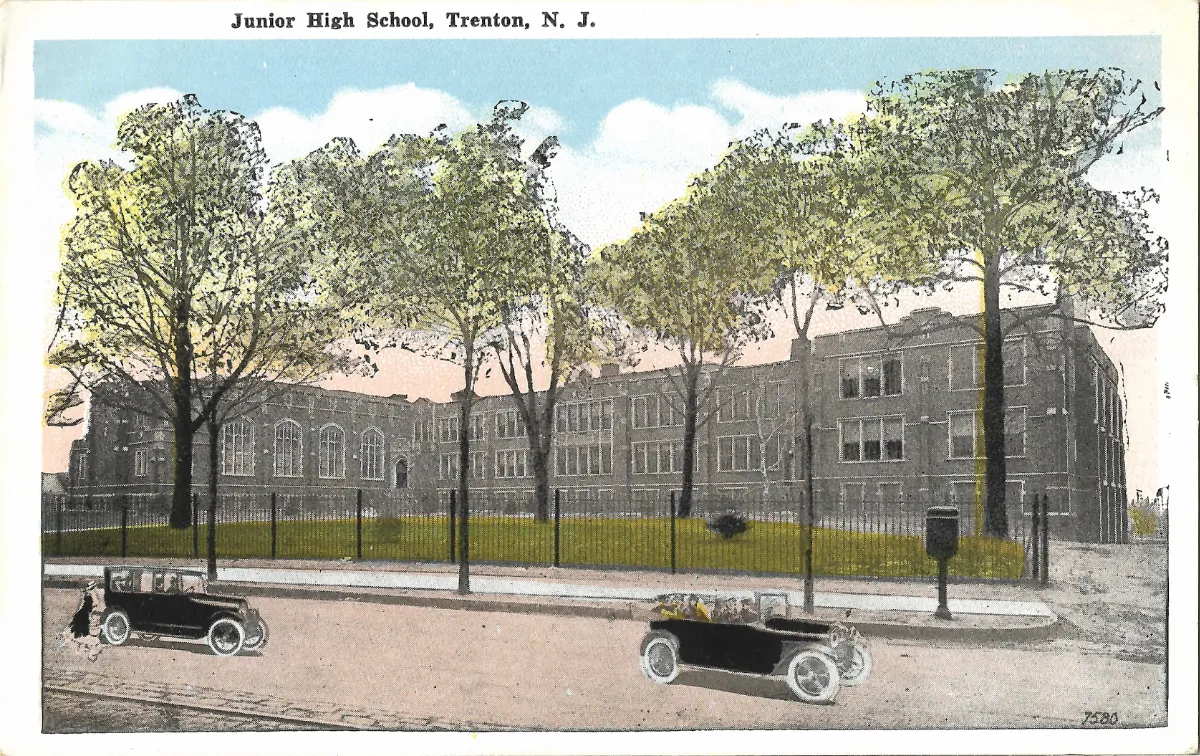
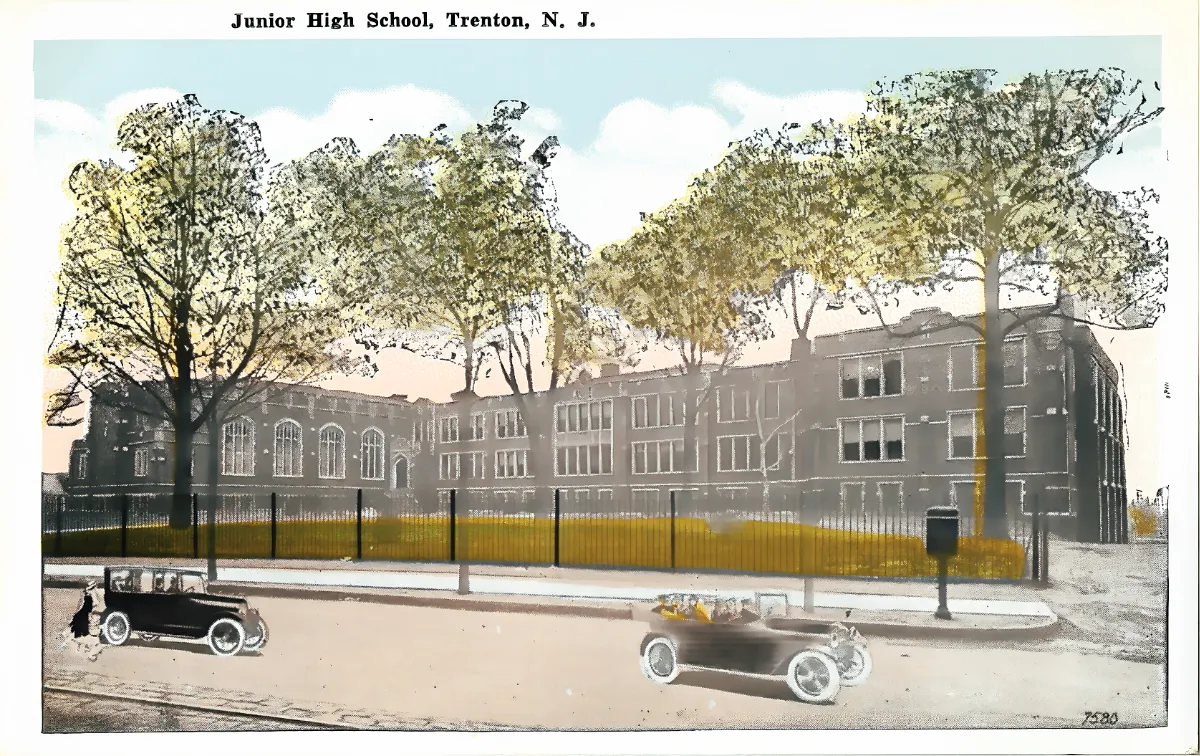
This antique postcard Trenton view shows the front facade of a school building identified by the printed caption “Junior High School, Trenton, N. J.” The structure is a three-story red brick building laid out in the symmetrical composition typical of early twentieth-century American school architecture: a left wing pierced by tall, gently arched windows at ground level, drawing on a Collegiate Gothic vocabulary common to school buildings of the period, and a longer main block marked by regular rows of rectangular windows on the upper floors. The caption tells us the building’s function, a junior high school, meaning a lower-secondary institution serving students of roughly twelve to fifteen years of age, a school type that was rapidly expanding across the United States at the time, and its location in Trenton, New Jersey, but it does not name the specific institution. Because Trenton historically operated several junior high schools built or expanded during the 1910s and 1920s, it is not possible from this image alone to determine with certainty which particular building is depicted. Checking Trenton’s municipal or school-district archives, or a local genealogy society, would help confirm the exact identity and address of the school. This card falls under the site’s secondary category of non-French antique postcards, in this case an American card from New Jersey.
The school grounds are enclosed by a wrought-iron fence set on a low wall, separating the maintained lawn from the sidewalk and street. A central walkway visible between the fence posts likely leads to the building’s main entrance. The sidewalk is lined with mature, fully leafed trees planted at regular intervals, suggesting a deliberate landscaping scheme typical of institutional and residential streets in North America during this era. Rail tracks visible in the foreground of the roadway indicate that the building stood on or near a street served by an urban streetcar line, a common mode of transportation in mid-sized and large American cities before streetcars were gradually phased out in the mid-twentieth century.
Two open touring cars are parked along the curb, one on the left with its folding top partly raised, the other on the right fully open. Their dark bodywork, spoked wheels, and general silhouette are consistent with the touring-car style produced in the early 1920s. A pedestrian figure, apparently a woman accompanied by a small animal, is visible near the car on the left, adding a touch of everyday life to the scene. In the lower right corner of the image is a printed number, “7580,” most likely a catalogue reference assigned by the postcard’s publisher, though the publisher itself cannot be identified without examining the reverse of the card.
Historical description:
Several visual clues converge to suggest a probable date range for this antique postcard Trenton view. The image’s graphic treatment, a black-and-white photograph enhanced with pastel colors through a tinted halftone printing process, combined with the plain white border framing the whole view, corresponds to the so-called “White Border” format that dominated the American postcard industry from roughly 1915 to 1930. This format gradually replaced the earlier full-bleed cards produced in the previous decade and was itself later supplanted by the textured “Linen” cards that became common from the early 1930s onward.
The two automobiles parked in the scene reinforce this dating hypothesis. Both are open touring cars with spoked wheels and no rigid closed body, and their overall proportions, along with the shape of the fenders and hood, are consistent with American automobile production of the very early 1920s, rather than with the more streamlined, curved-fender models that became standard by the middle of that decade. Without a clear view of the radiator grilles or license plates, this remains a reasoned hypothesis rather than a firm conclusion.
The rise of junior high schools in the United States, as institutions distinct from elementary schools and full high schools, took hold specifically during the 1910s and 1920s, as part of a broader reform of American secondary education aimed at creating an intermediate tier for students around twelve to fifteen years old. The construction or opening of such a school in Trenton fits within this wider movement, driven in part by the city’s demographic and industrial growth; Trenton was at the time a significant manufacturing center in New Jersey, known for pottery, rubber goods, and metalworking. This context helps frame the likely period of construction but does not pin down the exact date the photograph was taken, since the building may have been photographed some years after it first opened.
The absence of a scanned reverse side for this card significantly limits further analysis: no postmark, stamp, or handwritten message is available to confirm or refine the proposed dating, or to establish whether the card was actually mailed or simply kept unused. The number “7580” printed on the front is most likely a publisher’s catalogue reference, though the publisher’s identity remains undetermined without further evidence. Based on the available clues, a date range of approximately 1918 to 1925 appears the most plausible, held with moderate confidence, based on the convergence of the White Border format and the style of the automobiles shown. Further research through Trenton’s school district archives or New Jersey local history societies could help confirm the exact building and narrow this chronological estimate.