Antique Postcard Plaza Hotel New York: The Hotel and the Sherman Monument
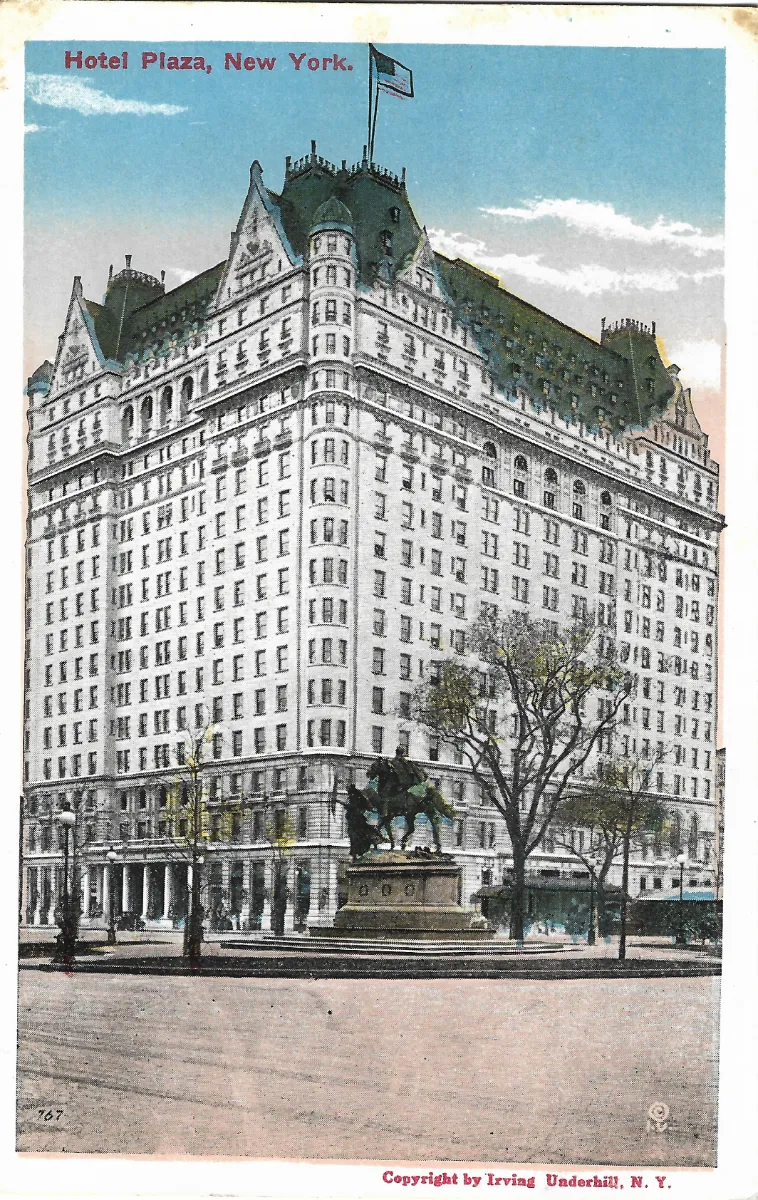
This antique postcard Plaza Hotel New York offers a low-angle view of the imposing Plaza Hotel, standing at the corner of Fifth Avenue and Central Park South, with the equestrian monument to General William Tecumseh Sherman prominently placed in the foreground. The building is identified by the hand-lettered red caption “Hotel Plaza, New York” in the upper left corner, and rises eighteen stories in a French Renaissance chateau style typical of New York’s grand hotels of the early twentieth century. The pale stone and white brick facade is richly composed: an arcaded, colonnaded ground floor, several evenly aligned tiers of windows, and a dramatic crown of green-toned copper mansard roofs, dormer windows with sculpted pediments, corner turrets, and ornate chimney stacks. A flagpole rising from the corner bay flies the American flag, the single vivid touch of color against a flat, stylized blue sky with rounded clouds, characteristic of the hand-tinted postcard aesthetic of the period.
In the foreground, the equestrian monument depicts a mounted officer in military uniform preceded by a winged female figure carrying a palm branch, an arrangement matching the well-documented iconography of General Sherman led by an allegorical figure of Victory. The statue rests on a granite pedestal at the center of a semicircular plaza bordered by trees still sparsely leaved, suggesting the photograph was taken in early spring or late autumn. Ornamental lampposts, a grassy verge, and a paved border define this public space, while in the background to the right lower commercial buildings with awnings and a simpler structure, likely a shopfront or annex building, face the avenue. The wide, light-colored street occupying the lower portion of the card shows no clearly identifiable vehicles; the image resolution does not allow a confident distinction between horse-drawn carriages, streetcars, or early automobiles. Small pedestrian figures appear near the hotel’s colonnaded entrance, but their clothing cannot be resolved in enough detail to support any reliable conclusions about fashion or social class.
The number “767” printed in the lower left corner most likely corresponds to a series or catalog number assigned by the postcard’s publisher, a common practice among illustrated postcard publishers of the era. A second small monogram in the lower right corner likely represents a publisher’s or printer’s mark, but its size and stylized design prevent a confident identification from the image alone.
Historical description:
The printed credit “Copyright by Irving Underhill, N. Y.” at the bottom of the card is a reliable, directly observable clue: Irving Underhill (1872-1960) was one of the most active commercial photographers in New York City during the first half of the twentieth century, specializing in city views supplied to numerous postcard publishers for hand-colored reproduction. This biographical fact is documented by external sources rather than deducible from the image alone, but it helps situate this antique postcard Plaza Hotel New York within the broader wave of early twentieth-century New York postcard photography; Underhill is known to have supplied images of comparable landmarks across this period, including the Botanical Garden in 1905, the Belmont Hotel in 1906, the Singer Building in 1909, and the corner of 34th Street in 1910, indicating sustained activity through exactly this window of time.
The building shown can only be the current Plaza Hotel, which opened on October 1, 1907, after the demolition of an earlier hotel of the same name on the site; this date functions as a firm chronological floor, since the card cannot have been produced before that opening. The Sherman equestrian monument, for its part, was unveiled in 1903, several years before the present hotel was completed; its joint appearance with the hotel in its finished state confirms that the scene postdates 1907. Without access to a postmark or handwritten message on the reverse — not provided here — it is not possible to narrow the date to a specific year based on postal evidence; this limitation should be stated plainly rather than filled in by assumption.
Several stylistic clues nevertheless support a reasonable dating hypothesis, held with moderate confidence. The hand-tinting technique applied over a photographic halftone base, combined with a red capitalized caption printed directly onto the sky, matches conventions widely used by illustrated postcard publishers roughly between 1905 and 1915, before the “white border” format became dominant from the mid-1910s through the 1930s. This particular card shows no white border framing the image, which tends to place its production before that later convention took hold, more plausibly within the decade immediately following the hotel’s 1907 opening — approximately 1908 to 1915. This range remains a hypothesis grounded in observed publishing conventions, not a certainty.
Regarding color choices, the equestrian statue is rendered in dark, greenish, bronze-like tones rather than gold, even though Augustus Saint-Gaudens’s sculptural group was originally gilded. This should not be read as evidence that the gilding had faded or disappeared by the time the photograph was taken: postcard colorists of the period routinely applied conventional or approximate tints with little direct relationship to the actual appearance of the subject photographed. This is therefore a purely visual observation and should not be confused with a verified historical fact about the statue’s condition.
As for its likely use, a card of this type, depicting a luxury hotel frequented by wealthy New York and international guests, fits squarely within the flourishing market for prestige and tourist postcards of the early twentieth century, often sold to visitors as souvenirs or mailed home to illustrate a trip to New York. This commercial and touristic function remains a plausible hypothesis consistent with the subject matter, but it cannot be confirmed without the information on the reverse, such as a handwritten message or postal cancellation that would clarify how this particular example was actually used. Further verification through specialized American postcard archives or publisher databases could help refine the identification of the small monogram visible in the lower right corner and, by extension, the dating proposed here.