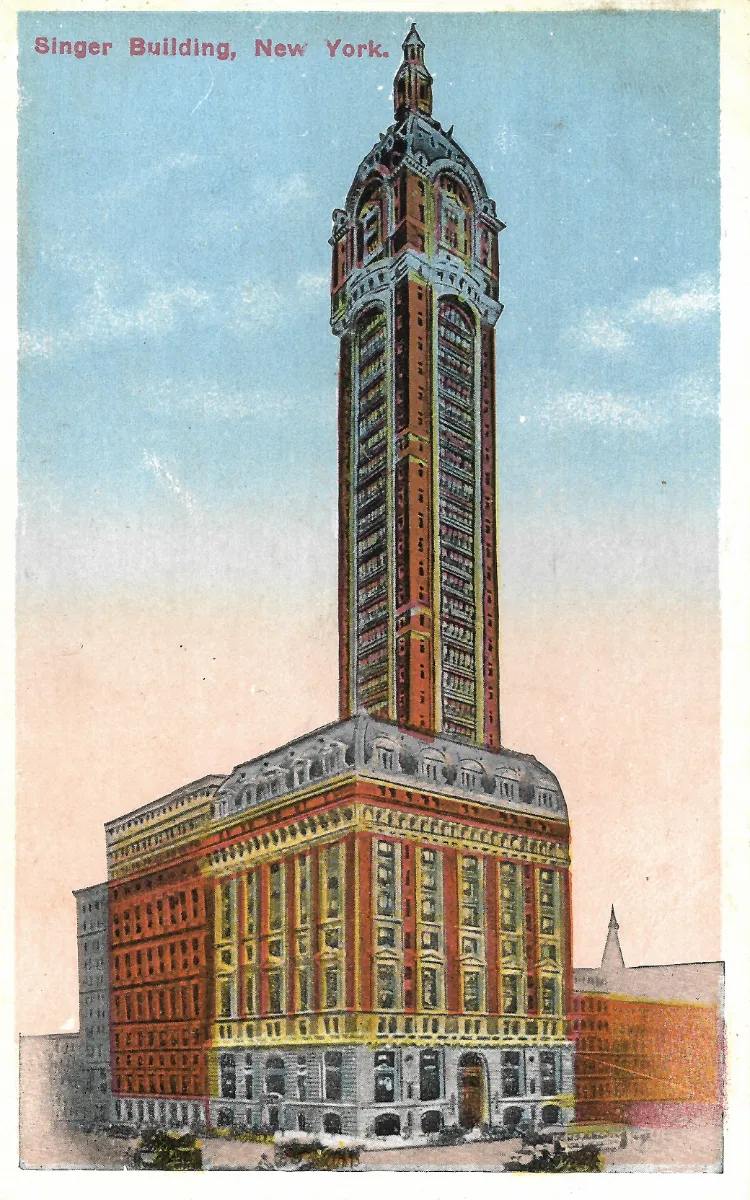
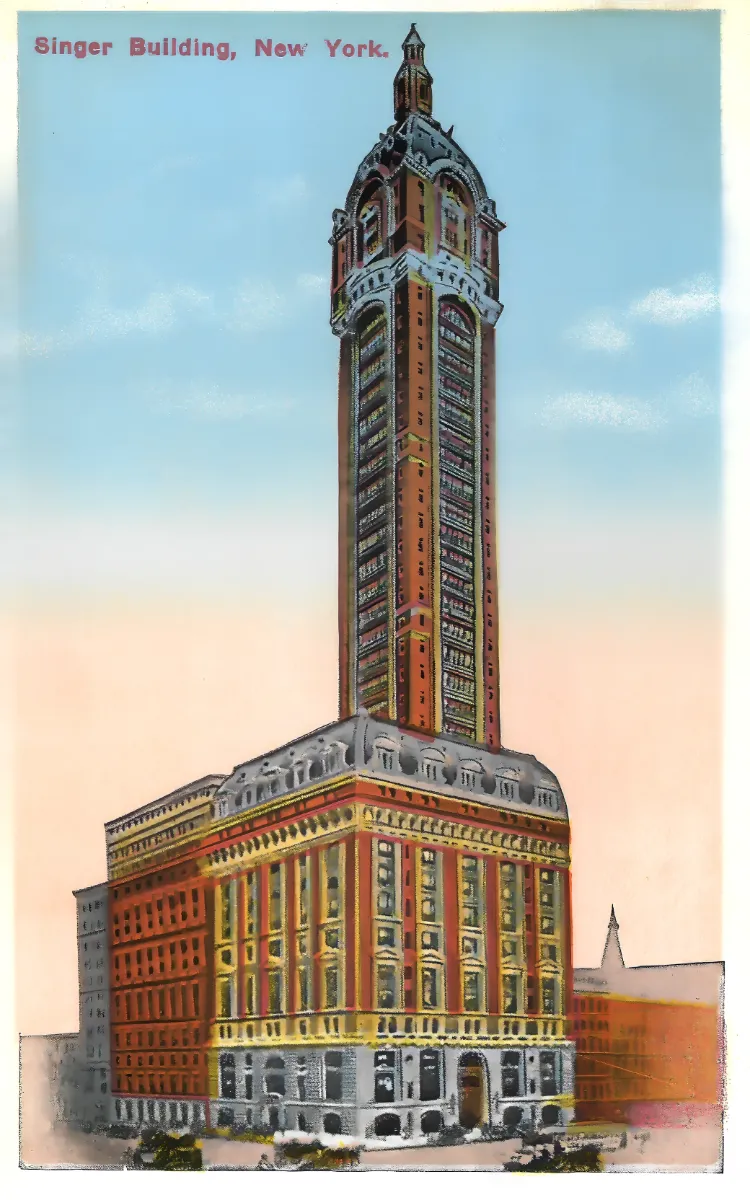
Antique Postcard Singer Building, New York Tower (1908)
Geographic description: This antique postcard Singer Building depicts the famous tower of the Singer Manufacturing Company in New York, whose name is printed directly in red lettering in the upper left corner of the card: “Singer Building, New York.” This printed caption provides a certain identification of the subject, not a hypothesis. The illustration, a hand-tinted chromolithograph typical of early twentieth-century tourist postcards, shows a sky gradient from blue to pale pink, a common device used at the time to emphasize the verticality of skyscraper views. The base of the structure is broad and massive, with a red brick facade accented by pale stone or terracotta banding, arched windows, and an ornate cornice separating the base from the tower above. Rising from this base is a narrow, slender tower organized in vertical bays of windows, culminating in an ornamented lantern topped by a slim spire. The overall silhouette combines a neoclassical Beaux-Arts base with a crown reminiscent of the French Second Empire style, including a domed cap and decorative ironwork visible near the top. At street level, small stylized shapes suggest vehicles or horse-drawn carriages moving along the road, though their exact nature (automobiles, carriages, streetcars) is difficult to confirm with certainty given the small scale and stylized rendering of the drawing; this observation should therefore be treated with caution. In the background to the right, a pointed spire rises above the surrounding rooftops, which could correspond to a nearby church steeple in the Broadway area, though this identification remains an unconfirmed hypothesis based solely on the visual elements available in this image.
Historical description: The historical analysis is grounded in the certain identification of the depicted structure as the Singer Building, located at the corner of Broadway and Liberty Street in Manhattan’s Financial District. This skyscraper was designed by architect Ernest Flagg for the Singer Manufacturing Company, the well-known sewing machine manufacturer. Construction of the tower, begun in 1906 to expand an earlier building already designed by Flagg on the same site, was completed in 1908. Rising to roughly 612 feet (187 meters), the Singer Building tower was, upon completion, the tallest office building in the world, a title it held for only one year until the Metropolitan Life Insurance Company Tower was completed in 1909. Its architectural style, blending a Beaux-Arts base with a crown inspired by the French Second Empire, made it one of the most heavily ornamented buildings on the early twentieth-century New York skyline. The building quickly became a favorite subject of tourist postcards, both because of its record-breaking height and its striking architectural character, which likely explains the production of numerous card editions depicting it between the late 1900s and the mid-1910s. Since no postmark, stamp, or handwritten note is visible on the image provided (recto only), it is not possible to establish a precise date from postal evidence: any proposed period therefore remains a stylistic hypothesis, to be confirmed if the verso becomes available for examination. Based on the graphic style of the illustration (gradient sky, colored lettering, hand-tinting technique) and the fact that the building could only have been depicted after its completion in 1908, it is reasonable to place the production of this card between 1908 and the mid-1910s, a period when this type of skyscraper view enjoyed strong popularity among tourists and collectors. It should be noted that the Singer Building remained a major landmark of the New York skyline until its demolition in 1968, meaning that similar cards may also have been printed over a longer span of time; in the absence of postal evidence, the 1908-1915 range remains a reasonable but not definitive estimate. Verification by a specialist in American deltiology, or comparison with postmarked and dated examples of the same view, could help refine this dating further.