Antique Postcard Biltmore Hotel New York: The Tower
Geographic description:
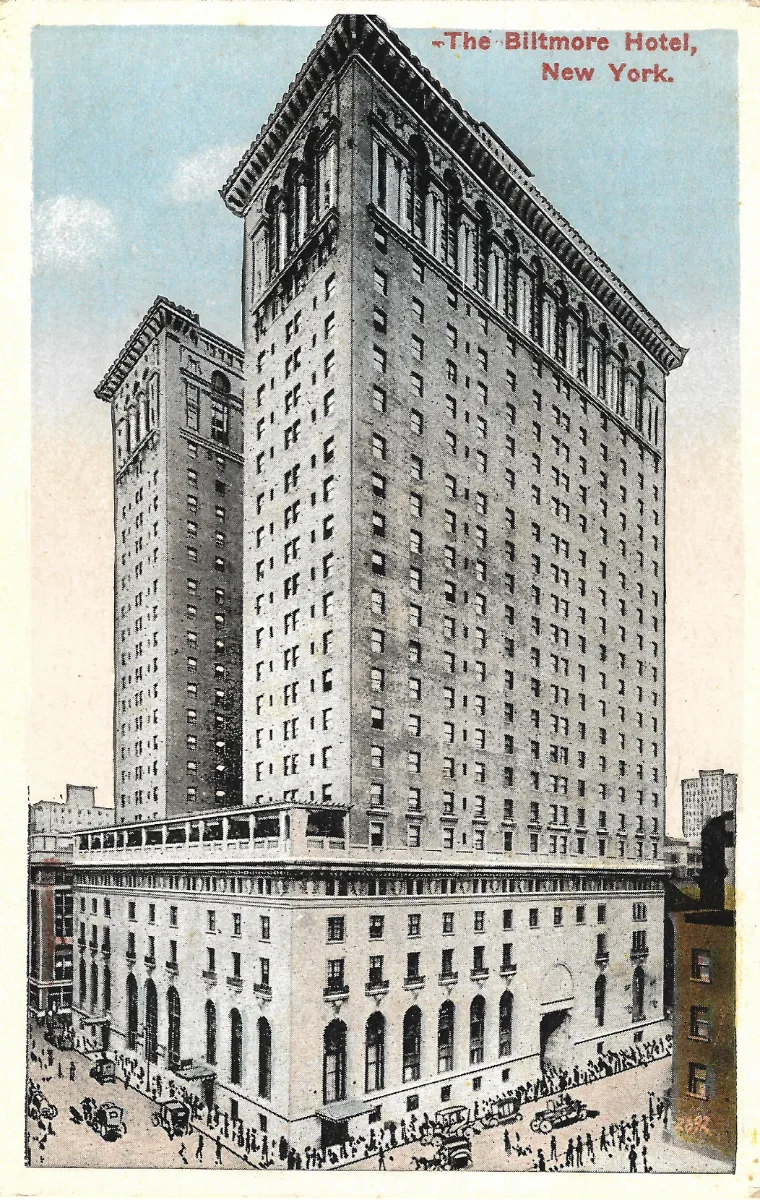
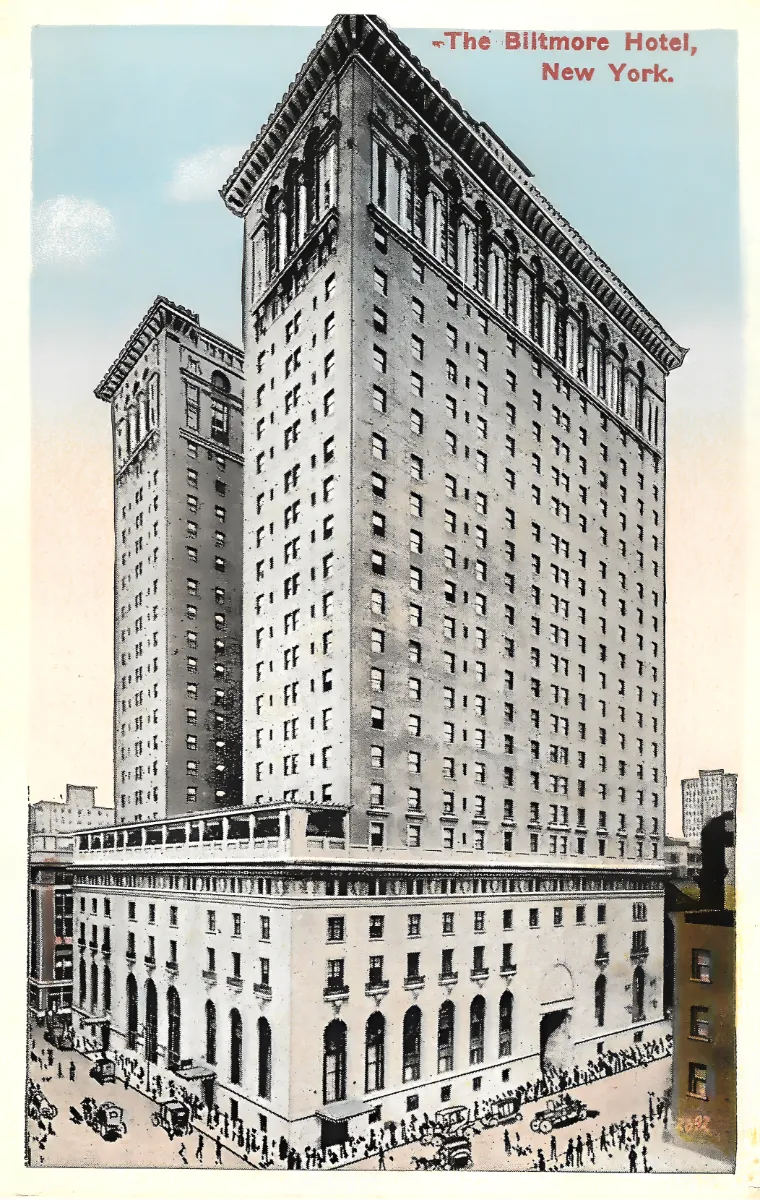
This antique postcard Biltmore Hotel New York offers a dramatic low-angle view of the building, whose name is printed explicitly in red lettering in the upper right corner of the image: “The Biltmore Hotel, New York.” This printed caption is the single most reliable identification clue available, since it comes directly from the card’s publisher rather than from visual deduction. The main structure, shown in the foreground, rises through roughly twenty visible stories, its facade organized by tightly aligned vertical window bays and crowned by a heavy cornice decorated with modillions and a classical frieze band, a treatment consistent with the Italian Renaissance Revival style then favored for large New York hotels and office towers in the early twentieth century. The building’s summit is capped by a pyramidal roof with wide overhanging eaves, a design echoed, in a slightly lower form, by the neighboring tower visible to the left of the frame. This second tower, separate from the hotel’s main mass, most likely belongs to an adjoining building or an annex wing of the same urban block, though this cannot be confirmed with certainty from the image alone.
At street level and across the lower floors, the antique postcard Biltmore Hotel New York shows a distinct architectural base separating the tower from the ground: round-arched openings, wide glazed bays, and an intermediate cornice marking the transition between the commercial ground floor and the hotel floors above. This two-part composition, a heavy base topped by a slender tower, was typical of large hotels and commercial buildings built near major New York railway terminals during the 1910s.
The street scene itself is animated: several touring-style automobiles and pedestrians in city dress pass in front of the hotel’s main entrance, partly sheltered by a canopy or marquee. These small but legible details provide an additional dating clue, discussed further in the historical description below. A partially legible number appears in the lower right corner of the card; it may correspond to a publisher’s catalog reference, but the digits are not sharp enough to be transcribed with certainty.
Historical description:
The caption printed on the card, “The Biltmore Hotel, New York,” identifies the depicted building without ambiguity: this is the prestigious Biltmore Hotel, which opened on January 1, 1913, at the corner of Vanderbilt Avenue and 43rd Street, directly across from Grand Central Terminal in Manhattan. This detail is confirmed by external historical sources and is not a mere assumption: the hotel was part of the large real-estate development known as Terminal City, built by the New York Central Railroad around Grand Central Terminal. Its design is credited to the architectural firm Warren and Wetmore, also responsible for the terminal itself, working in a monumental Italian Renaissance Revival style, a style that matches closely the proportions and ornament visible on this antique postcard Biltmore Hotel New York.
On purely visual grounds, several clues allow for a dating hypothesis regarding the printing of the card itself, independent of the hotel’s opening date. The plain white border framing the image, the hand-tinted coloring (blue sky, sepia building tones, red lettering), and the matte paper finish are all characteristics typical of what postcard specialists call the White Border Era, spanning roughly 1915 to 1930. This printing style succeeded the earlier undivided-back cards produced before 1907. On this basis, it is reasonable to hypothesize that the card was printed not at the time of the hotel’s 1913 opening, but rather during the following decade, roughly between 1915 and 1925, since the hotel remained a popular tourist attraction and postcard subject for decades after it opened.
The automobiles visible at street level, of a touring-car type with folding tops, support this dating range: their general silhouette, with rounded fenders and a vertical radiator grille, is consistent with American automobile production of the 1910s and 1920s, though no specific make or model can be identified given the small scale of the vehicles in the image. Likewise, the pedestrians’ clothing, dark suits and hats for the men, long coats for the few female figures visible, remains compatible with this period without offering a more precise dating element.
The Biltmore Hotel had a rich history until its closure in 1981, when the interior was entirely demolished and the building converted into an office tower; only the original steel frame survived, along with the hotel’s famous gold lobby clock, now displayed in the lobby of the building that replaced it. While this information lies outside the strict content of the image itself, it helps place this antique postcard Biltmore Hotel New York within the long history of a landmark that no longer exists in its original form. Since no reverse side was submitted with this card, analysis of any postmark, stamp, or handwritten inscription could not be carried out; the dating proposed here therefore remains a stylistic hypothesis, one that could be refined through examination of the card’s verso or further archival research.