Antique Postcard Mâcon: Saint-Vincent Church, France
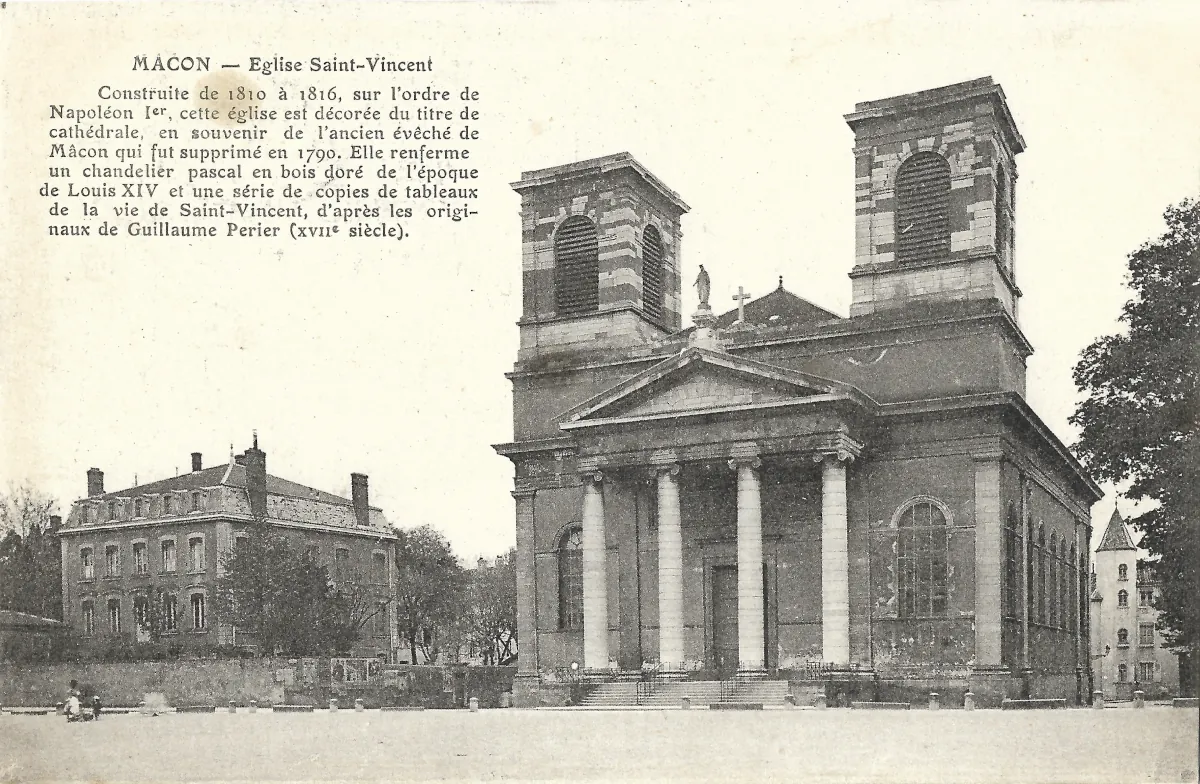
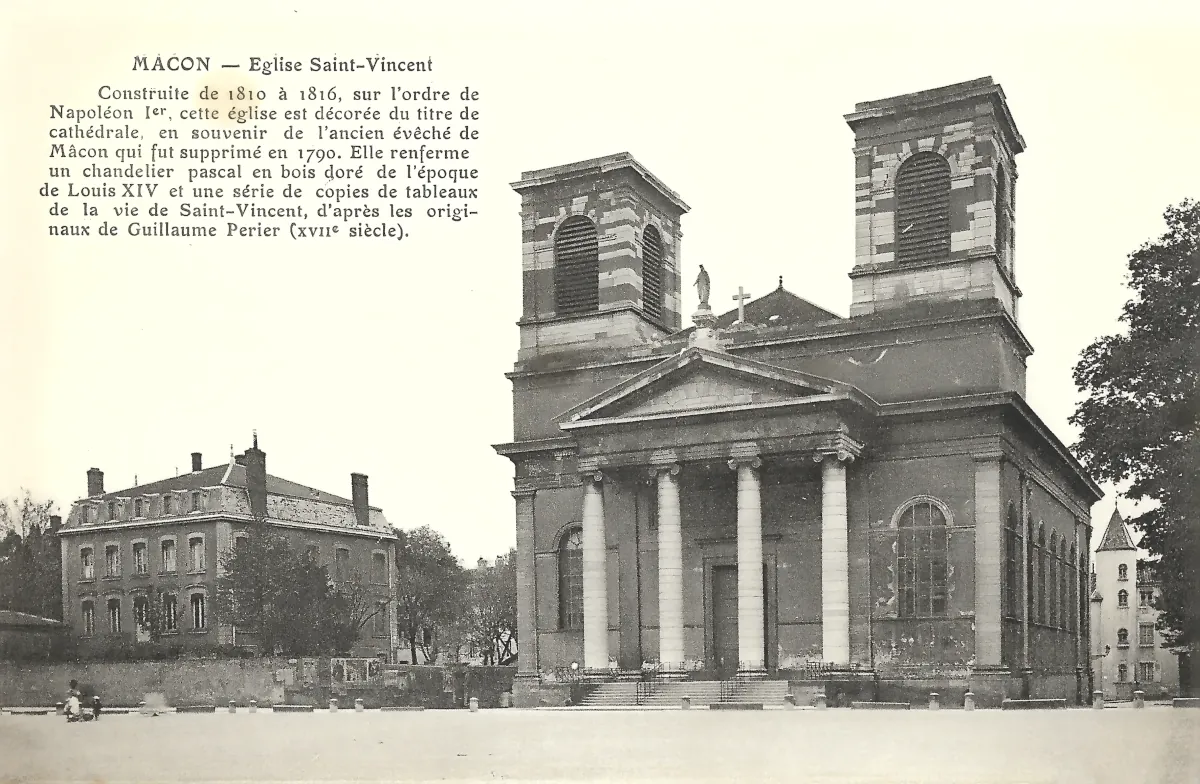
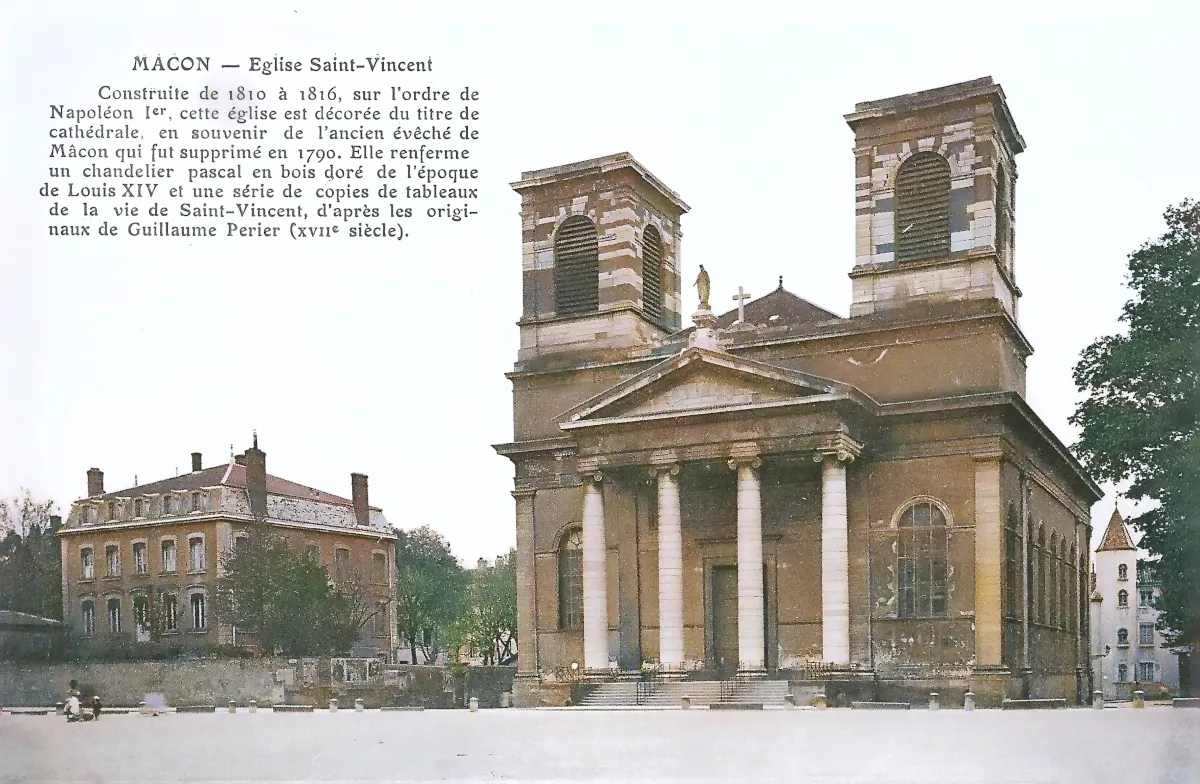
Geographic description: This antique postcard Mâcon offers a frontal, slightly low-angle view of Saint-Vincent Church, whose facade fills nearly the entire photographic frame. The building is flanked by two square twin bell towers framing a broad triangular pediment supported by a portico of fluted classical columns, probably of Corinthian order judging by the capital treatment, though the image resolution does not allow a fully certain identification of the exact order. At the apex of the pediment, a standalone statue is visible, likely a religious figure, together with a cross crowning the roofline. A wide stone staircase leads up to the portico and the central entrance door, bordered by low metal railings marking off the forecourt. On the left of the shot stands a two-story building with a steeply pitched roof and several chimney stacks, whose institutional appearance — regular windows, sober facade — suggests an administrative, educational, or ancillary religious use, though its precise function cannot be established from the image alone. In the right background, partially hidden by a large, dense-foliaged tree, a small turret with a conical roof is visible, an isolated architectural feature whose exact nature (pavilion, kiosk, or garden folly) remains undetermined given the limited visual detail. The foreground is occupied by an open, paved esplanade, where a few very small human figures can be made out near the lower left edge of the frame, too indistinct to draw any reliable conclusions about period clothing. No vehicles, tramways, or characteristic street furniture appear anywhere in the photograph, which limits the clues available for situating the immediate urban surroundings of the building. The card carries, printed directly on its front, the caption “MACON — Église Saint-Vincent,” followed by a descriptive text integrated into the image itself, a common editorial practice for documentary or tourist-oriented postcards of the early twentieth century.
Historical description: On this antique postcard Mâcon, the printed text states that Saint-Vincent Church was built between 1810 and 1816 by order of Napoleon I, and that it was granted the title of cathedral in memory of the former Diocese of Mâcon, suppressed in 1790. This information comes directly from the caption printed on the front and is therefore certain as content the card itself asserts; its underlying historical accuracy could be confirmed through diocesan or municipal archives, a step beyond the scope of this image-based analysis alone. The text further specifies that the church houses a gilded wooden paschal candlestick dating from the era of Louis XIV, along with a series of copies of paintings depicting the life of Saint Vincent, made after seventeenth-century originals by the painter Guillaume Perier. As for dating the postcard itself, as distinct from the monument it depicts, no verso elements (postmark, stamp, handwritten note, or publisher’s mark) were provided, which leaves any conclusion about the card’s postal circulation indeterminate. The analysis must therefore rely solely on the production clues visible on the front: the photographic halftone reproduction, the typographic integration of the caption directly within the image frame rather than in a separate cartouche, and the absence of a visible white border in this crop, all point toward a probable production date somewhere between 1900 and 1920, a period when this type of informative card, combining a photographic view with a historical notice, circulated widely in France. This range remains a hypothesis grounded in editorial style rather than a certainty, in the absence of any unambiguously dated element. The card’s very format, designed as an educational aid pairing image and scholarly notice, suggests a likely audience of visitors, pilgrims, or local residents wishing to learn about the monument’s history, a common use for religious buildings of local significance during that period. Further verification through Mâcon’s municipal archives or postcard-collecting resources specializing in the Saône-et-Loire region would help refine both the print date and the identification of the publisher, currently undetermined based on the visible elements alone.