Lyon on the Saône — a Sunday of steam and stone
ND Phot series, no. 1364 — double panoramic card — circa 1900–1910
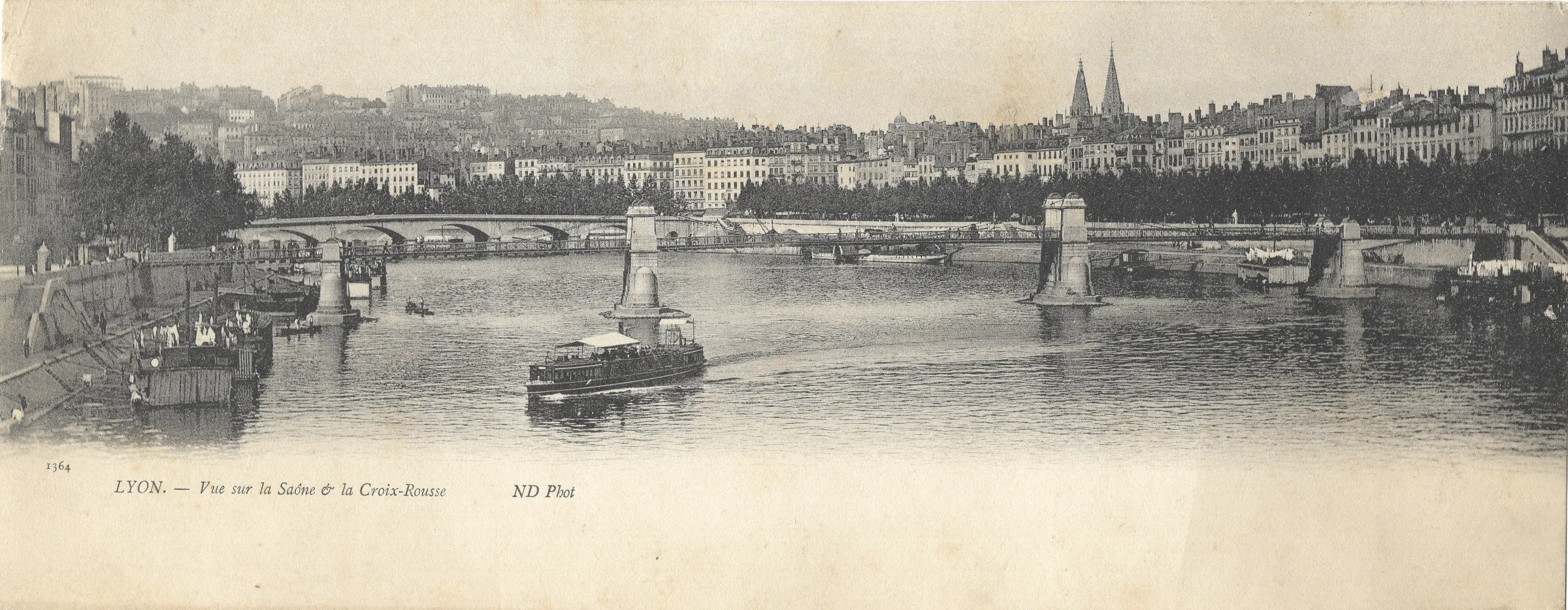
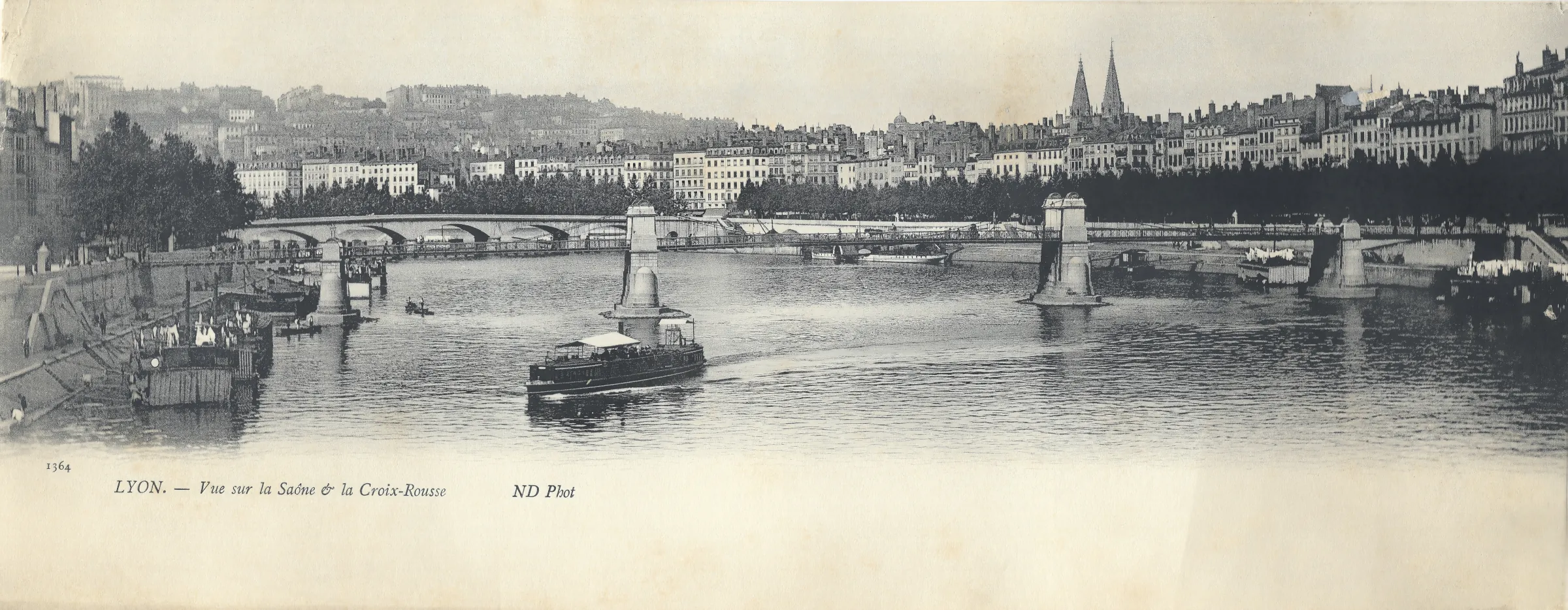
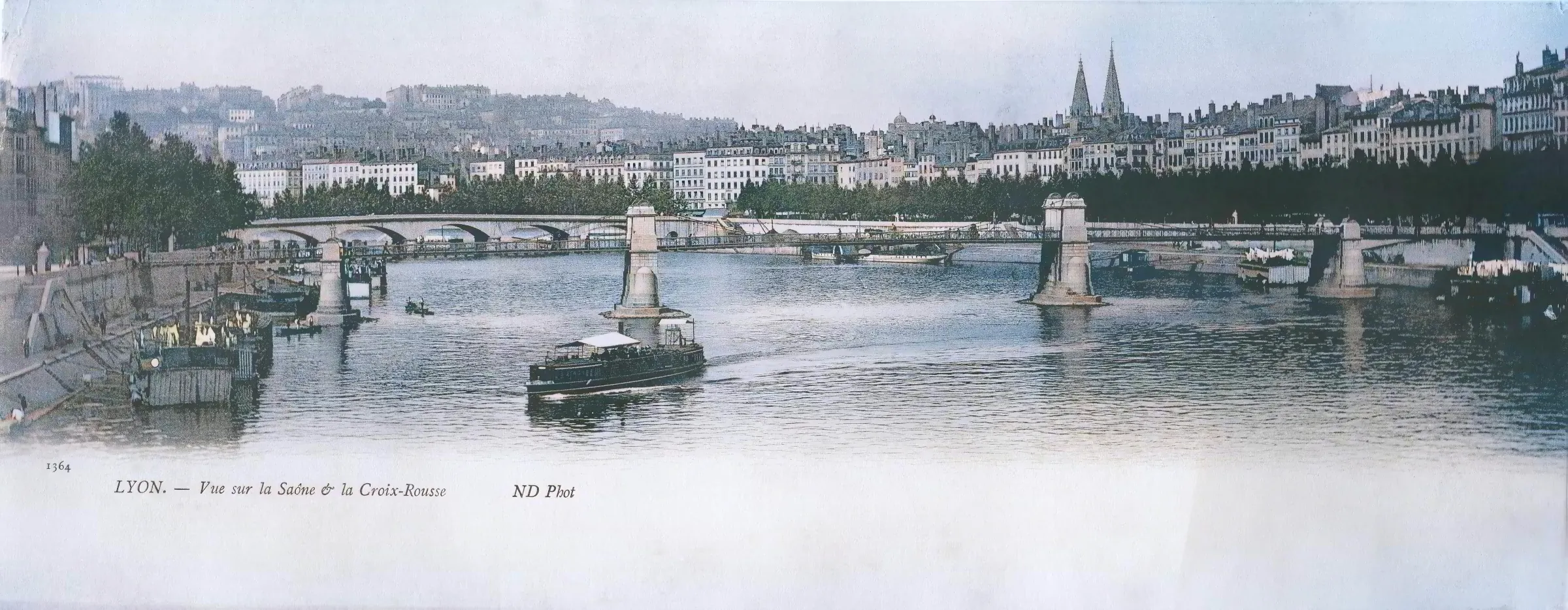
The caption at the lower left leaves no doubt: Lyon — Vue sur la Saône & la Croix-Rousse. But it is the format that strikes first. This card is a double panoramic — most likely two standard postcards joined side by side, a common technique among Belle Époque publishers eager to capture the full breadth of river cities in a single frame. The result is remarkable: in one sweeping glance, the eye travels across the entire width of the Saône, from the Quai de Serin to the slopes of the Croix-Rousse.
At the centre of the river, a flat-bottomed steam vessel drifts slowly downstream — probably one of the local vapeurs that served as river ferries between Lyon’s riverside neighbourhoods, or carried freight toward the upstream ports. On either side of the channel, the massive stone piers of a suspended or metal-deck bridge stand like sentinels. In the background, a second, lighter bridge spans the Saône with an elegance that contrasts with the monumental quality of the Haussmann-era quaysides lining the right bank. The regular, pale-stone façades and mansard rooflines of these Second Empire apartment buildings are characteristic of the residential blocks built along Lyon’s riverbanks from the 1860s onward.
The Croix-Rousse hill fills the background, its densely packed buildings climbing the slope in tight rows. Toward the right of the image, the slender spire of a church — likely Saint-Bruno-les-Chartreux or Saint-Polycarpe — pierces the grey sky of the phototypie print. This halftone printing technique, mastered to near-perfection by the Neurdein Brothers firm (whose trademark “ND Phot” appears at the lower right), gives the scene an exceptional atmospheric depth: the river’s reflections, the steamer’s smoke, the leafy plane trees lining the quays — all rendered with a delicacy that honours the quality of the original photograph.