St. Elizabeth Hospital Antique Postcard, Elizabeth NJ
Geographic description:
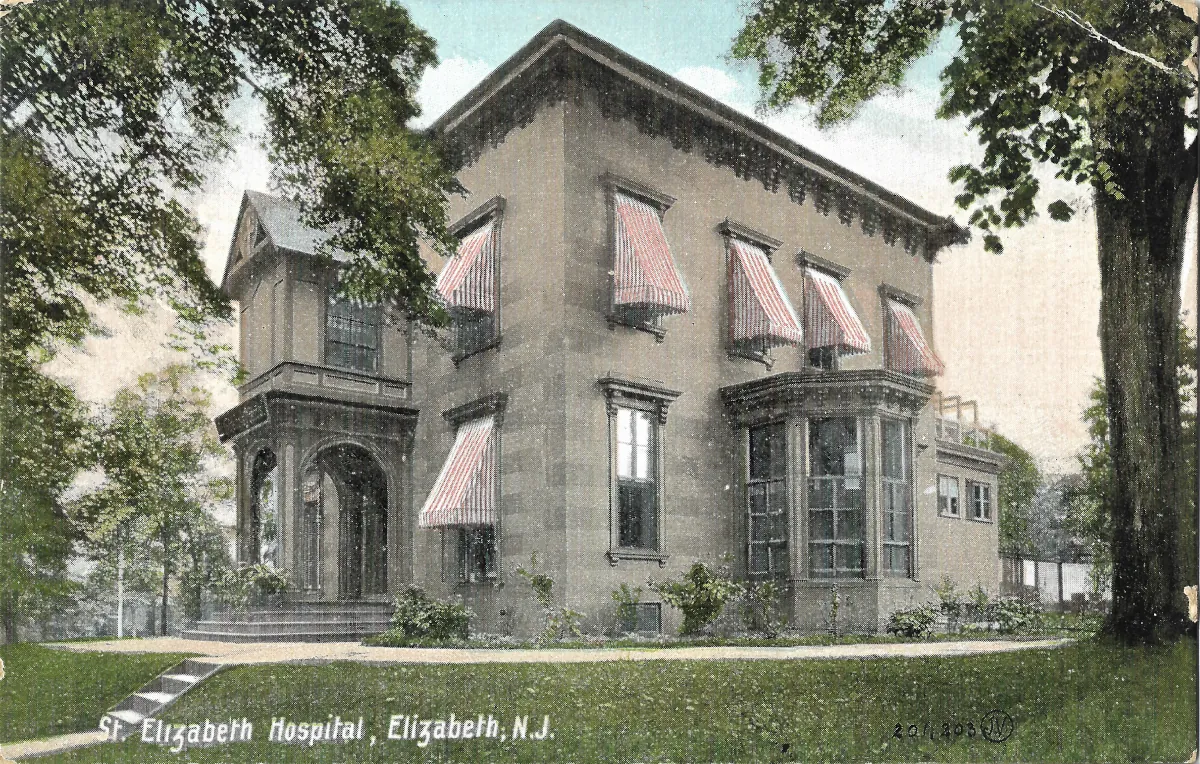
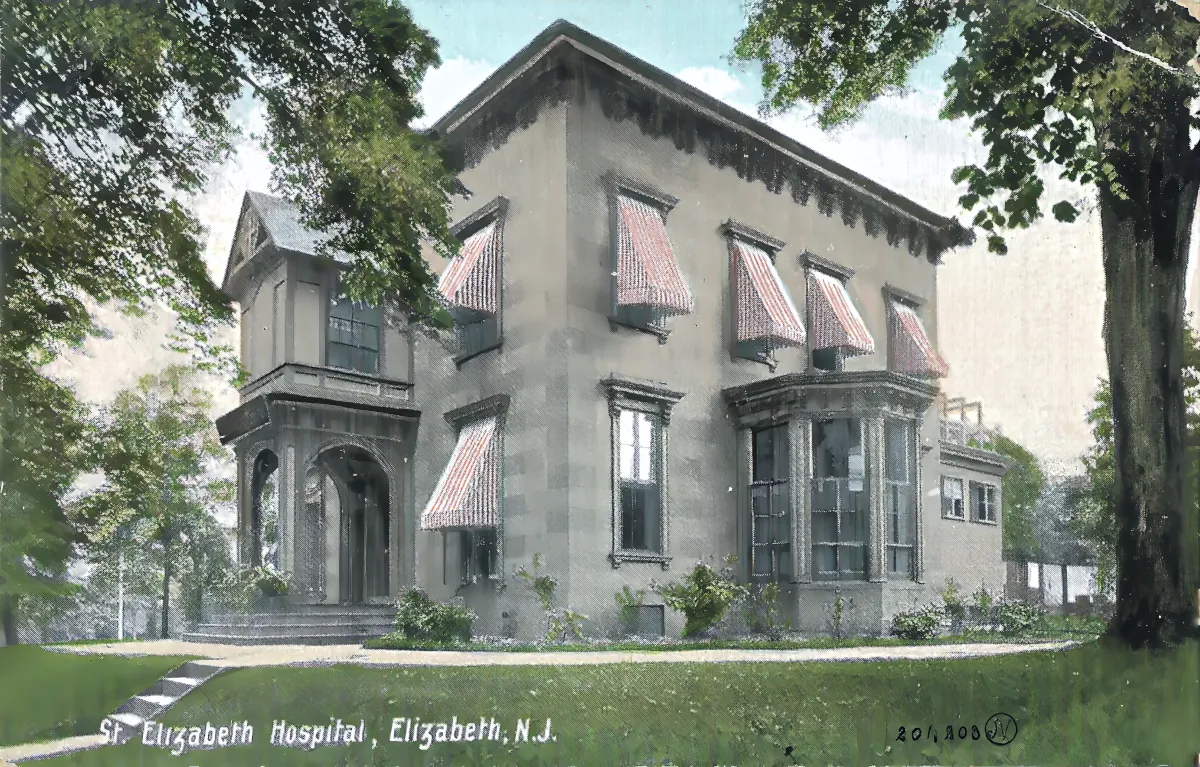
This St. Elizabeth Hospital antique postcard shows an elegant Italianate residence, photographed from a three-quarter angle that highlights both the main façade and the side gable. The building, constructed of stone and rendered brick, is topped with a wide bracketed cornice, a hallmark of American residential architecture from the last third of the nineteenth century. At ground level, a projecting bow window sits at the corner of the building, alongside a round-arched entrance framed by columns and crowned with a small tower-like belvedere with a pointed roof, a detail typical of late-Victorian urban villas. Several first-floor windows are fitted with red-and-white striped awnings, a decorative and functional feature very common on American façades in the early twentieth century, meant to shield the interior from direct sunlight. A stone stairway leads from the sidewalk to the main entrance, bordered by a well-planted garden: several large, dense-canopied trees frame the composition, suggesting a property surrounded by grounds or an ornamental garden rather than a busy commercial street. No automobile, pedestrian, or shop sign is visible anywhere in the image, reinforcing the impression of a quiet residential setting, away from urban bustle. The caption printed in the lower left corner of the card, “St. Elizabeth Hospital, Elizabeth, N.J.”, formally identifies the location depicted: a hospital facility in the city of Elizabeth, Union County, New Jersey (United States). A partially legible number, accompanied by a small circular mark, appears in the lower right corner of the image; it may correspond to a publisher’s catalog reference, but its partial illegibility does not allow certain identification. Only the front of the card has been provided, so no handwritten inscription, postmark, or stamp can be examined at this stage.
Historical description:
Identifying the building allows for a fairly precise dating, based on documentary research external to the image itself, which should be clearly distinguished from what is directly observable on the card. The building shown very likely corresponds to the residence purchased in 1904 by the Sisters of Charity of Saint Elizabeth, at 204 South Broad Street, on the corner of Pearl Street, formerly the private home of a local physician. This brownstone house was renovated to accommodate roughly twenty-five patients and opened as St. Elizabeth Hospital around 1904-1905. The institution occupied this original building for more than two decades, before a new, modern red-brick building was constructed and opened in 1927 to meet growing demand for hospital care. This St. Elizabeth Hospital antique postcard therefore most likely shows the hospital’s very first home, predating that 1927 reconstruction.
On a purely visual level, several details support a dating earlier than 1920: the delicacy of the coloring, achieved through a chromolithographic-type process similar to that used on so-called “divided back” cards, rather than the coarser woven “linen” paper texture that became standard from the 1930s onward; the absence of any visible automobile; and the architectural style itself, typical of a private villa from the 1860s-1880s rather than a building purpose-built as a hospital. These converging clues suggest, with reasonable but not absolute confidence, a printing date somewhere between roughly 1905 and 1920. Since no postmark or stamp is visible on the front-only image provided, it is not possible to confirm whether the card was actually mailed, nor to pin down a cancellation date; examining the reverse side, if available, would help refine this dating considerably.
In terms of social context, the founding of this hospital by a Catholic women’s religious congregation, with the approval of the Diocese of Newark, fits within a broader movement to establish faith-based healthcare institutions in industrial East Coast cities in the late nineteenth and early twentieth centuries, a period marked by strong urban growth and rising demand for local medical infrastructure. Converting a private residence into a care facility, without an initial purpose-built structure, was common practice at the time, as religious congregations often prioritized getting a facility running quickly over erecting a new building. The card, likely intended for promotional or commemorative use — a widespread practice among hospitals and charitable institutions of the era for fundraising campaigns or annual reports — thus captures a specific, datable moment in Elizabeth’s local health history, prior to the major 1920s expansion. Further verification through municipal archives or local genealogical societies would help confirm the card’s publisher with certainty and, where possible, its exact printing date.