Antique Postcard Elizabeth New Jersey: Broad Street
Geographic description:
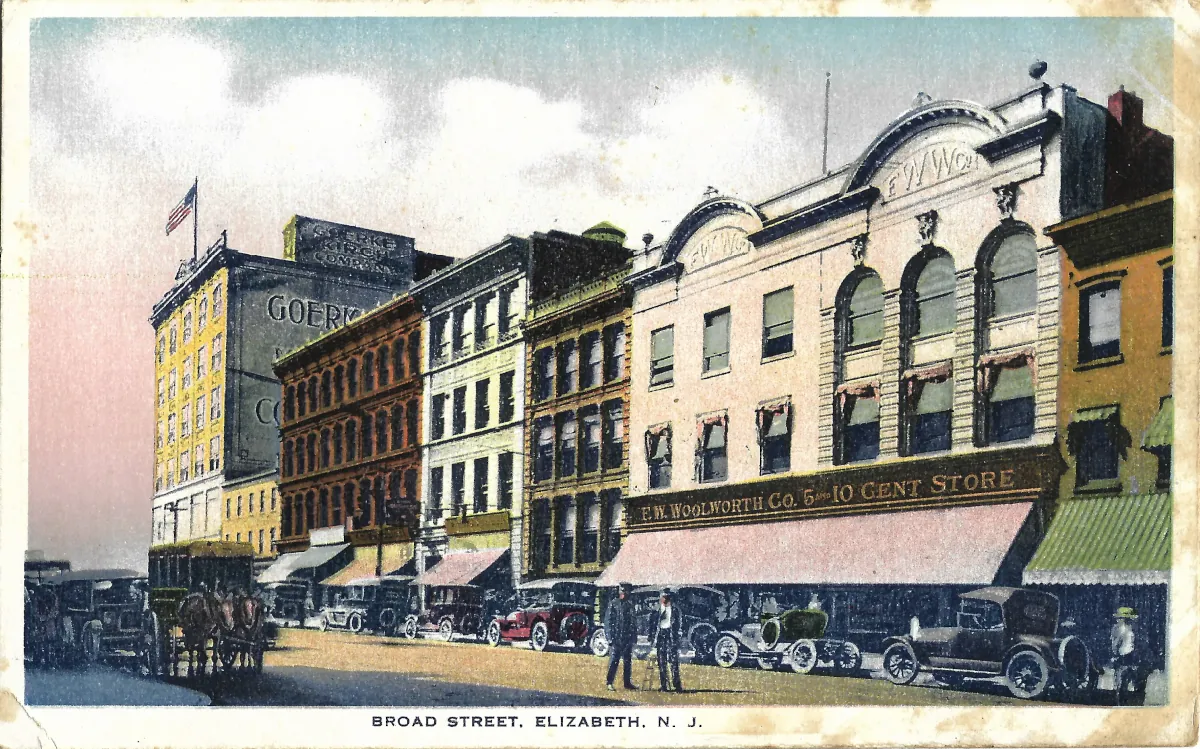
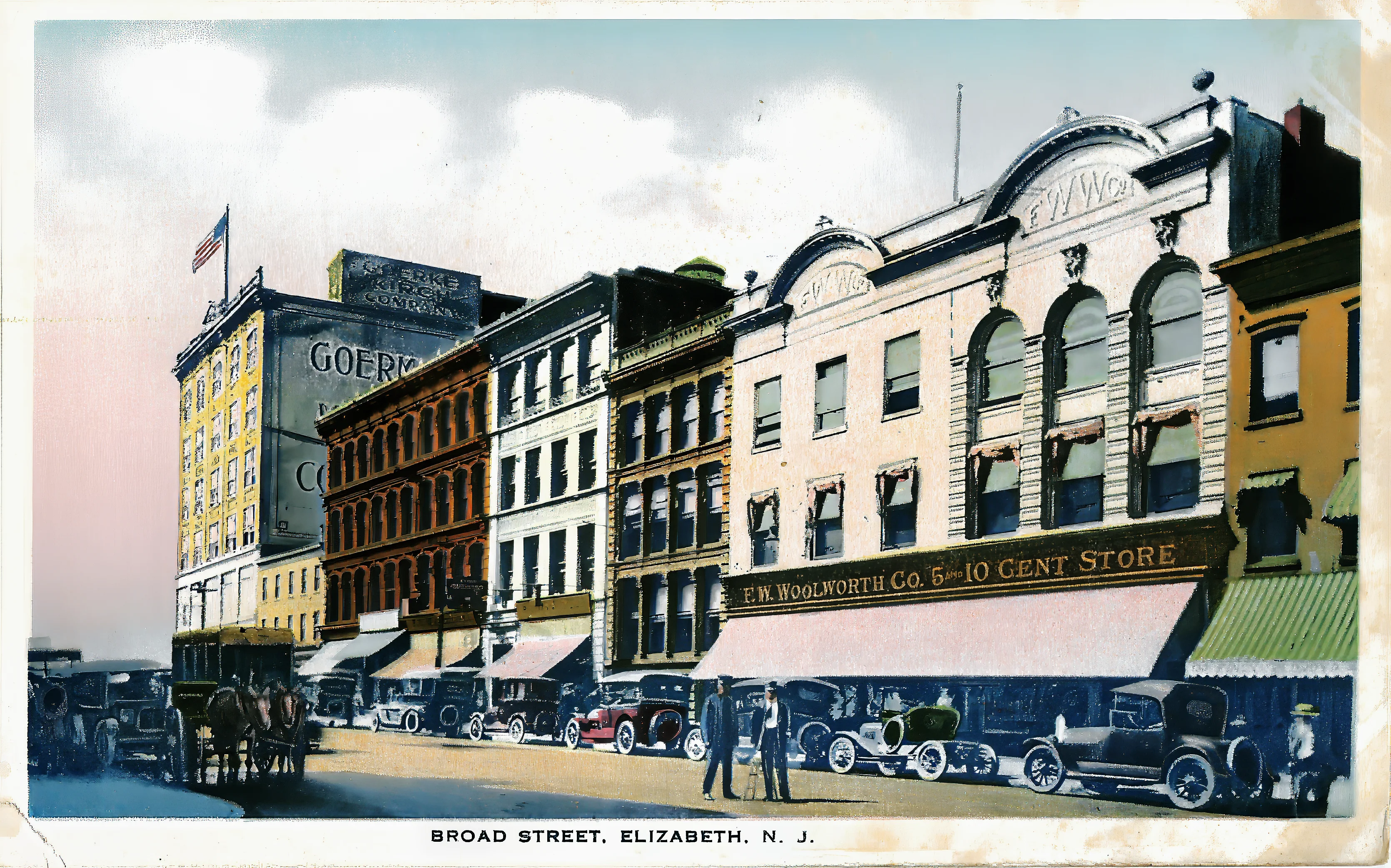
This antique postcard Elizabeth New Jersey offers a perspective view of Broad Street, the central commercial thoroughfare of the city of Elizabeth, in Union County, New Jersey (United States). The printed caption at the bottom of the card, “Broad Street, Elizabeth, N. J.”, confirms the location without ambiguity, so this identification is a direct reading rather than a hypothesis. The vantage point shows a row of commercial facades between four and eight stories tall lining the right-hand side of the street, with a strong vanishing-point effect toward the background, a composition typical of American main-street view cards produced in the early twentieth century.
In the right foreground stands a large light-colored building featuring round-arched windows on its uppermost level and a curved pediment bearing the partially visible letters “F.W. Wo…”, which can be confidently linked to the sign painted across the ground-floor awning: “F.W. WOOLWORTH CO. 5 AND 10 CENT STORE”. This identifies the building as a branch of the Woolworth chain, known for its single-price “5 and 10 cent” retail format, recognizable here by its carefully designed commercial architecture, its wide ground-floor display windows shaded by extended canvas awnings, and its upper stories, more ornamented than most of the neighboring buildings.
Further along the left side of the composition stands a tall, pale-yellow building flying an American flag from its rooftop and carrying a large painted sign on which the letters “…ERKE / KIRCH / COMPANY” are legible, along with a fragment reading “GOERM…” and “CO…” on the adjoining facade. Read together, these fragments allow for a near-certain identification of the Goerke-Kirch department store signage, its full name reconstructed from the visible pieces. Between this building and the Woolworth store sits a row of more modest three-to-five-story brick and stone buildings, their facades pierced by regularly spaced rectangular windows, some featuring projecting cornices and moulded lintels characteristic of North American commercial architecture of the late nineteenth and early twentieth centuries.
The street itself is filled with heavy traffic: open-bodied automobiles with rounded fenders and thin spoked wheels, some parked and others moving in both directions, along with a two-horse wagon at the far left of the image, indicating that horse-drawn transport had not yet fully disappeared from urban commercial use at the time the photograph was taken. In the center foreground, two men in dark suits, one wearing a bowler hat and the other a straw boater, stand in conversation in the middle of the roadway, suggesting that automobile traffic was still moderate enough to allow pedestrians to linger on the street.
Historical description:
Identifying the Goerke-Kirch store makes it possible to narrow the dating of this antique postcard Elizabeth New Jersey using a documentary source rather than visual evidence alone. The most famous of these department stores was R.J. Goerke’s six-story building at Broad and West Jersey, which opened shortly before World War 1; through a variety of corporate changes, it would become Steinbach’s. Other sources indicate that Goerke-Kirch Co. of Elizabeth, New Jersey, was discontinued in 1935, following the liquidation of several store chains under the City Stores group during the Great Depression. It is therefore reasonable to place the existence of the “Goerke-Kirch Company” signage visible on this card somewhere between the early 1910s and the mid-1930s, though this window cannot be narrowed further without access to the postmark, stamp, or any handwritten correspondence on the reverse, none of which were provided for this analysis. VisithistoricalelizabethnjEncyclopedia.com
The simultaneous presence of an F.W. Woolworth store is also consistent with this chronological window: at the height of its commercial dominance, Broad Street was also the site of three chain department stores, W.T. Grant, F.W. Woolworth, and H.L. Green’s, alongside the locally founded Goerke’s and Levy Brothers department stores. This mix of independent department stores and national single-price chains matches descriptions of Broad Street as the principal shopping district of the city and the surrounding region during the early decades of the twentieth century. Visithistoricalelizabethnj
The automobiles provide an additional dating clue, though of a purely visual nature this time, and should be treated with appropriate caution in the absence of a legible postmark. The open bodies, thin wood or metal spoke wheels, prominent headlamps mounted on rounded fenders, and the absence of any closed-body vehicles among the majority of cars shown all point toward a vehicle fleet typical of the mid-1910s, before closed car bodies became widespread later in the 1920s. The coexistence, within the same image, of a horse-drawn wagon and an already sizeable number of automobiles also reflects a period of technological transition, consistent with a range of roughly 1913 to 1922. Cross-referencing this visual clue with the documented lifespan of the Goerke-Kirch signage, the most probable hypothesis for the dating of this view falls between 1913 and 1920, though without absolute certainty.
As for the card’s likely use, it was probably a commercial street-view postcard intended for sale to visitors and residents of Elizabeth, in keeping with the tradition of main-street view cards widely produced across the United States during this period. Since no reverse side was provided for this analysis, it cannot be determined whether this particular copy was mailed or left unused; this detail, along with the identity of the card’s publisher or printer, remains undetermined given the information currently available. Further verification through Elizabeth municipal archives or American postcard databases could help refine this dating and identify the publisher with more precision.