Antique Postcard Chablis France: The Hospice, 1904
Geographic description:
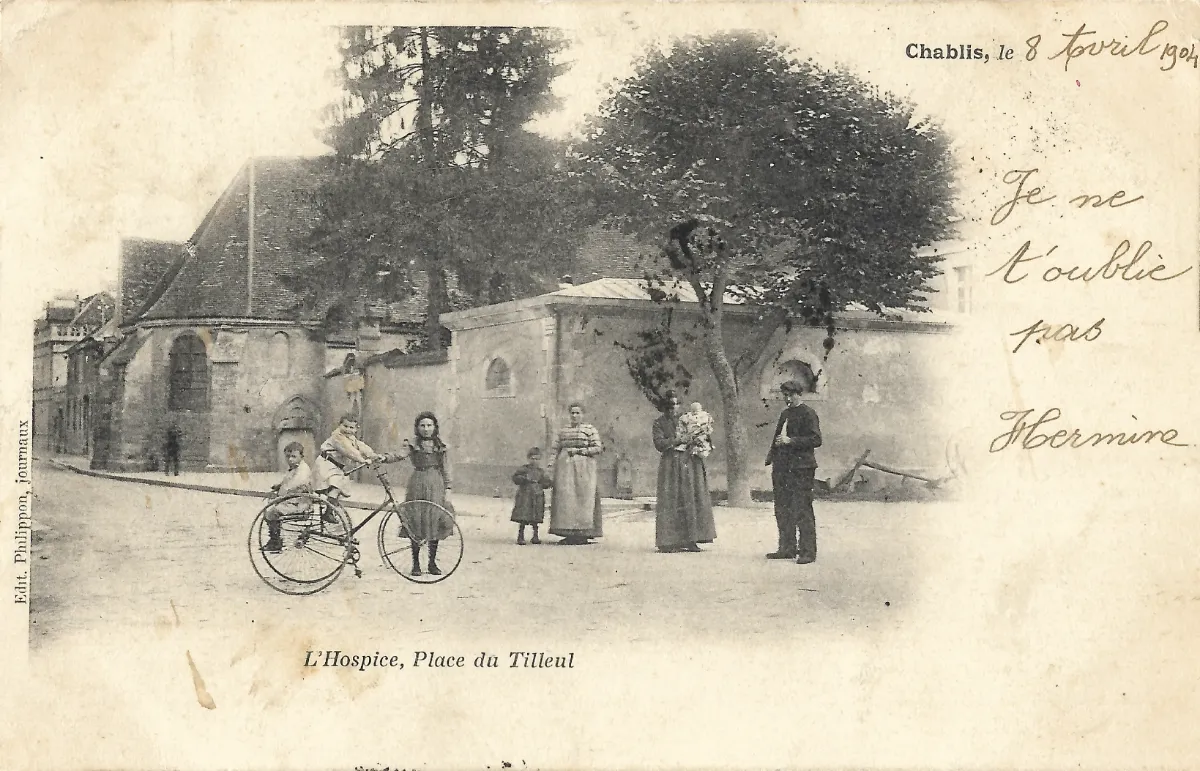
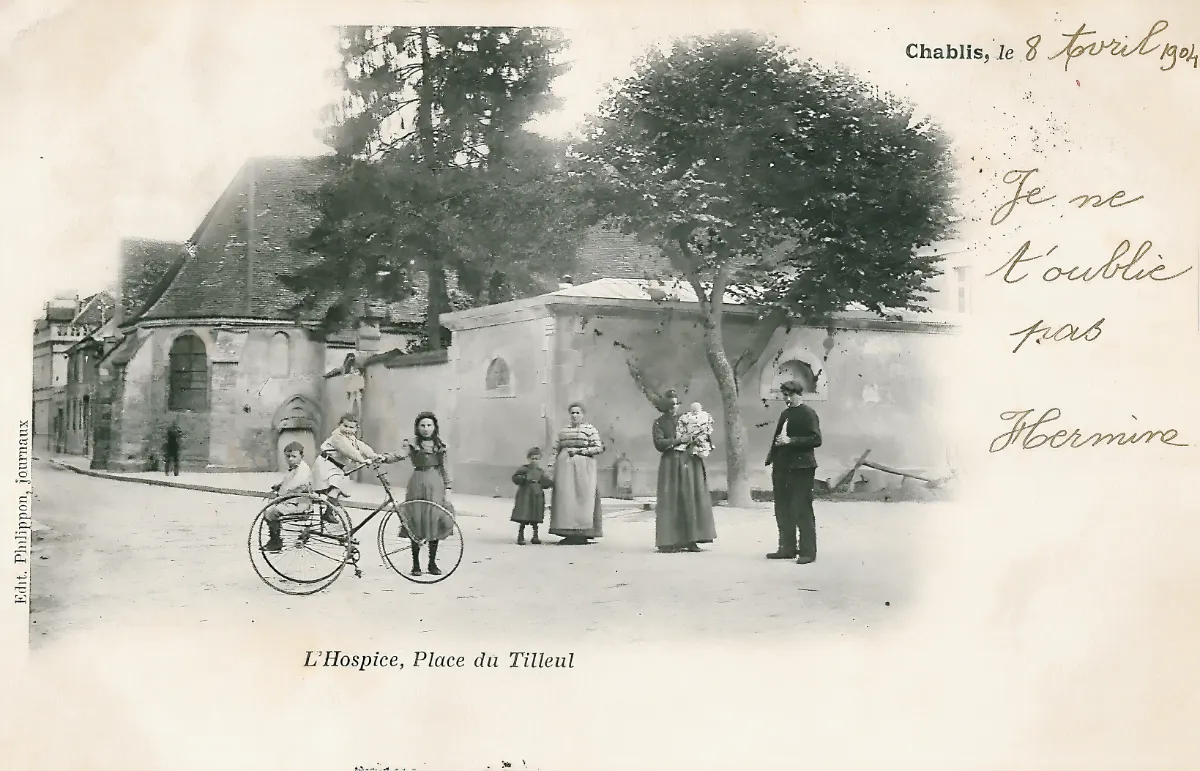
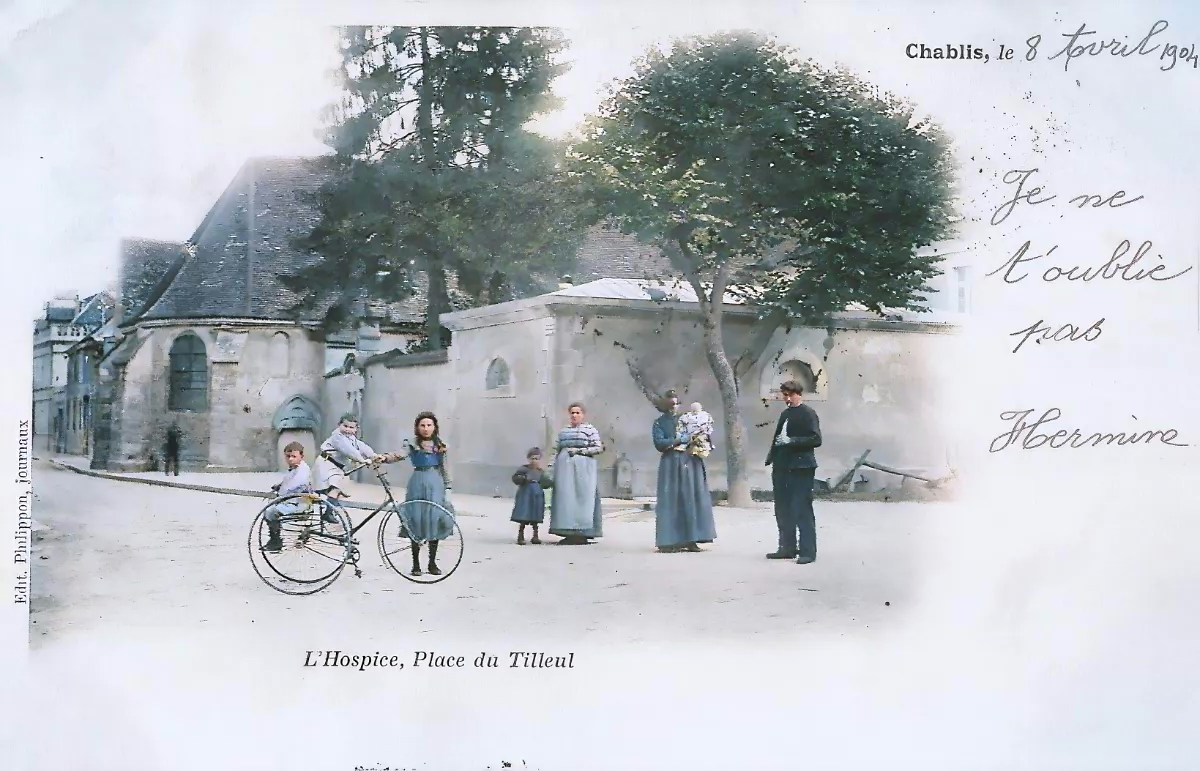
This antique postcard Chablis France captures a view of the Place du Tilleul, as confirmed by the printed caption at the bottom of the image: “L’Hospice, Place du Tilleul.” The main building, visible on the left, is a stone structure with a steeply pitched roof and a rounded stone archway whose masonry suggests an older construction, likely predating the nineteenth century — a plausible hypothesis given the charitable function of a hospice, an institution frequently housed in a medieval or Ancien Régime building altered over the centuries. A second, lower rendered building closes the square at the centre of the photograph; its segmental-arched windows and shallow roofline suggest an annex or outbuilding of the hospice, though its precise use (chapel, laundry, staff housing) cannot be determined with certainty from the image alone.
Two large trees dominate the composition: a tall conifer on the left and, at the centre, a broad-crowned tree that could correspond to the linden (“tilleul”) that gave the square its name — a plausible but unverifiable hypothesis, as the exact species remains indeterminate from the photograph. On the right, a fragment of an additional building appears at the edge of the oval frame characteristic of early twentieth-century photographic postcards, a vignetting technique commonly used on illustrated postcards of this period.
In the foreground, seven figures animate the scene: a young boy seated on the frame of a pneumatic-tyre bicycle, a girl standing beside the bicycle in a light-coloured dress with a sailor collar, a young child in a dark pinafore, two women in everyday dress — long-sleeved blouses and long skirts, one wearing an apron, the other holding a swaddled infant — and a man or adolescent in a dark suit and cap. This multi-generational group composition matches the conventions of “local life” postcards widespread in France at the turn of the twentieth century, in which residents of a neighbourhood or small town posed in front of a locally significant monument or landmark.
Historical description:
The handwritten inscription in the upper right of the recto, “Chablis, le 8 avril 190[4],” together with the message “Je ne t’oublie pas,” signed Hermine, allows this antique postcard Chablis France to be dated with a high degree of confidence to April 1904. The fact that the handwritten text appears directly on the illustrated side, rather than on the reverse, provides an additional dating clue: until late 1904, French postal regulations reserved the back of postcards exclusively for the recipient’s address, leaving the front — or part of it — as the only available space for personal messages. Only from late 1904 onward was the divided back (address and message separated by a vertical line) progressively authorised and then generalised. The handwritten date of April 1904 is therefore fully consistent with this layout.
Since the reverse of the card is not available, analysis of the postmark, stamp, and postage details remains indeterminate: no conclusion can be drawn regarding the actual postal routing of this item, nor can the date be confirmed by a cancellation mark. This limitation should be noted, and further verification against a copy showing the reverse, or against collector archives, could help refine or confirm this dating.
The printed credit at the bottom left, “Édit. Philippon, journaux,” identifies the publisher of the card: a certain Philippon, likely a local newsagent and stationer in Chablis who commissioned, as was common practice at the time for shopkeepers in small French towns, a series of postcards depicting notable local monuments and sites for sale in his own shop. This practice was widespread in France between 1900 and 1914, a period often referred to as the “golden age” of the illustrated postcard.
In terms of urban and social context, the scene depicts the Place du Tilleul in Chablis, a wine-producing town in the Yonne department of Burgundy, at a time when the communal hospice remained a local charitable institution, caring for the elderly, the sick, and the indigent. The presence of a pneumatic-tyre bicycle, a model widely available in France from the 1890s-1900s onward, together with the absence of any motor vehicle in the frame, are converging — though individually insufficient — indicators supporting a dating to the very beginning of the twentieth century, consistent with the handwritten date of 1904. The clothing of the figures — aprons, high-necked blouses, and a cap for the male figure — likewise corresponds to rural and provincial dress conventions observed in France during this period, though it does not allow for a more precise dating beyond the 1900-1910 range suggested by the combined visual evidence. Overall, this antique postcard Chablis France offers a rare, dated glimpse of provincial French daily life in 1904.