Antique Postcard Chablis: Rue des Moulins, 1907 View
Geographic description:
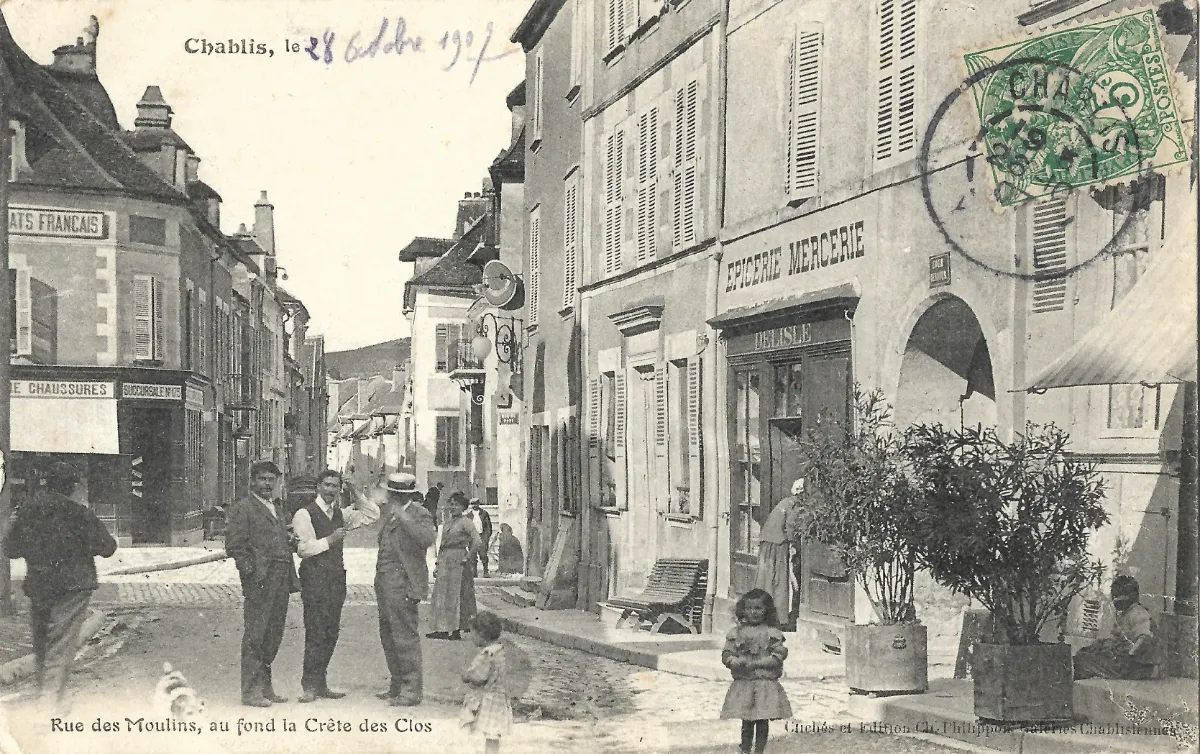
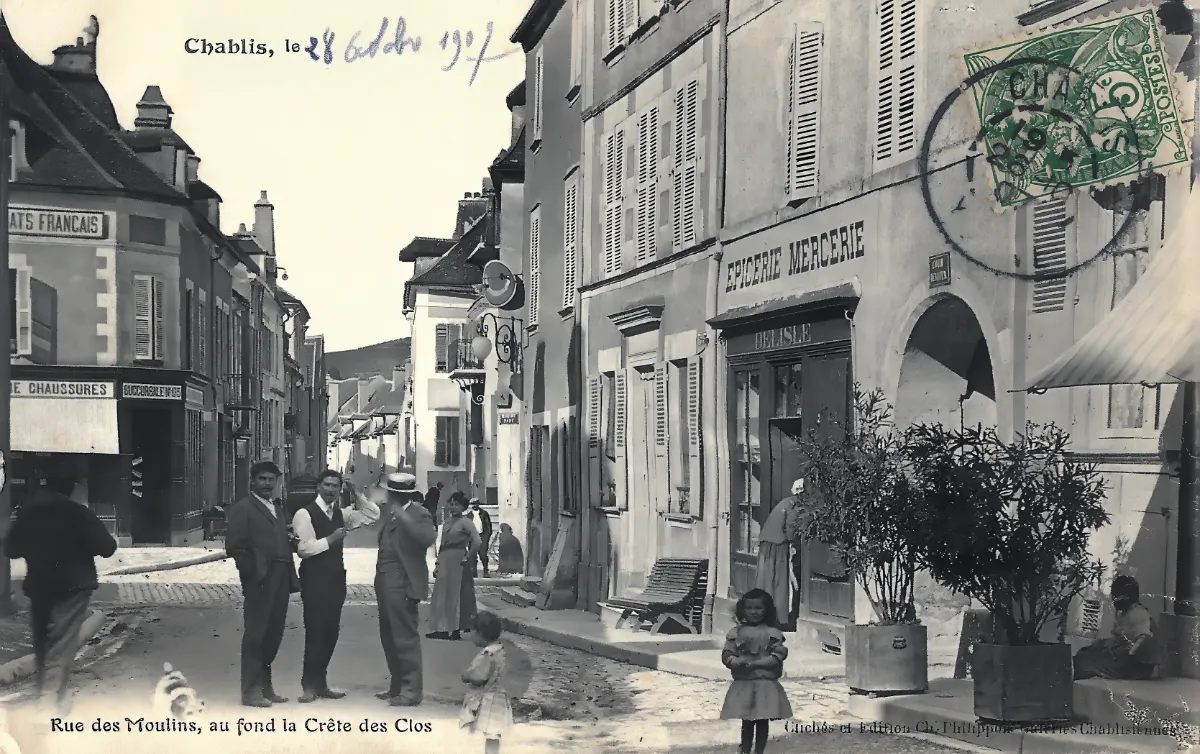
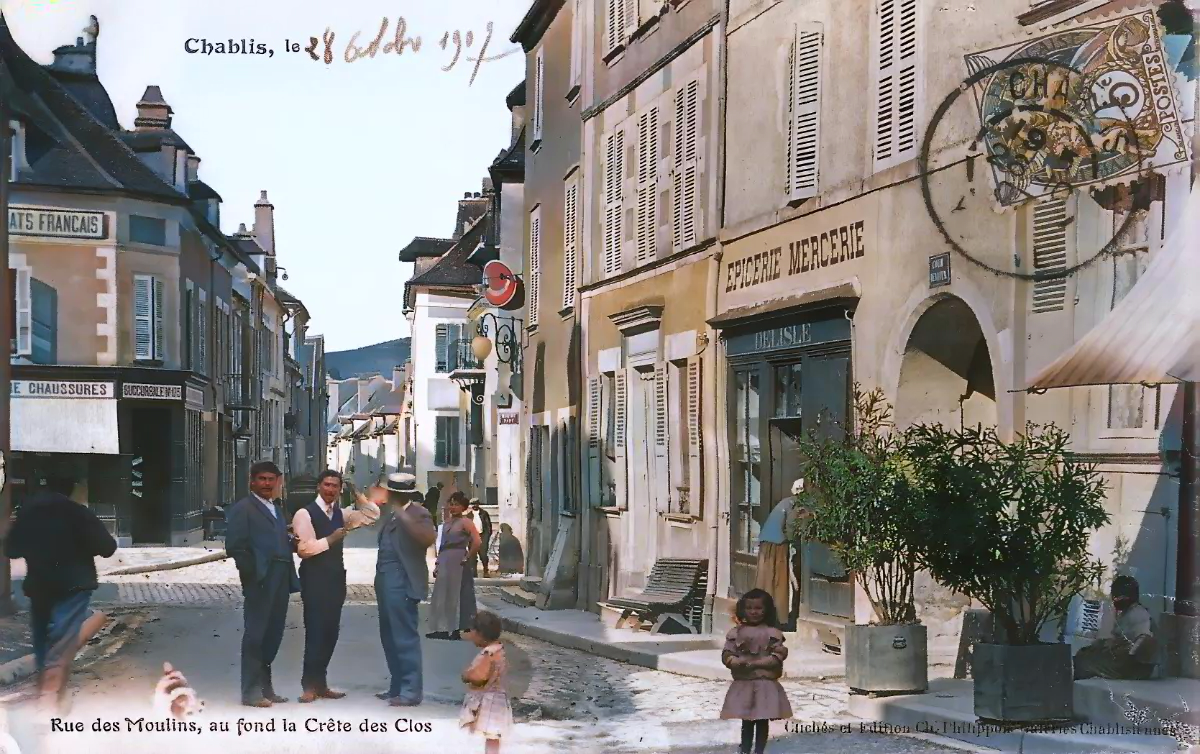
This antique postcard Chablis shows a view of Rue des Moulins, as indicated by the printed caption at the bottom of the image: “Rue des Moulins, au fond la Crête des Clos” (“Rue des Moulins, with the Crête des Clos in the background”). The photograph was taken from the middle of the cobbled street, looking toward the far end of the road, where the caption points to the “Crête des Clos” — most likely a reference to the Clos hillside, one of Chablis’s celebrated Grand Cru vineyard sites, though it is not sharply visible in the print itself. The street is lined with limestone facades typical of Burgundian architecture, fitted with shuttered windows on the upper floors, some left ajar and others closed. In the foreground on the right, a shopfront displays the words “ÉPICERIE MERCERIE” (grocery and haberdashery) along with the shopkeeper’s name, “DELISLE,” painted on the awning; two potted shrubs flank the entrance next to a public wooden bench. On the left side of the image, another storefront bears the partially visible word “CHAUSSURES” (shoes) along with a mention of a branch location, suggesting a small local retail chain. An ornate wrought-iron sign bracket with a circular medallion hangs above the street, a typical piece of early twentieth-century shop signage. The corner building visible at the far left features a turret and steeply pitched roof, characteristic of a notable’s residence or a merchant’s house in a small Burgundian wine town. The street surface is cobbled, with no asphalt or road markings, and no automobiles appear anywhere in the frame — only pedestrians occupy the roadway, placing the scene before motor vehicles became common in rural France. Several figures are frozen in the deliberate poses typical of the period, when residents consciously posed for the photographer: three men in matching dark suits and waistcoats converse in the middle of the street, one wearing a boater hat; a young girl in a dark dress and pinafore stands still in front of the Delisle shop; further back, a woman in working attire, apron and headscarf, appears to be leaving a shop; and a man is seated on a doorstep to the right, completing this everyday street scene. The card’s format, with its narrow white border and slightly contrasted black-and-white print, matches the typical postcard printing standards of the first decade of the twentieth century.
Historical description:
The handwritten inscription at the top of the card, “Chablis, le 28 octobre 1907,” written in ink by the sender, allows this antique postcard Chablis to be dated with a high degree of confidence to late October 1907. This date is supported by the stamp affixed in the upper right corner: a French Semeuse-type stamp printed in green, corresponding to the 5-centime rate then used for open-face postcards in the early twentieth century. The circular postmark, only partly legible, shows the name “CHABLIS” along with a date of which only some digits remain clear; it confirms without doubt that the card was postmarked at the Chablis post office, consistent with the handwritten date above. In the lower right corner of the image, a partially obscured publisher’s credit — overlapped by the postmark — appears to read “Clichés et Édition Ch. Philippon,” likely followed by a reference to “cartes chablisiennes” (postcards of Chablis), suggesting a series of local views produced specifically for the town. This was most likely a local editor or photographer active in producing Chablis postcards around the turn of the century, though the exact name cannot be confirmed with certainty given the overlapping cancellation mark, and would benefit from external verification. From an urban history standpoint, the scene documents an active town-center commercial district: the simultaneous presence of a grocery-and-haberdashery shop run by a merchant named Delisle and a shoe shop with a branch location suggests a fairly dense local retail network for a town the size of Chablis at the time, likely supported by the local wine trade and the passage of travelers connected to it. The complete absence of automobiles, the exclusively pedestrian traffic, and the still-rural cobbled road surface all point to a pre-First World War date, consistent with 1907. The clothing visible in the scene — dark three-piece suits and boater hats for the men, long dark dresses and aprons for the women and children — matches the dress codes of the rural lower-middle and working classes during the Belle Époque, with no obvious sign of a special event or ceremony: this is most likely an ordinary weekday street scene. The mention of the “Crête des Clos” in the printed caption very probably refers to the Clos vineyard hillside, one of the most renowned climats within the Chablis Grand Cru appellation, situating this street view within the town’s already well-established winemaking reputation at the start of the twentieth century. Taken together, this postcard offers both an urban and a social record of an active Burgundian wine town, captured at a precisely documented moment thanks to the sender’s own handwritten date.