Saarbrücken – The Luisenbrücke and Tramway around 1912
Geographic description
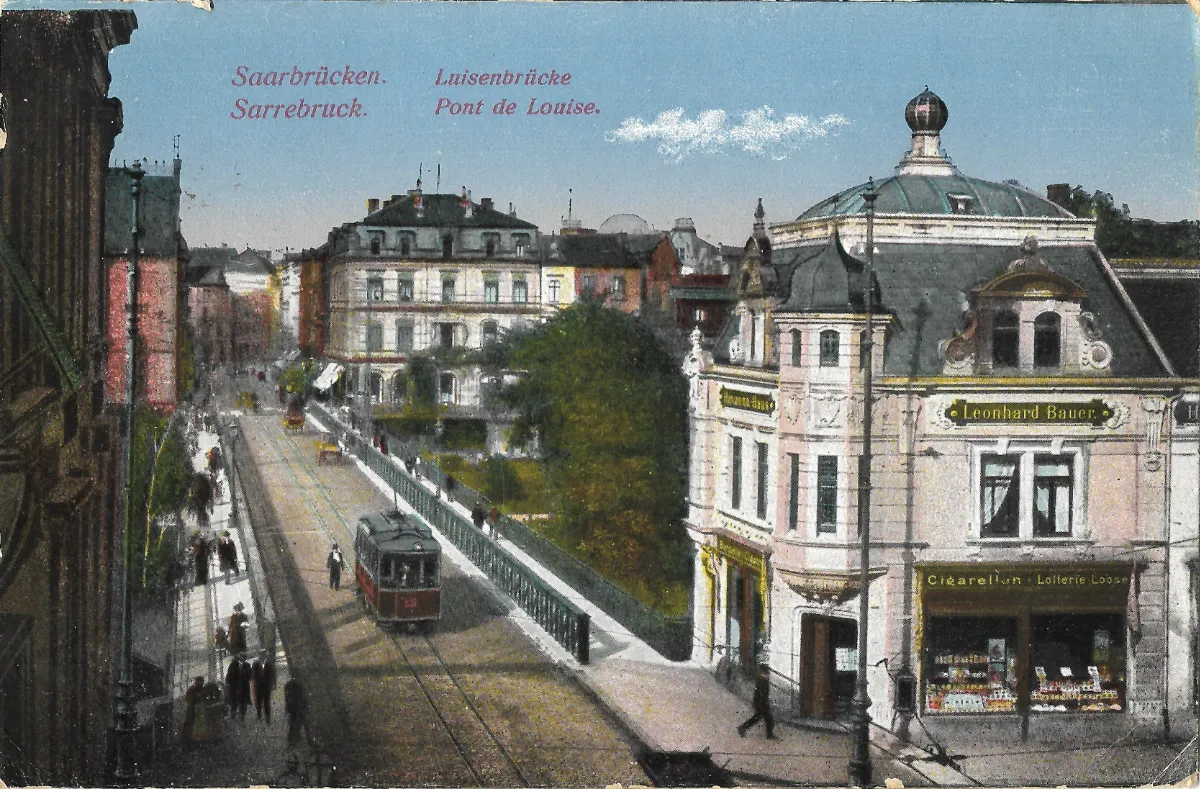
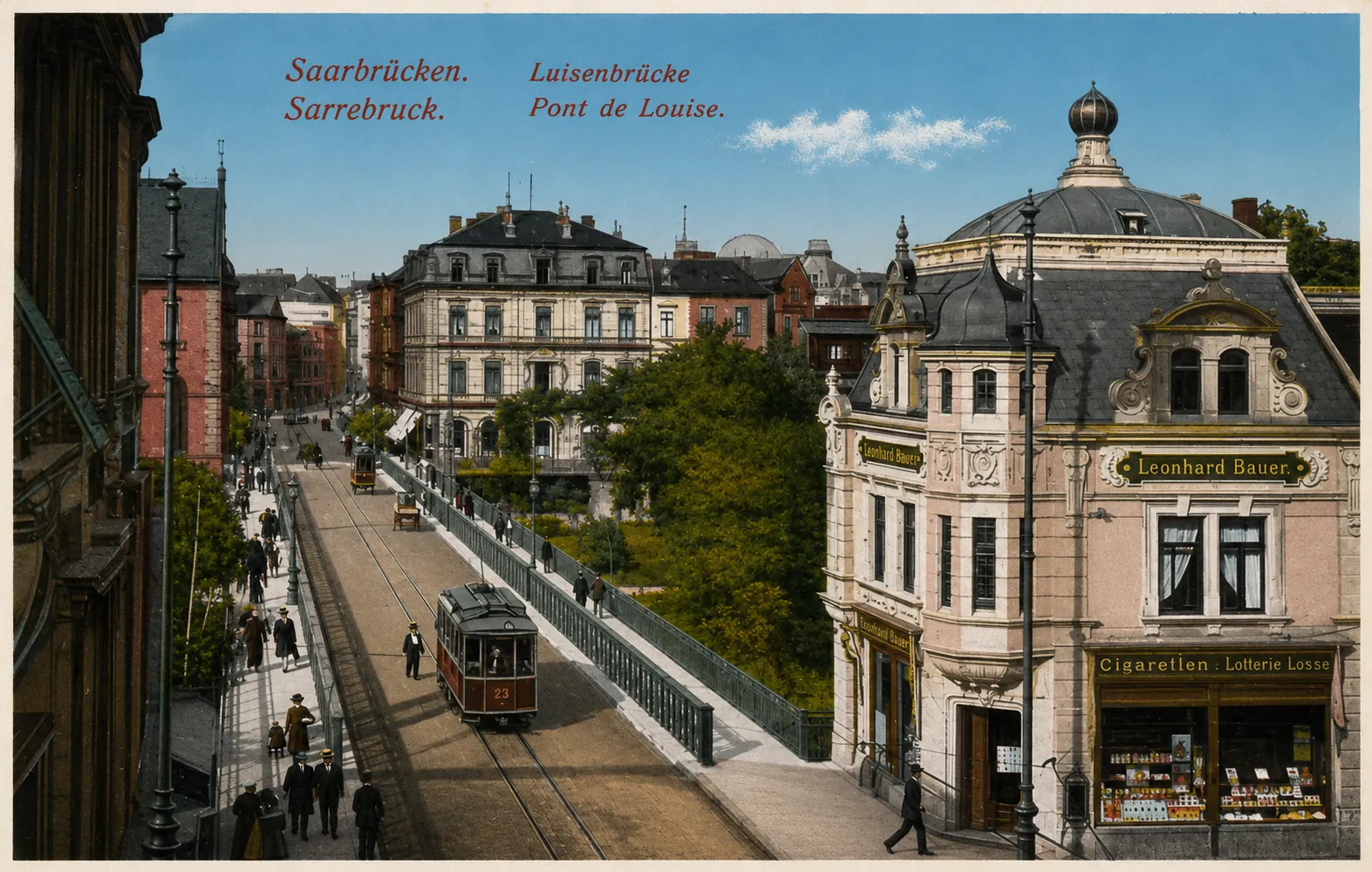
The Luisenbrücke in Saarbrücken is shown on this vintage postcard as one of the city’s important crossings over the Saar, surrounded by a remarkably developed urban landscape. The printed caption is bilingual, reading “Saarbrücken – Sarrebruck” and “Luisenbrücke – Pont de Louise.” The combination of German and French reflects Saarbrücken’s position close to France and the obvious commercial interest postcard publishers had in serving travellers from both sides of the border.
The composition looks directly along the roadway. Tram rails run through its centre, and a dark electric tramcar with a reddish lower body is travelling away from the camera. Several pedestrians can be seen on the pavements and roadway, including small groups near the foreground. Almost no motor vehicles are present, giving the scene the characteristic appearance of an early twentieth-century European city in which pedestrians and public transport still dominated street life.
The Luisenbrücke crossed the Saar between Saarbrücken and St. Johann. At the time the bridge was originally built, these were still separate municipalities. One of the bridge’s main purposes was to provide Saarbrücken with a more direct connection to the railway station on the St. Johann side. Saarbrücken’s official city chronicle records the construction in 1866 of the “Neue Brücke,” today’s Luisenbrücke, specifically mentioning its importance for access to the station.
One of the postcard’s most striking architectural features is the ornate corner building on the right. It has a pale façade, a mansard-style roof, elaborate curved decoration and a distinctive domed corner feature. The name “Leonhard Bauer” is clearly visible on the building. At street level, signs advertise “Cigaretten” and “Lotterie Loose”—cigarettes and lottery tickets. The richly stocked shop windows provide an unusually vivid glimpse of everyday commercial life beside the bridge.
This storefront is also an important clue for identifying the view. Catalogues of historic postcards list the Saarbrücken Luisenbrücke together with the Leonhard Bauer cigarette and lottery business and a tramway. One catalogue attributes a version of this scene to the postcard publisher Reinicke & Rubin of Magdeburg. Since no publisher’s mark can be read on the visible front of the present card, this attribution should be regarded as evidence for the known image type rather than as definitive proof concerning this particular copy.
Beyond the bridge stand substantial multi-storey buildings characteristic of Saarbrücken’s rapid urban expansion around the turn of the twentieth century. A considerable amount of greenery is also visible beside the bridge. This corresponds with the landscaped area that once existed near the crossing: the Luisenanlage, also known as the Luisengarten, was established beside the bridge from 1876 onwards.
The exact orientation cannot be established beyond doubt from the postcard alone, although the street alignment and historical geography make a view from the Alt-Saarbrücken side towards St. Johann the most probable interpretation.
Historical description
The original Luisenbrücke was itself a product of Saarbrücken’s nineteenth-century expansion. Its foundation stone was laid in 1863, and the iron bridge was constructed in 1865-1866. Named after Queen Louise of Prussia, it became the second road and pedestrian crossing connecting Saarbrücken and St. Johann after the much older Alte Brücke. A toll house originally stood at its southern end.
The bridge played an important role in bringing the neighbouring Saar towns together economically and physically. Its direct connection towards the railway station encouraged movement between the two urban centres. This long process of integration culminated on 1 April 1909, when Saarbrücken, St. Johann and Malstatt-Burbach officially merged to form the enlarged city of Saarbrücken.
The tramcar in the photograph is particularly useful for dating the scene. Electric public transport appeared early here. Saarbahn’s historical records state that Saarbrücken’s first electric tram began running on 8 February 1899, from the area of today’s Luisenbrücke towards St. Arnual. By the first decade of the twentieth century, electric tramways were therefore a familiar feature of the city.
The postcard was probably produced from a photograph dating from around 1910-1912. This estimate is supported by the tramcar, clothing, architecture and hand-coloured photographic appearance. More importantly, another postcard showing the same Luisenbrücke setting, including the cigarette and lottery shop and tramway, is catalogued as having been posted in 1912. This does not prove that the present copy was mailed in 1912, since the same photograph could have been reproduced for several years, but it provides a valuable chronological benchmark. A date around 1909-1912, and in any event probably before the First World War, is therefore plausible.
The wording on the postcard provides another interesting clue. It uses the spelling “Luisenbrücke.” Research from Saarland University notes that after 1918 the official form was altered to “Louisenbrücke,” a spelling retained until 1935. The bilingual French-German caption should consequently not be taken on its own as proof that the card dates from the League of Nations period after 1920. A bilingual edition intended for travellers in this Franco-German border region before 1914 is entirely consistent with the other evidence.
Very little of the scene survived unchanged. The historical Luisenbrücke was blown up in 1945 near the end of the Second World War. It was rebuilt in steel and concrete in 1948 and substantially altered again in 1962 during major road developments. The old Luisenanlage disappeared completely during construction of the urban motorway in 1962-1963, while much of the surrounding historic building stock had already been destroyed during the war.
The postcard therefore records much more than a bridge. It preserves an almost vanished streetscape from early twentieth-century Saarbrücken, combining electric public transport, local shops, ornate architecture and a tree-lined riverside environment at a time when the formerly separate Saar towns were becoming a modern industrial city.