Lyon – Place Morand and Cours Morand in the Early 1900s
Geographic description
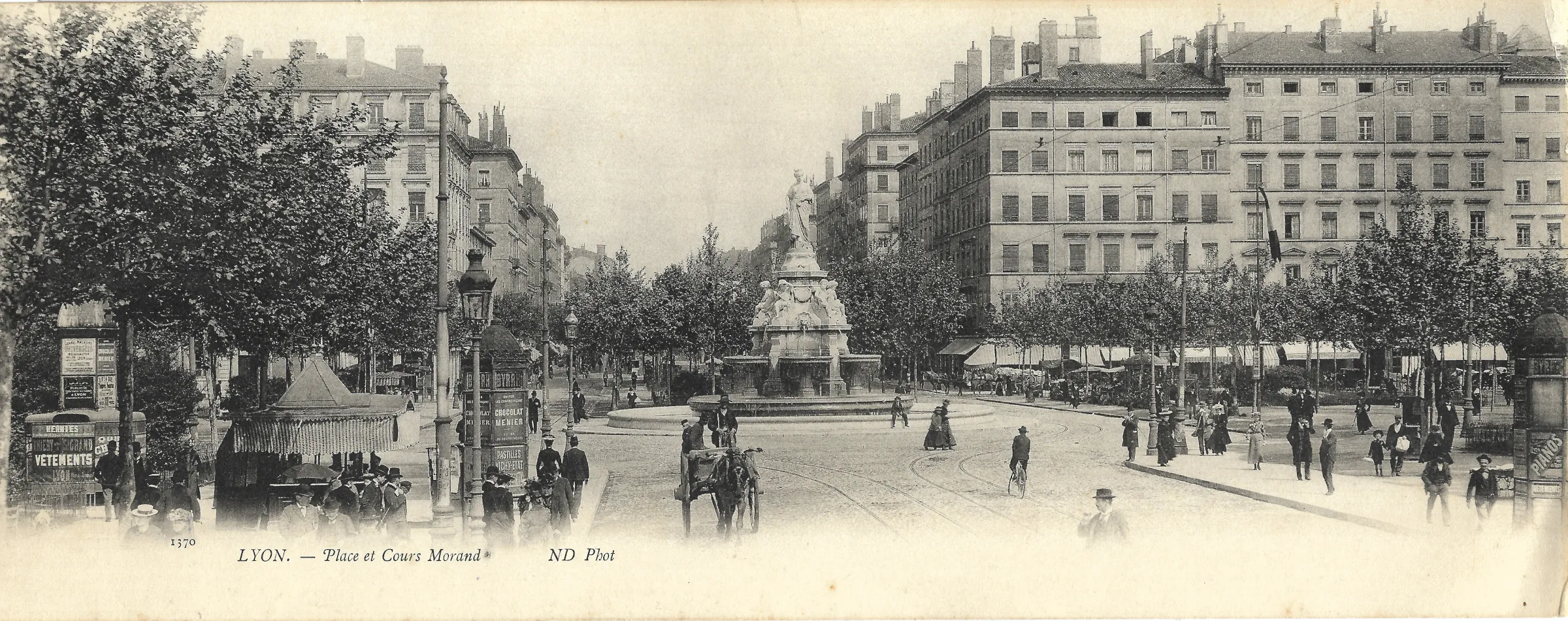
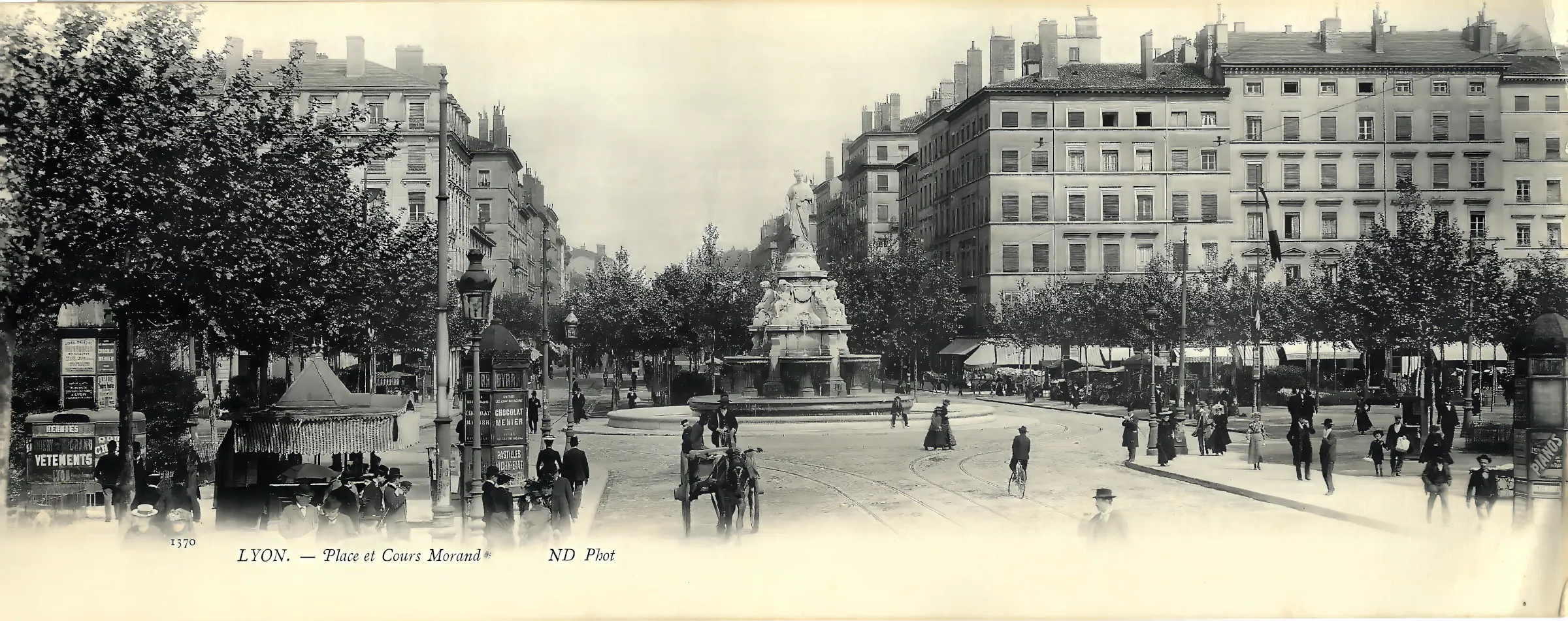
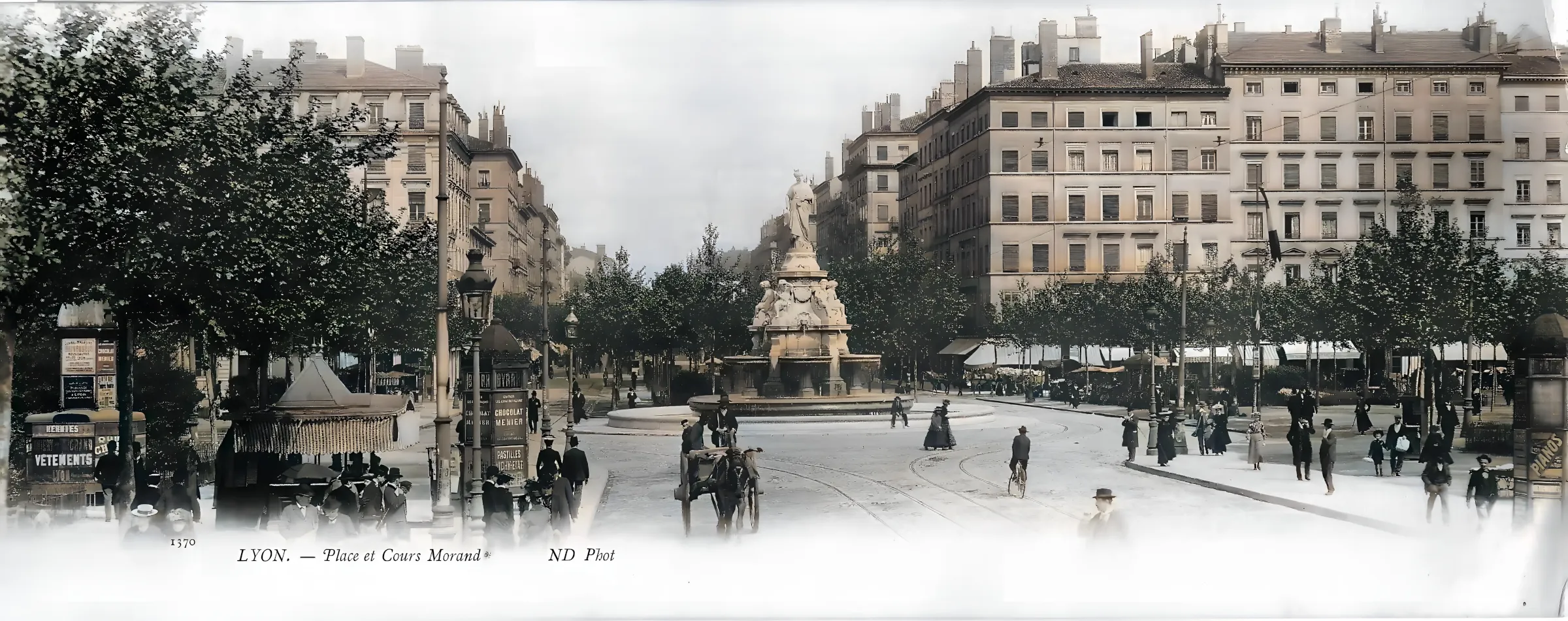
Place Morand in Lyon is shown in this vintage postcard as a lively and remarkably detailed urban scene, looking along what was then Cours Morand in the present-day 6th arrondissement. The printed caption at the bottom clearly reads “LYON. – Place et Cours Morand”. The number 1370 and the photographer-publisher mark “ND Phot” are also visible.
The location can be confidently identified as today’s Place du Maréchal-Lyautey, on the left bank of the Rhône. The avenue extending eastwards behind it was Cours Morand, renamed Cours Franklin-Roosevelt in 1945. The square itself received the name Place du Maréchal-Lyautey through a municipal decision in 1944.
The monumental fountain in the centre provides the most obvious landmark. Beyond it, Cours Morand forms a long perspective between rows of substantial multi-storey buildings. Lyon’s municipal library identifies the historic Place Morand with today’s Place du Maréchal-Lyautey and attributes the fountain to architect Antoine, commonly known as Tony, Desjardins, sculptor Guillaume Bonnet and sculptural decorator Édouard Clauses.
The photographer was probably standing on the western side of the square, near the Rhône and the entrance to Pont Morand, looking east along the boulevard. This interpretation is supported by the historic alignment of the fountain with the former bridge and Cours Morand.
The foreground captures everyday city life in considerable detail. A horse-drawn carriage with its driver moves across the square, while several cyclists can be seen nearby. Tramway rails curve through the roadway, illustrating how closely different forms of transport shared the same public space. No motor car can be confidently identified in the photograph.
Pedestrians are numerous. Most men wear dark jackets and hats, while women can be seen in full-length dresses typical of the period. Together with the bicycles and horse-drawn traffic, these details give the scene a strong turn-of-the-century character.
Regular rows of trees provide shade along both sides of the square. On the right, a succession of striped awnings shelters cafés or shops at ground-floor level. On the left are several small structures, kiosks or shelters, accompanied by advertising panels. Elaborately designed street lamps add to the formal appearance of the public space.
The surrounding buildings are characteristic of 19th-century Lyon. Their tall, regular façades, repeated window bays, cornices, steep roofs and numerous chimneys frame the broad avenue and create a strongly unified urban landscape.
What is particularly striking is the mixture of monumentality and everyday activity. The fountain and imposing façades express the ambitions of a major French city, while horse-drawn transport, bicycles, pedestrians and small commercial kiosks reveal the rhythm of ordinary life before the motor car became dominant.
Historical description
Place Morand and Cours Morand belong to the history of the development of Les Brotteaux, on the eastern side of the Rhône. Their name refers to architect and town planner Jean-Antoine Morand, who proposed an ambitious plan for Lyon’s eastward expansion in 1764. His project included a regular street grid, strategically positioned squares and a new bridge across the Rhône. Today’s Place du Maréchal-Lyautey is regarded as one of the places where the structure of Morand’s urban plan remains particularly evident.
The fountain shown prominently in the postcard dates from the Second Empire. Lyon’s municipal archives record that the fountain was unveiled in August 1865, although the statue representing the city was initially a temporary plaster version. Numelyo, the digital library of Lyon’s municipal library, states that Guillaume Bonnet’s final statue in Carrara marble was installed in August 1867.
The monument was more than a decorative fountain. It was commissioned by local residents and the city to commemorate the abolition of tolls on the Rhône bridges under Napoleon III. At the summit stands the allegorical female figure of the City of Lyon. Below her, sculpted figures represent themes including Navigation, Strength or Industry, Commerce, History and Geography, while lion-head mascarons supply water to the basins.
The postcard itself cannot be dated to a specific year from its front alone. However, a date around 1900-1905 appears reasonable.
One important clue is the “ND Phot” signature. This mark is associated with the Paris photographic and publishing firm Neurdein Frères. The Bibliothèque nationale de France records the Neurdein brothers as photographers, printers and publishers, notes the use of the “ND” mark from 1885, and lists a catalogue of their postcard collections dating from around 1904-1905.
The Lyon Municipal Archives provide additional context. Several Lyon postcards credited to Neurdein Frères, ND Phot in their collections are dated 1902 or 1903. This does not prove that this particular image was produced in 1903, but it makes an early-1900s date a convincing working estimate.
The visual evidence is consistent with that conclusion. Horse-drawn vehicles remain prominent, bicycles are common, tram rails cross the square, clothing belongs to the turn-of-the-century period and motor traffic is not yet visually dominant. None of these details alone provides a precise date, but together they support the proposed timeframe.
This postcard therefore preserves an especially valuable view of Place Morand in Lyon at a transitional moment. The architecture and urban layout of the Brotteaux district were already firmly established, while street life still retained many features of the 19th century. The surviving fountain makes the scene particularly easy to relate to today’s Place du Maréchal-Lyautey, even though both the square and Cours Morand have since changed names.