Asbury Park – Feeding the Swans on Sunset Lake
Geographic description
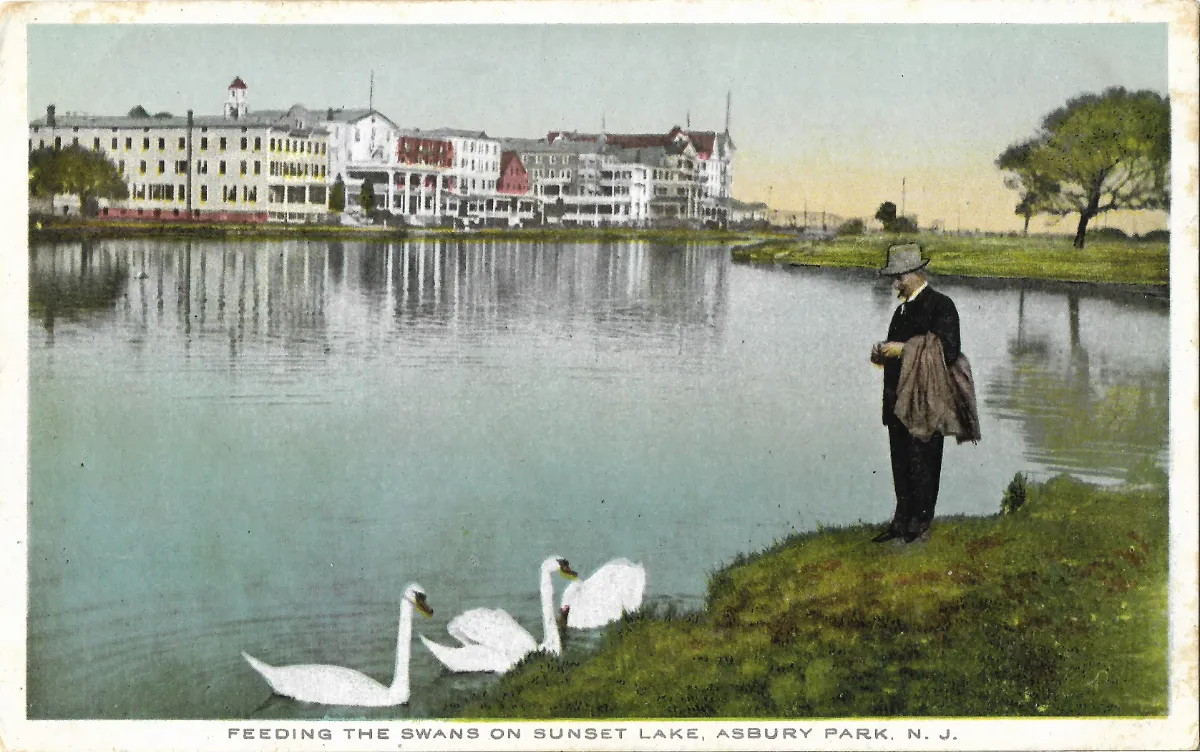
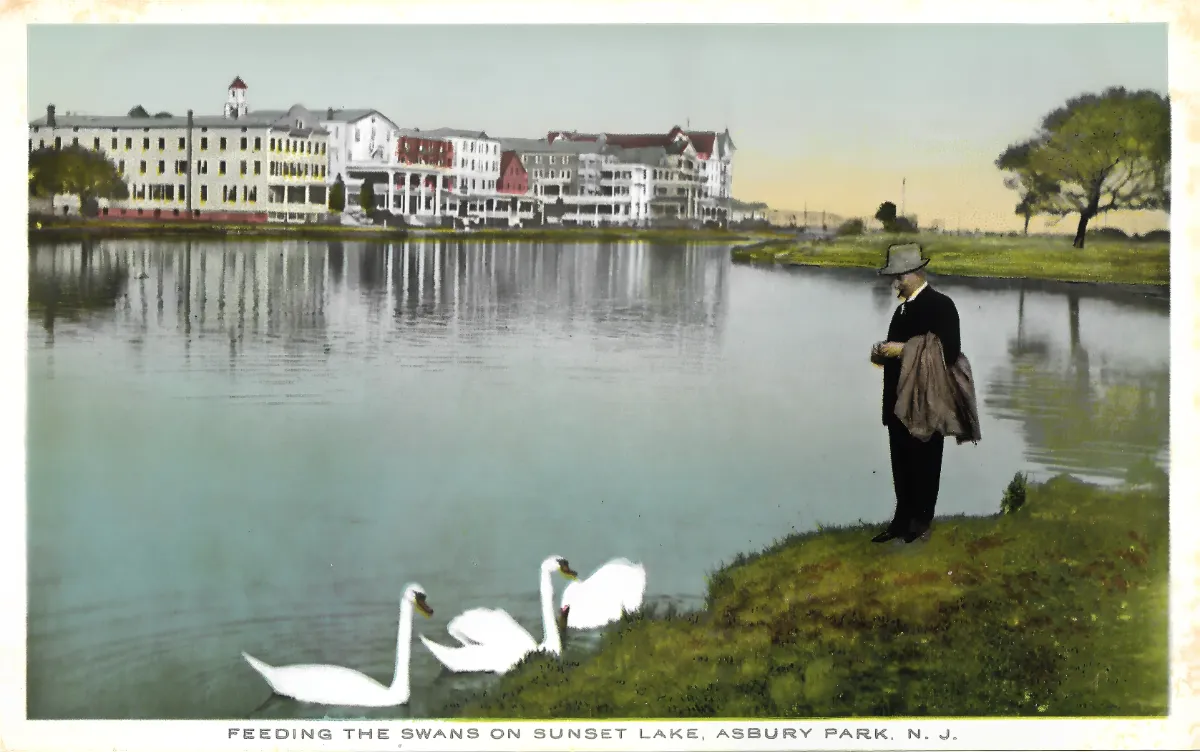
Sunset Lake Asbury Park is shown here in a peaceful scene dominated by the lake, three white swans and a visitor feeding the birds from the grassy bank. The printed caption along the bottom edge can be read clearly: “FEEDING THE SWANS ON SUNSET LAKE, ASBURY PARK, N. J.” The geographical identification is therefore certain rather than inferred from the landscape or architecture.
Three swans occupy the lower foreground, two approaching the shore while another remains slightly farther out on the water. On the right stands a man dressed in a dark suit and soft-brimmed hat. He carries what appears to be an overcoat folded across his left arm while using his other hand to feed the birds. His action corresponds directly with the printed caption.
The lake itself fills most of the composition. Its relatively still surface provides faint reflections of the buildings on the opposite shore. The photographer deliberately emphasizes open water and greenery rather than streets or traffic. Neatly maintained grass covers the near bank, while a few mature trees can be seen farther away. The overall impression is of a landscaped leisure area designed for walking, resting and enjoying the surroundings.
The modern City of Asbury Park officially defines the Sunset Lake area as the lake and surrounding grounds between Sunset Avenue and Fifth Avenue and between Bond Street and Webb Street. This confirms that Sunset Lake forms part of a substantial urban park landscape rather than being an isolated body of water outside the resort.
Across the lake stands a long group of substantial multi-storey buildings. Their light façades, extended porches or verandas, gabled rooflines and occasional decorative architectural features strongly resemble the hotels and boarding establishments commonly associated with American seaside resorts during the late nineteenth and early twentieth centuries. A small tower or cupola is particularly noticeable toward the left of the group. The postcard itself does not provide enough evidence to identify these individual buildings by name, so any more precise attribution would remain speculative.
Their presence nevertheless fits the known development of Asbury Park. James A. Bradley laid out the resort beginning in 1871, arranging the community around four major bodies of water: the Atlantic Ocean, Wesley Lake, Sunset Lake and Deal Lake. Sunset Lake was consequently part of the planned landscape of Asbury Park from the town’s formative period.
The postcard is especially interesting because it presents a quieter side of a resort more commonly associated with its beach, boardwalk and entertainment buildings. There are no amusement rides, crowds or busy commercial streets in this view. Instead, the publisher selected a small recreational moment: a smartly dressed visitor standing beside the water and feeding swans.
That choice was almost certainly deliberate. Resort postcards did more than document buildings; they promoted an atmosphere. In this case, Sunset Lake is presented as an orderly, picturesque retreat complementing the much livelier oceanfront. The carefully maintained lawns, ornamental birds and substantial accommodation buildings across the water create an image of comfort, leisure and respectability.
The exact viewpoint is harder to establish from the image alone. The shoreline and buildings have inevitably changed, and there are not enough distinctive architectural features to assign the photographer to a specific street or bank with confidence. What can be stated securely is that the photograph shows Sunset Lake within Asbury Park and that the scene was intended to showcase the lake as one of the resort’s attractive recreational landscapes.
Historical description
Dating this postcard is less straightforward than locating it. The front has a broad white border and a colour image produced from a photographic scene. The Smithsonian Institution identifies a general American White Border period from about 1915 to 1930, followed by the Linen period, approximately 1930 to 1945. It also cautions that these ranges are general collecting guidelines rather than absolute production dates.
Although the white margin might initially suggest the earlier period, the appearance of this particular card deserves closer attention. Its relatively strong colours and pictorial printing, especially in the grass, trees, water and sky, appear compatible with the visual character of linen-era American postcards. The front alone, however, cannot establish the printing process with complete certainty.
There is some useful supporting evidence. Another postcard offered under the exact caption “Feeding the Swans on Sunset Lake, Asbury Park, N. J.” is catalogued commercially as a linen postcard. A separate sales record for a postcard carrying the same title assigns its example to 1944. Commercial descriptions are not strong enough to establish a definitive publication date, but when combined with the physical appearance of the front they make a 1930s to mid-1940s date a reasonable working estimate.
The postcard’s subject, however, belongs to a much longer history. Asbury Park was developed as a seaside resort beginning in 1871, with its lakes and oceanfront deliberately incorporated into the urban layout. Sunset Lake was already sufficiently important to the town’s circulation and recreation network by the late nineteenth century that the Sea Shore Electric Railway, first operating in 1888, crossed the lake on a trolley bridge at Emory Street.
By the likely period of this postcard, the lake was therefore an established feature familiar to both residents and returning holidaymakers. The postcard publisher was not introducing a new attraction but presenting a recognized part of the resort’s identity.
The man’s clothing also remains broadly compatible with the proposed period, although it should not be used for precise dating. His dark suit and hat reflect a standard form of respectable public dress that persisted for many years. The absence of automobiles is equally inconclusive because the photographer deliberately framed the lake rather than the adjacent streets.
The swans are more significant to the postcard’s message than to its chronology. They turn a straightforward landscape view into a scene of human interaction and leisurely recreation. Rather than simply recording Sunset Lake, the photograph tells a small story: a visitor has stopped during a walk, the birds approach the shore, and the hotels or large lodging houses in the background remind the viewer that this quiet scene belongs to a major seaside resort.
For these reasons, the safest dating is circa 1930-1945, with moderate confidence. The identification of Sunset Lake and the activity shown are certain because both are explicitly stated on the postcard itself; the date remains approximate until evidence from the reverse, publisher records or a securely dated archival copy becomes available.