Antique Postcard Waterbury Connecticut: Municipal Building
Geographic description:
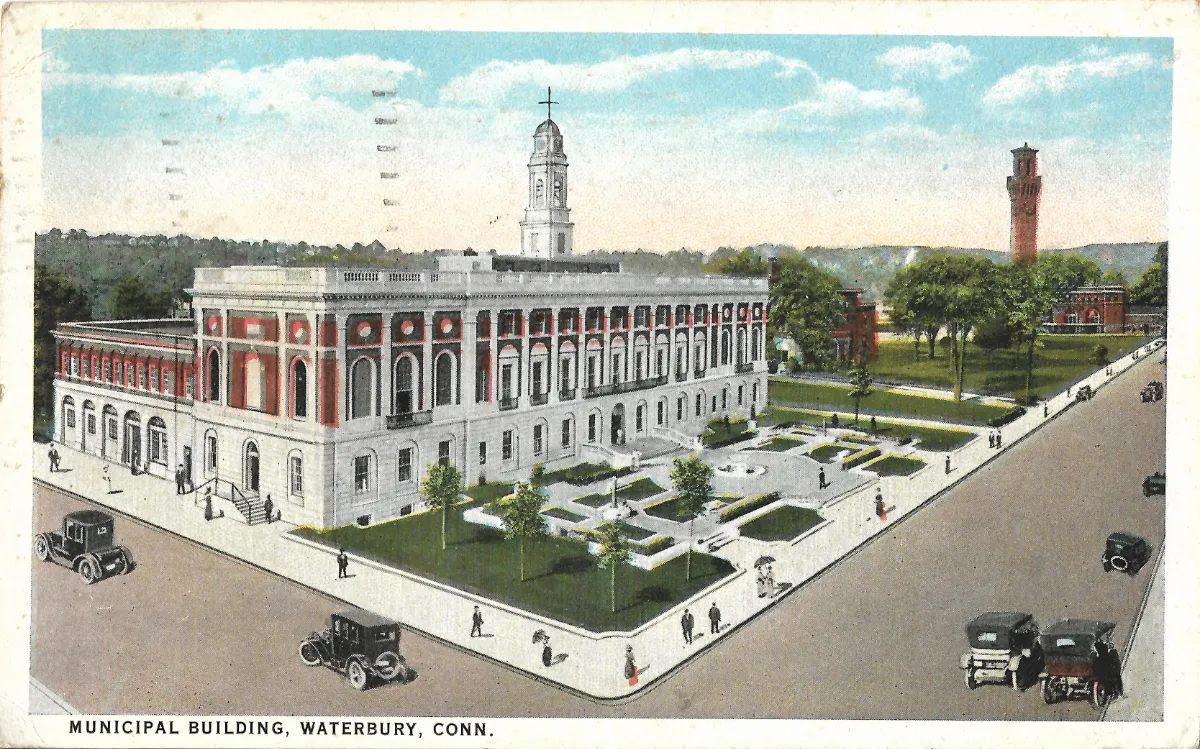
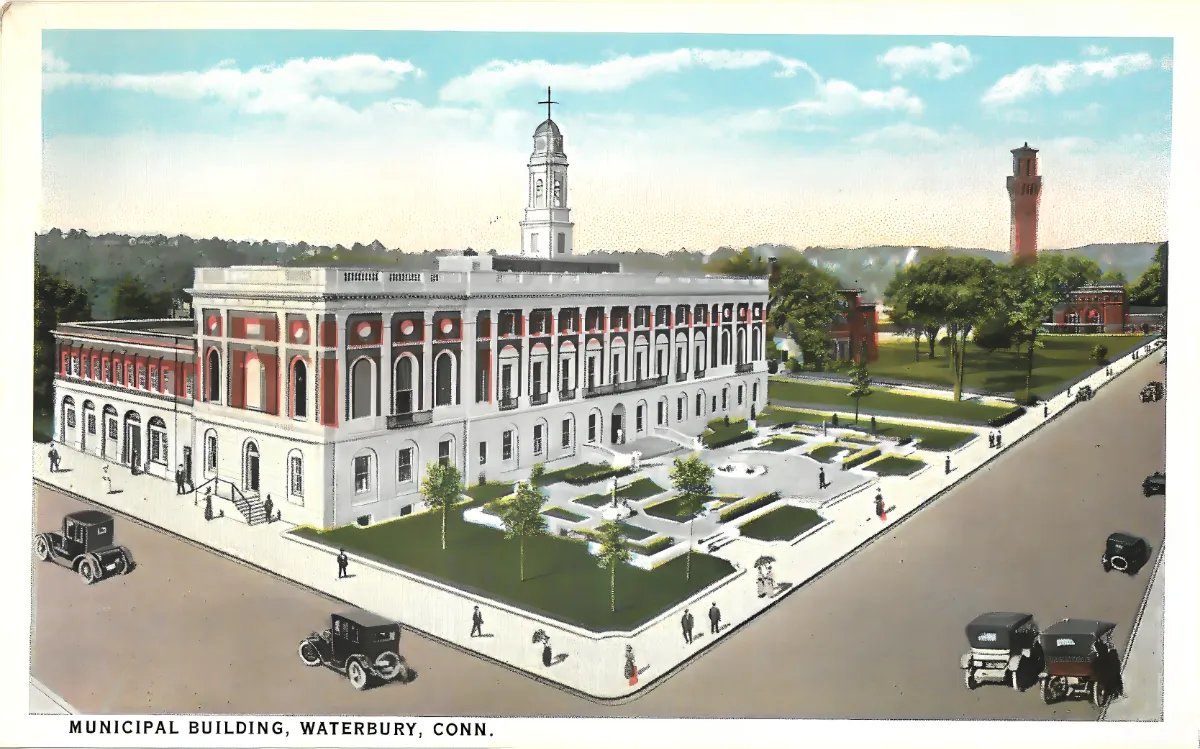
This antique postcard Waterbury Connecticut shows a slightly elevated view, taken from a street corner, of the Municipal Building in Waterbury, Connecticut, United States. The printed caption at the bottom of the image, “MUNICIPAL BUILDING, WATERBURY, CONN.”, removes any doubt about the location: this is a documented fact provided by the card’s publisher, not a hypothesis.
The main building, occupying the left side of the composition, is an American Beaux-Arts / neoclassical civic structure built of red brick and light-colored stone (likely limestone or marble). Its façade features a regular sequence of round-arched openings on the ground floor, tall arched windows on the upper stories, and vertical pilasters articulating the bays. The building is crowned by a multi-stage tower topped with a dome and what appears to be a cross — in reality almost certainly a weathervane, a detail commonly mistaken for a cross on American civic towers of this period. This clock-tower silhouette is a typical architectural marker of early twentieth-century North American civic planning, associated with the “City Beautiful” movement.
In front of the building lies a formally landscaped plaza: geometric grass parterres, paved paths crossing in a star pattern, and a circular central feature that most likely corresponds to a fountain or basin. This formal landscaping — documented in historical sources as the building’s “entourage” — confirms the site’s representative and monumental purpose: a public space designed to stage municipal authority, not a simple ornamental garden.
In the right background, a second tower, built of red brick and noticeably slimmer in silhouette, rises above the tree line. Its shape and coloring differ clearly from the Municipal Building’s own tower; it is very probably another civic or railway-related structure in downtown Waterbury, though this cannot be confirmed with certainty since no caption directly identifies it.
The wide, paved street in the foreground structures the composition diagonally and includes several automobiles as well as pedestrians — men in suits and hats, women in long dresses, some carrying parasols — details consistent with an affluent North American urban setting in the early twentieth century.
Historical description:
The Municipal Building shown on this antique postcard Waterbury Connecticut was designed by architect Cass Gilbert, winner of a design competition held in 1913 following the 1912 fire that destroyed the previous City Hall. Construction began in July 1914, and the building opened in 1915. This information is presented here with a high degree of confidence, as it comes from external documentary sources consulted for this analysis rather than from a detail directly readable on the image itself; it therefore goes beyond strict visual reading.
The building is part of a larger urban project known as the Waterbury Municipal Center Complex, financed in part by the Chase family, local brass industrialists (Chase Brass Company), following the 1902 fire that had devastated part of downtown Waterbury. This context of reconstruction and urban renewal explains the deliberate monumentality of the building and its surroundings, designed to assert the city’s industrial prosperity at the turn of the twentieth century.
The precise printing date of the postcard itself remains a hypothesis, since no postmark or stamp is visible — only the front of the card was provided for this analysis, and the absence of the reverse side prevents any verification through postal cancellation. Two converging clues nonetheless allow for a reasonable dating range: first, the white border surrounding the image, characteristic of the “White Border Era” of American postcard production, generally dated between 1915 and 1930; second, the style of the automobiles visible in the scene — tall, boxy bodies, rounded fenders, thin spoked wheels — consistent with American automobile production of roughly 1918 to 1925. Cross-referencing these two clues suggests a probable printing date within the decade following the building’s completion, approximately 1918 to 1925. This range remains a stylistic inference rather than a certainty.
No publisher’s mark or collection number is clearly legible on the image provided; this point remains undetermined and could be clarified by examining the postcard’s reverse side, if available, or by consulting specialized American deltiology archives.
The coloring applied to the image, with its even tones and gradated sky, corresponds to the semi-artisanal tinting processes used by many American postcard publishers of the period, typically applied over black-and-white photomechanical prints.